
Slot Machine Volatility
in Slot Machines?
Why Volatility Matters More Than Most Players Realise
You’ve probably looked at a slot game page and seen a rating like “high volatility” or “medium variance” somewhere in the description. Most people scroll past it. It sounds like a technical detail that doesn’t really affect the experience.
It absolutely does. In fact, volatility might be the single most important thing to understand about any slot you sit down at. It shapes everything — how often you win, how big those wins tend to be, how quickly your balance moves, and what kind of patience the game demands from you.
Get it wrong and you’ll burn through your bankroll on a high volatility game when you only had budget for an hour of casual play. Get it right and you’ll pick games that actually suit how you want to spend your time and money.
What Volatility Actually Means
Volatility — sometimes called variance — measures how a slot distributes its payouts. Specifically, it tells you two things: how often wins land, and how large they tend to be when they do.
High volatility means wins come around less frequently, but they tend to be bigger when they hit. Low volatility means the game pays out more regularly, but those wins are usually smaller. Medium sits somewhere in the middle — not dramatic in either direction.
That’s really it. No complicated maths required. It’s just a description of the game’s payout rhythm.
Volatility tells you how a game pays, not how much it pays overall. Two games with the same RTP can feel completely different to play depending on their volatility level.
Volatility vs RTP — They’re Not the Same Thing
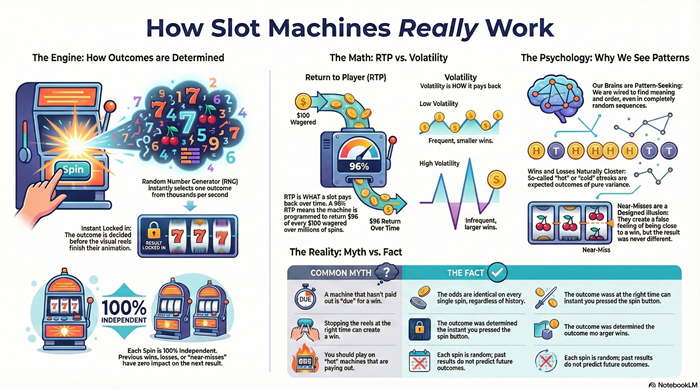
This is where a lot of players get confused. RTP (return to player) is the percentage of money wagered that a game pays back over millions of spins. A 96% RTP game returns £96 for every £100 wagered — in theory, across an enormous sample.
Volatility is something different. It describes the shape of how that money comes back to players. Two games can both have a 96% RTP but feel nothing alike. One might drip out small wins every few spins. The other might go 200 spins without a meaningful win, then drop a huge payout that more than makes up for it.
Same overall return. Very different experience. That’s volatility at work.
| Volatility Level | Win Frequency | Typical Win Size | Best For |
|---|---|---|---|
| Low | High — wins land often | Smaller amounts | Casual play, stretching a budget, longer sessions |
| Medium | Moderate — fairly regular | Mid-range | Most players, balanced bankroll management |
| High | Low — long dry spells | Larger, less predictable | Patient players chasing bigger payouts |
What It Actually Feels Like to Play Each Type
Low volatility games keep you in the action. You won’t be staring at a static balance for long — small wins land regularly, and your session has a steady rhythm to it. Nothing spectacular usually happens, but you rarely feel like you’re just watching money disappear either. These games are good if you want a couple of hours of entertainment without needing to spike big to enjoy yourself.
High volatility games are a completely different experience. They test your patience. You can go a long stretch without much happening, and that’s not a malfunction — it’s just how the game is built. The trade-off is that when things do click, the payout can be significantly larger. These games suit players who are happy to ride out the quieter spells for a shot at something more exciting.
Medium volatility is where most slots sit, and there’s a reason for that. It gives developers — and players — a bit of both. You’re not grinding through endless dry spells, but you’re also not collecting a small token win every other spin. It’s a reasonable middle ground for most bankrolls and most playing styles.
- Low volatility suits players who want extended sessions and don’t mind smaller wins.
- High volatility suits players with a bigger bankroll and the patience for longer waits between meaningful hits.
- Medium volatility works for almost everyone and is a safe default if you’re unsure.
- Neither high nor low is objectively better — it comes down to what you’re looking for from a session.
How to Match Your Bankroll to the Right Volatility
This is the practical bit. And it’s simpler than it sounds.
If you’ve got a limited session budget — say you’re playing for fun with money you’re comfortable losing — low or medium volatility games give you more spins for your money. You’re less likely to hit a long dry run that wipes out your balance before the fun even starts.
If you’ve got a bit more cushion and you’re genuinely chasing a bigger win, high volatility games give you that chance. But you need enough bankroll to survive the quiet periods. Going into a high volatility game with 20 spins worth of budget is likely to be a frustrating experience. You need enough runway to actually hit the game’s better moments.
A rough rule of thumb: for high volatility slots, have at least 100 spins worth of budget at your chosen stake. For low volatility, 50 spins is plenty to get a real sense of how the game plays.
How to Find a Game’s Volatility Before You Play
Most online casinos and game developers include volatility information somewhere in the game’s details — often in the paytable or the info screen you can access before or during play. It’s usually listed as low, medium, or high, though some providers use a numbered scale (1–5 or 1–10).
If it’s not listed directly, the paytable tells you a lot. A game where the top symbol pays 500x your bet and there are only a handful of mid-range symbols is almost certainly high volatility. A game with lots of paying combinations spread across similar values is more likely to be low volatility. The shape of the pay table reflects the game’s rhythm.
- Check the game’s info screen — volatility is often listed directly alongside RTP.
- Read the paytable — big gaps between top and bottom prizes usually signal higher volatility.
- Look at the bonus features — games with rare but lucrative bonus rounds tend to be higher variance.
- Many review sites list volatility ratings for popular titles if you want to check before loading a game.
Where to Put This Into Practice
Understanding volatility is useful. Actually applying it at a casino you trust makes it worthwhile. All three casinos below carry a wide selection of slots across every volatility level, so you can put what you’ve learned to work straight away.
Super Slots has one of the biggest game libraries available to US players, with slots from multiple providers covering everything from laid-back low variance titles to high-volatility games with big jackpot potential. They also run weekly promotions that add genuine value if you’re a regular. Read the full Super Slots Casino Review before you deposit.
Slots LV is well worth a look if you want a clean, well-organised experience with a strong selection of slots and reliable payouts. Our Slots LV Review covers the bonuses, games, and withdrawal process in full.
And if you want to try a new casino without risking your own money first, exclusive offer at Slots Capital gets you 50 Free Spins with no deposit needed — a genuinely low-risk way to explore the game selection. Check out the Slots Capital Review for the full picture, and see what’s currently running on their Slots Capital promotions page.
Now you know the difference between high and low volatility — find the right game for your bankroll and playing style at one of our top-rated casinos.
Super Slots → Slots LV → exclusive offer — 50 Free Spins →Slots Capital — See All Promotions