
How Video Poker Really Works: Paytables, Probability, and Why Myths Persist
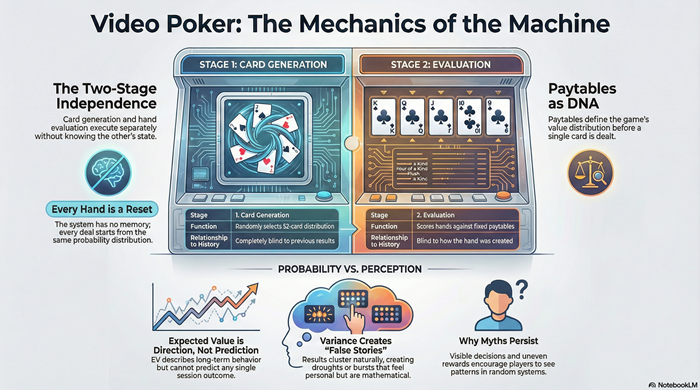
Video poker looks simple. Five cards are dealt, some are held, others are replaced, and the result is evaluated. Because the cards are visible and decisions are explicit, the game feels understandable in a way many casino games do not.
That feeling is deceptive.
Video poker combines random outcomes with visible choice, fixed payout rules with emotionally uneven rewards, and short-term feedback with long-term mathematics. This combination makes it easy to form convincing explanations that are nevertheless wrong.
This guide explains video poker from the inside out. Not how to play it, and not how to optimize it, but how it actually functions as a probabilistic system. It breaks the game down into its core components—independence, paytables, expected value, variance—and shows why common interpretations fail even when they feel correct.
By the end, video poker stops looking mysterious, unfair, or personal. It starts looking mechanical.
What Video Poker Actually Is
At its core, video poker is a two-stage system.
First, cards are generated randomly. Second, completed hands are evaluated against fixed rules.
These stages are separate, even though they appear connected during play. The card generation process does not know how the hand will be scored. The evaluation process does not know how the hand was created. Each stage executes independently according to predefined rules.
This separation explains why outcomes do not react to previous results, why decisions feel meaningful without rewriting probability, and why payouts feel selective even though they are structurally fixed.
For a deeper explanation of how independence, visible decisions, and perception interact in video poker, see What Video Poker Really Is: Random Hands, Fixed Paytables, and Player Illusions.
Independence: Why Every Hand Starts Fresh
Independence is the most important concept in video poker—and the one most often ignored.
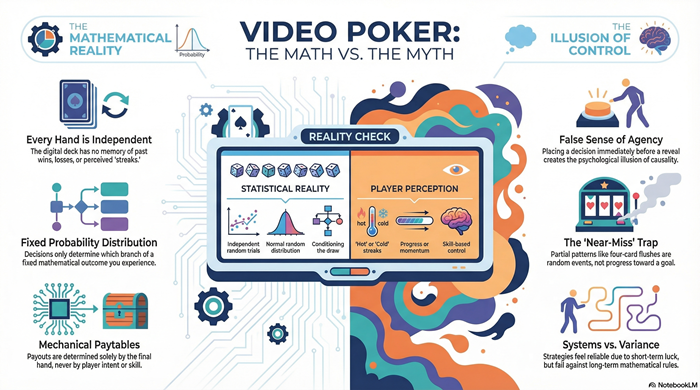
Every hand is generated without reference to what came before it. The cards do not remember wins, losses, near misses, or streaks. The system does not rebalance, compensate, or respond. Each deal begins from the same probability distribution as the last.
This is not a philosophical claim. It is a mechanical one.
Independence means that outcomes do not build toward anything. A long stretch without a rare hand does not increase the likelihood of that hand appearing next. A recent win does not reduce future chances. The game does not track fairness over time, because fairness is defined statistically, not sequentially.
Random systems naturally produce clustering. Some outcomes appear together. Others vanish for long periods. This behavior feels wrong only because intuition expects balance to arrive quickly.
The visibility of cards worsens the misunderstanding. Seeing repeated shapes invites pattern recognition, but patterns in random systems do not imply memory or intention.
For a deeper breakdown of how independence interacts with perception, see What Video Poker Really Is.
Paytables: The Structure That Actually Determines Outcomes
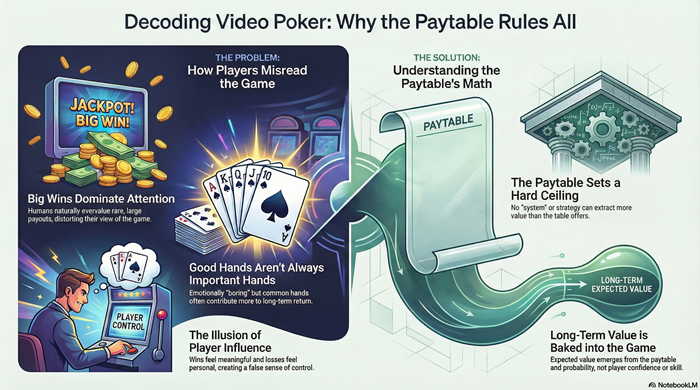
A video poker paytable is not a list of rewards. It is the game’s underlying structure.
Before a single card is dealt, the paytable has already defined which outcomes matter, how much each contributes, and how value is distributed over time. Every completed hand is evaluated mechanically against this table.
Rare outcomes pay more because they occur less often. Common outcomes pay less because they occur more often. Together, these weighted outcomes determine long-term behavior.
Small changes in paytables can have large effects over time, even if those effects are invisible in short sessions.
For a focused explanation of how paytables encode behavior, see How Video Poker Paytables Determine Long-Term Results.
Expected Value: Direction, Not Prediction
Expected value describes how a video poker game behaves over time. It does not describe how it behaves in any single session.
Expected value emerges from fixed structure: the paytable and the frequency of each outcome. Once those inputs are set, expected value is determined.
It does not predict results. It does not smooth outcomes. It does not promise visibility.
Winning sessions do not confirm expected value. Losing sessions do not refute it. Expected value remains constant while outcomes fluctuate around it.
For a full explanation of why expected value is often misused, see Expected Value in Video Poker Explained Without Strategy Myths.
Variance: Why Short-Term Results Mislead
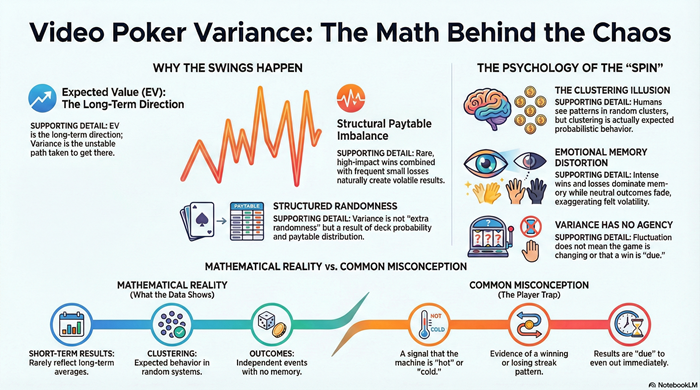
Variance explains why outcomes spread unevenly around their long-term direction.
Because value is concentrated in rare events, results arrive in clusters. Long droughts and sudden bursts are normal behavior, not signals.
Variance does not contradict expected value. It obscures it in the short term.
This turbulence makes outcomes feel personal even when nothing is changing.
For a focused explanation of variance in video poker, see Video Poker Variance: Why Short-Term Results Feel Misleading.
Why Video Poker Myths Persist
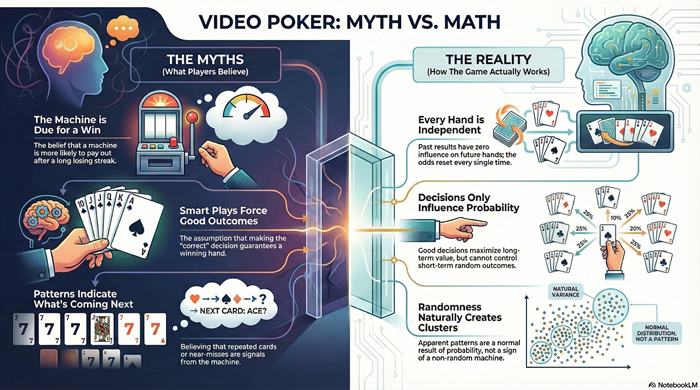
Video poker myths arise not from ignorance, but from structure.
Visible decisions create agency. Uneven payouts shape memory. Variance creates emotionally charged clusters. Immediate feedback encourages interpretation.
Together, these forces produce experiences that feel meaningful while concealing their causes.
Myths persist because experience repeatedly reinforces them, even though none of it alters the underlying mathematics.
For a breakdown of the most common myths and why they survive, see Common Video Poker Myths and Why They Persist.
What Video Poker Is Not
Video poker is not predictive. It is not adaptive. It does not remember the past or respond to belief.
Outcomes do not correct themselves. Sessions do not reveal truth. Confidence does not change probability.
Video poker does not tell stories. It executes rules.
How the Pieces Fit Together
Independence ensures nothing carries forward. Paytables define value distribution. Expected value describes direction. Variance explains instability. Myths fill the gaps.
Skipping any piece breaks understanding.
Once the framework is clear, outcomes stop acting as evidence. Experience stops demanding explanation.