
Self-Exclusion Programs: How They Work and When to Use Them
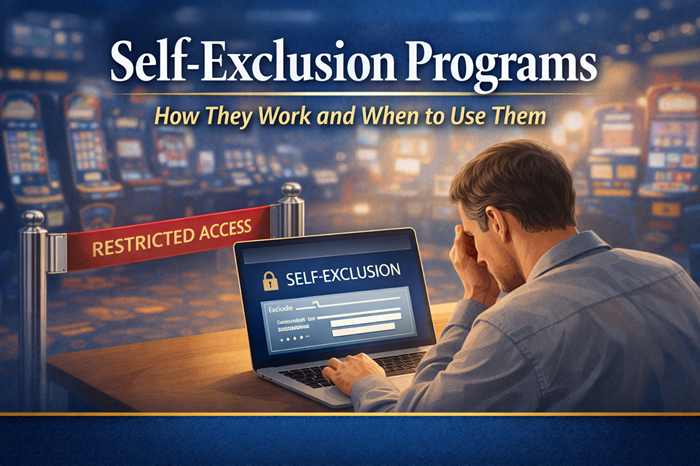
Self-exclusion programs are one of the most effective tools available for people who want to restrict or pause access to gambling. They are designed to support control and prevention—not punishment—and are widely used across regulated gambling jurisdictions.
This page explains what self-exclusion is, how different programs work, and when it may be appropriate to consider using one.
For broader context and support organizations, see our
👉 Responsible Gaming Resources page.
What Is Self-Exclusion?
Self-exclusion is a voluntary program that allows an individual to block themselves from gambling activities for a defined period of time.
Once enrolled, a self-excluded person is typically prevented from:
- Accessing online gambling accounts
- Creating new accounts with participating operators
- Receiving gambling-related marketing
The exact scope depends on the program and jurisdiction.
Types of Self-Exclusion Programs
Casino or Operator-Level Self-Exclusion
Many licensed casinos offer their own internal self-exclusion tools. These apply only to that specific operator.
Key characteristics
- Limited to one casino or platform
- Shorter exclusion periods may be available
- Does not block access to other casinos
This option may be suitable for individuals seeking temporary or narrowly focused limits.
National or Multi-Operator Self-Exclusion Schemes
Some jurisdictions operate centralized self-exclusion programs that apply across multiple licensed operators.
Key characteristics
- Covers many or all licensed casinos in a region
- Longer exclusion periods (months or years)
- More difficult to reverse early
These programs are designed for stronger protection and long-term prevention.
How Long Does Self-Exclusion Last?
Self-exclusion periods vary by program and may include options such as:
- 24 hours or 7 days
- 1 month or 6 months
- 1 year or longer
- Permanent or indefinite exclusion
In many cases, exclusions cannot be lifted early, even if circumstances change. This is intentional and helps reduce impulsive reversals.
What Self-Exclusion Does Not Do
It’s important to understand the limitations of self-exclusion:
- It does not prevent access to unregulated or offshore sites
- It does not replace counseling or emotional support
- It does not guarantee financial recovery
Self-exclusion works best when combined with education, support resources, and personal awareness.
When Self-Exclusion May Be Appropriate
Self-exclusion may be worth considering if:
- Gambling feels difficult to control
- Time or spending limits are no longer effective
- Gambling is being used to cope with stress or emotions
- You want a clear, enforced break from access
Using self-exclusion early can prevent escalation and reduce long-term harm.
Self-Exclusion and Responsible Gaming
Responsible gaming is not only about knowing odds—it’s about having practical tools when behavior starts to shift.
Self-exclusion is widely recognized by regulators and support organizations as a legitimate harm-reduction strategy, not a sign of failure.
Many people use self-exclusion temporarily and later return to gambling with clearer boundaries—or choose not to return at all.
Support Beyond Self-Exclusion
Self-exclusion addresses access, but it does not address motivation or stress.
For emotional support, education, and guidance, independent organizations such as those listed on our
👉 Responsible Gaming Resources page can help individuals understand patterns and explore additional support options.
Editorial Transparency
This page is provided for informational and educational purposes only.
Self-exclusion programs vary by jurisdiction and operator, and availability may change over time.
We encourage readers to review official program terms and seek independent support when needed.