
Unmasking the Algorithm: Why Online Gambling is Rigged by Design
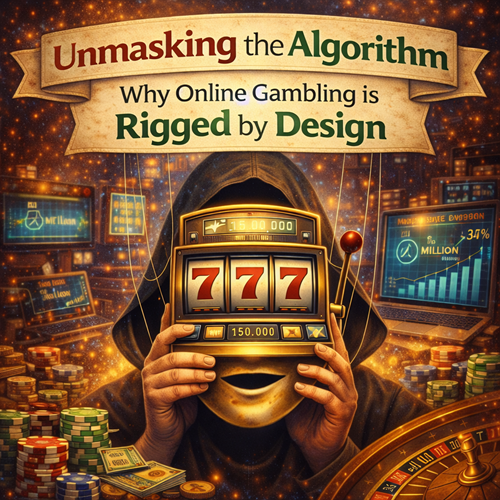
Online gambling is not a game of luck; it is a meticulously engineered data-driven enterprise where the house’s outcome is a statistical certainty. This digital ecosystem uses unyielding mathematics and behavioral economics to ensure that revenue extraction occurs at a predictable and inevitable rate. By unmasking the structural architecture of these platforms, we reveal that every spin and hand is part of a system designed for your certain financial decay.
The Illusion of Randomness: How RNGs Map Your Loss
Chapter 1 exposes that digital randomness is a carefully constructed simulation, as deterministic computers are incapable of generating true chance. Investigative analysis reveals that Pseudo-Random Number Generators (PRNGs) execute complex instructions to map results into a rigged game environment where the house always holds the blueprint.
- The PRNG algorithm utilizes a “seed input,” often derived from the exact millisecond of the server’s system clock, to generate a mathematically dense sequence of numbers that appears unpredictable to the human observer.
- The software produces a massive output of exactly 4,294,967,296 possible numbers, which are then mapped to specific symbols, card values, or reel positions on the player’s screen.
- Digital games utilize “weighted reels,” which create a fundamental asymmetry where millions of the available 4.29 billion numbers are assigned to losing combinations, while only a few correspond to a jackpot.
- Third-party audits confirm that the RNG is technically unbiased in its selection of numbers, but this does not guarantee a “fair” chance because the underlying mapping is engineered for a structural player disadvantage.
The Mathematics of Churn: Why the House Edge is Just the Beginning
Chapter 2 dismantles the myth of the “House Edge” by showing how macro-level statistics like Return to Player (RTP) are weaponized against the individual. While players focus on small percentages, the casino’s strategy is built on the cumulative erosion of capital through continuous action.
- Analysts must distinguish between the theoretical house edge and the actual “hold percentage,” which represents the total portion of a deposit the casino eventually keeps from a player.
- While a game may advertise a modest 4% house edge, the casino’s actual hold on a player’s deposit can reach 30% or more due to the relentless “churn” of reinvested winnings.
- The concept of churn allows a small edge to grind away an entire bankroll because the house advantage applies to every single dollar wagered, rather than just the initial deposit amount.
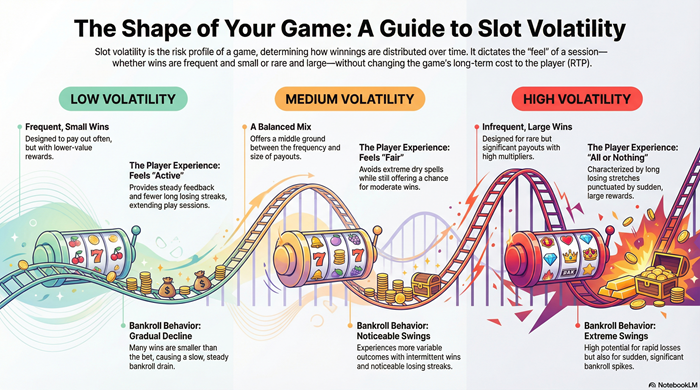
- Casinos use “variance” or volatility to create dramatic swings in a bankroll, effectively masking the steady downward financial trajectory of the player behind the illusion of a coin flip.
- Operators rely on the Law of Large Numbers to ensure that individual winning sessions are irrelevant, as the aggregate volume of millions of bets results in guaranteed, predictable corporate revenue.
Psychological Hooks: Dopamine Loops and Losses Disguised as Wins
Chapters 3 and 4 reveal how casinos weaponize neurobiology to bypass a player’s logical defenses through engineered feedback loops. By modeling games after operant conditioning experiments, the industry treats consumers like laboratory subjects to ensure maximum engagement.
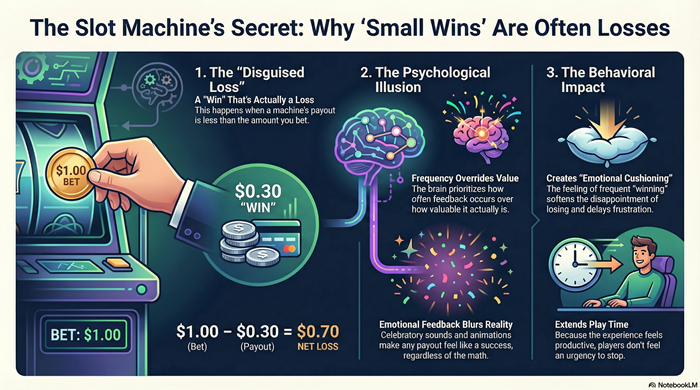
- “Losses Disguised as Wins” (LDWs) occur when sensory celebrations, such as flashing lights and triumphant sounds, mask a net financial loss when a payout is less than the original wager.
- The industry mirrors the Skinner rat and pellet experiments by utilizing “intermittent reinforcement” and unpredictable reward schedules to create obsessive, compulsive betting patterns.
- Neuroscientific data confirms that dopamine spikes peak during the anticipation of a reward rather than the receipt of it, allowing casinos to exploit the tension of spinning reels to keep players hooked.
- “Near misses” are specifically coded into visual display algorithms to trigger a neurological response identical to a win, tricking the brain into feeling closer to a payout than it actually is.
- The ultimate goal of these psychological triggers is to increase “Time on Device” (TOD), ensuring the mathematical house edge has sufficient time to systematically extract the player’s entire bankroll.
The Bonus Trap: Financial Tethers and Lifetime Value
Chapters 7 and 10 expose promotional offers not as generosity, but as calculated financial tethers designed to maximize the “Lifetime Value” (LTV) of every player. These tools are surgical instruments used to prevent player burnout while ensuring funds never leave the casino’s ecosystem.
- A standard $100 deposit paired with a $100 bonus with a 30x rollover requirement necessitates $6,000 in total wagers; at a 95% RTP, the expected loss is $300, which is $100 more than the total balance.
- “Reload bonuses” are strategic retention tools deployed with artificial urgency the moment an account runs dry to lure players back into the extraction cycle.
- Data scientists use the metric of “Lifetime Value” (LTV) to calibrate a “slow bleed” experience, keeping players active within an “entertainment budget” while avoiding sudden financial “bust outs.”
- Personalized VIP account managers foster parasocial relationships with high-value targets to offer loss rebates, which are merely recycled funds intended to encourage fresh deposits and further play.
- Individual jackpots are publicized as marketing expenses, yet these prize pools are often self-funded by the players themselves through a siphoned portion of every bet placed on the network.
For More
The only mathematically sound strategy in online gambling is non-participation, as the system is structurally designed for your inevitable bankruptcy. Once the machine is unmasked as an automated tool for capital confiscation, the illusion of opportunity vanishes, and the only winning move is to walk away.
- Refer to the article Slot Machine Guides.
- For a more detailed look, suggest the Ebook called “Rigged by Design: How Online Gambling Really Makes Money” available on Google Books.