
Why Slot Sessions Feel Shorter Than They Are (Time Distortion)
🎰⏳ Many slot players are shocked when they check the clock. What felt like a quick session turns out to be an hour — or several. This isn’t poor time management or bad memory. It’s a predictable psychological effect created by how slot machines are designed.
Slot machines don’t just consume money; they consume attention. When attention is fully occupied, the brain loses track of time. To understand why this happens so consistently, you need to look beyond probability and into perception. As explained in our guide on how slot machines really work, slot outcomes are mathematically fixed — but the experience surrounding those outcomes is engineered to keep players engaged without temporal awareness.
This article explains why slot sessions feel shorter than they are, how time distortion works, and why it materially increases the cost of play without changing odds.
What Time Distortion Actually Is
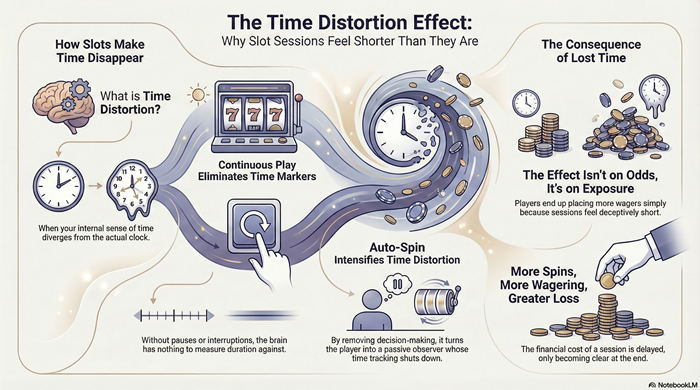
Time distortion occurs when subjective time perception diverges from objective clock time.
In slot play:
- Minutes feel like seconds
- Sessions feel compact
- Duration feels disconnected from reality
This is not accidental. It is a well-documented effect in immersive environments where attention is fully occupied.
When awareness narrows, time collapses.
Why Slots Create “Attention Tunnels”
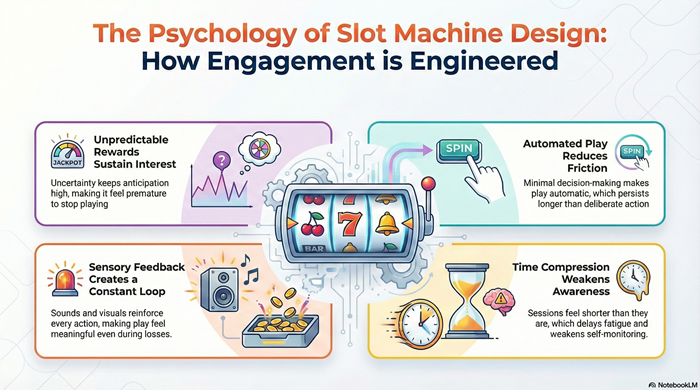
Slot machines create what psychologists call attentional tunneling.
Attention becomes focused on:
- Reels
- Animations
- Sounds
- Anticipation
When attention is narrowly focused, the brain stops tracking external markers like:
- Time
- Fatigue
- Spending
The player exists in a loop of stimulus and response.
Continuous Play Eliminates Time Markers
Time perception relies on markers — pauses, transitions, interruptions.
Slots remove these markers by:
- Allowing rapid, continuous spins
- Reducing downtime between actions
- Using auto-spin and fast animations
Without breaks, the brain has nothing to measure time against.
No pauses means no perception of duration.
The Role of Sensory Saturation
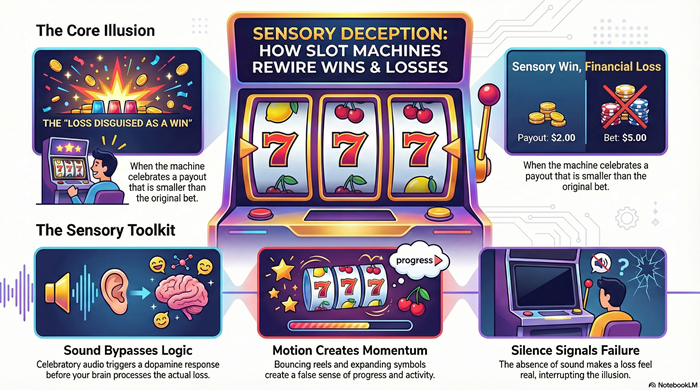
Sound and visuals amplify time distortion.
Constant stimulation:
- Prevents boredom
- Reduces reflection
- Keeps arousal levels elevated
When stimulation is continuous, the brain prioritizes processing input over tracking time.
Silence or stillness would restore awareness — which is why slot machines avoid it.
Why Small Wins Make Time Disappear Faster
Losses disguised as wins contribute directly to time distortion.
Frequent positive feedback:
- Signals progress
- Reinforces continuation
- Reduces stopping cues
When every few spins feel “productive,” there’s no psychological reason to stop — or to notice time passing.
How Auto-Spin Intensifies Time Distortion
Auto-spin removes decision-making entirely.
When spins trigger automatically:
- Conscious choice disappears
- The player becomes a passive observer
- Time tracking shuts down
Sessions end not because time feels long, but because money runs out or an external interruption occurs.
Online Slots and Accelerated Time Loss
Online slots are particularly effective at distorting time.
They:
- Eliminate physical cues (chips, cash, machines)
- Remove environmental interruptions
- Encourage solitary play
Without social or physical reference points, time collapses even faster.
What feels like a short online session can represent hundreds of spins.
Why Physical Casinos Still Distort Time
Casinos engineer environments to remove time cues:
- No clocks
- No windows
- Consistent lighting
Slot areas intensify this by adding constant motion and sound. The environment supports the machine’s design.
The goal isn’t deception — it’s immersion.
Why Players Rarely Stop Because of Time
Players usually stop because of:
- Balance depletion
- Emotional exhaustion
- External interruption
Rarely do players stop because “it’s been long enough.”
Time doesn’t trigger stopping because time doesn’t feel real inside the session.
How Time Distortion Increases Cost
Time distortion doesn’t change odds.
It changes exposure.
More perceived “short” sessions mean:
- More spins
- More wagering
- Greater cumulative loss
The cost isn’t hidden — it’s delayed.
Why Time Distortion Feels Comfortable
Time distortion is not stressful in the moment.
It feels:
- Absorbing
- Relaxing
- Effortless
This comfort discourages self-monitoring. When the session ends, the realization arrives all at once — often paired with regret.
What Awareness of Time Distortion Changes
Understanding time distortion does not:
- Improve odds
- Create advantage
What it does change is behavior.
Players who recognize time distortion:
- Set external timers
- Avoid auto-spin
- End sessions deliberately
Awareness reintroduces time into the experience.
Continue Learning About Slot Machines
If you want to understand how slot machines influence perception beyond probability, these guides explain the behavioral mechanisms that shape player experience:
- How Slot Machines Really Work
- What Is RTP in Slot Machines?
- Slot Volatility Explained (Low vs Medium vs High)
- Does Auto-Spin Increase Losses?
- How Near Misses Manipulate Player Perception
- Why Small Wins Feel Like Progress
- How Slot Sound and Visuals Influence Player Behavior
Each article explains one way slot machines extend play without changing odds.
Final Thought: Lost Time Is the Real Cost
Slot machines don’t need to rush players.
They only need to keep them unaware.
When time disappears, decisions stop feeling cumulative. Sessions feel shorter than they are — and losses feel lighter until they’re complete.
Understanding time distortion doesn’t make slots fair.
It makes them visible.
And visibility changes when you walk away.