
Can Roulette Be Predicted? Randomness, Physics, and Reality
Roulette sometimes feels close to predictable because it involves physical motion rather than pure abstraction. The spinning wheel, the bouncing ball, and the visible mechanics invite the idea that outcomes could be anticipated with enough observation or precision.
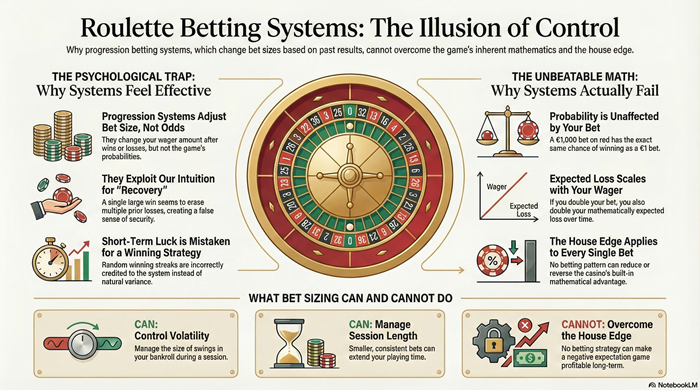
This article is part of our complete guide on How Roulette Really Works: Odds, House Edge, and Why Systems Fail, which explains roulette odds, house edge, wheel types, and why betting systems fail.
Why Roulette Feels Predictable
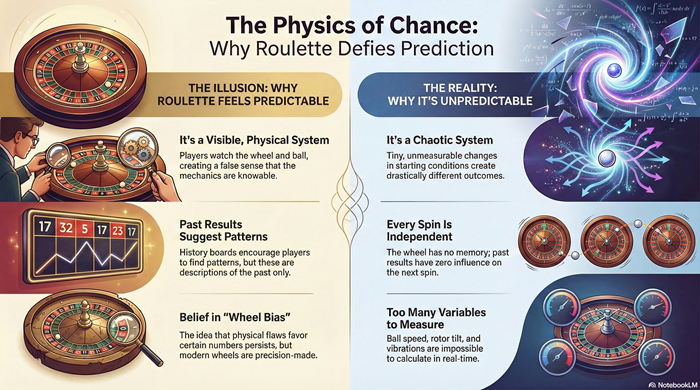
Unlike card games or digital RNGs, roulette is a physical system. Players can see the wheel spin, watch the ball bounce, and observe where it lands. This visibility creates the impression that outcomes are governed by knowable mechanics rather than randomness.
That impression is incomplete.
Physical systems can still behave randomly when they are chaotic, meaning small differences in starting conditions produce large differences in outcomes.
The Role of Physics in Roulette
In theory, roulette follows the laws of classical mechanics. If every variable were known precisely, the outcome could be calculated.
Those variables include:
- Initial ball speed and angle
- Wheel speed and deceleration
- Point of release
- Rotor tilt and vibration
- Deflector position and contact
- Microscopic surface imperfections
In practice, measuring and computing all of these in real time is not feasible under casino conditions.
Chaos Makes Prediction Impractical
Roulette is a chaotic system, not a simple mechanical one. In chaotic systems, tiny, unmeasurable differences lead to drastically different results.
This means:
- A millimeter change in release point can change the outcome
- Minor vibration alters ball trajectory
- Human launch inconsistency compounds error
Chaos turns physical determinism into practical unpredictability.
Why Past Results Offer No Predictive Power
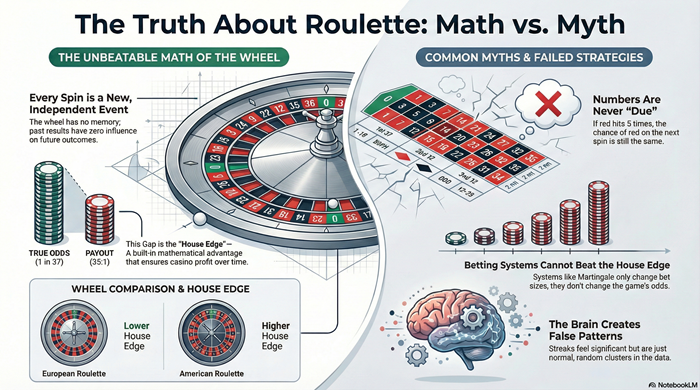
Because roulette spins are independent, historical outcomes do not contain information about future spins.
- Result boards show history, not probability
- Patterns describe the past only
- No memory exists between spins
Even perfect record-keeping does not improve prediction because the system resets every time.
Why “Wheel Bias” Is Often Misunderstood
Wheel bias refers to consistent physical imperfections that cause certain pockets to appear more frequently over extremely large samples.
In modern casinos:
- Wheels are precision-manufactured
- Regular maintenance reduces bias
- Frequent wheel changes disrupt data collection
Any residual bias is typically too small, unstable, or short-lived to exploit reliably.
Why Casinos Don’t Fear Prediction
If roulette were predictably exploitable in normal play, casinos would not offer it openly.
Instead:
- Bet limits constrain exposure
- Wheel conditions are monitored
- Dealers vary speed and release
- Equipment is replaced or adjusted
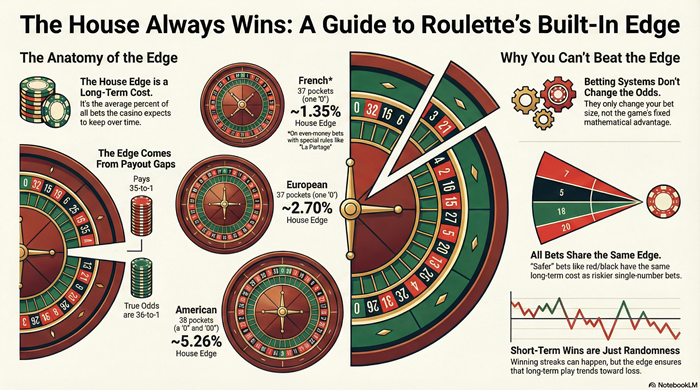
The game persists because randomness is preserved well enough to maintain the house edge.
Simulation vs. Reality
Computer simulations can model roulette outcomes accurately—but only by assuming randomness. Simulations do not reveal exploitable structure; they confirm expected distributions.
Simulation shows:
- House edge emerges reliably
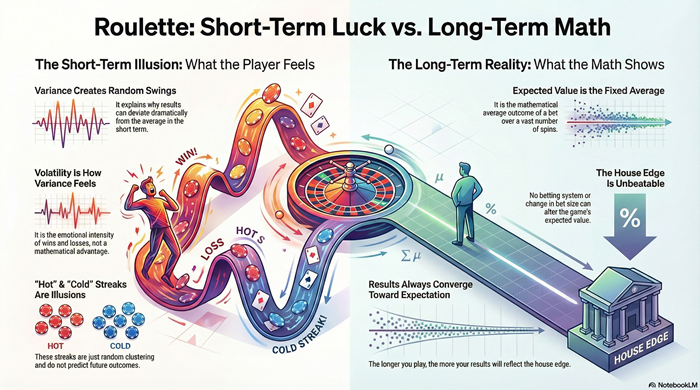
- Variance creates short-term noise
- No betting pattern changes expectation
Modeling roulette reinforces why prediction fails, rather than how it might succeed.
Why Prediction Claims Persist
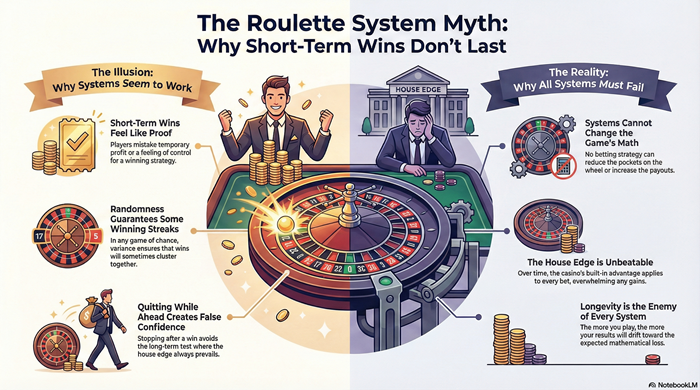
Claims of roulette prediction survive because short-term success is inevitable in random systems.
These claims usually rely on:
- Selective reporting
- Small sample sizes
- Survivorship bias
- Confusion between variance and control
A few correct guesses prove nothing about long-term predictability.
Random Does Not Mean “Anything Can Happen”
Randomness does not imply lack of structure. Roulette outcomes follow strict probability rules even though individual results are unpredictable.
This means:
- Outcomes are unpredictable individually
- Distributions are predictable collectively
- Expectation remains fixed
Prediction fails at the spin level but succeeds at the population level.
What Physics Can and Cannot Explain
Physics explains why roulette outcomes are unpredictable, not how to overcome that unpredictability.
Physics can:
- Describe motion
- Explain chaos
- Justify independence
Physics cannot:
- Provide reliable prediction methods
- Eliminate variance
- Reverse expected value
Understanding the physics of roulette reinforces its randomness rather than undermining it.
Why Roulette Remains Unpredictable
Roulette is unpredictable because:
- Spins are independent
- The system is chaotic
- Variables are unmeasurable in practice
- Outcomes reset every spin
The wheel is not mysterious. It is uncompromising.
What This Means for Understanding Roulette
Roulette does not fail to be predictable because players lack skill. It fails because predictability is structurally impossible under real conditions.
Recognizing this:
- Ends the search for systems
- Explains short-term success honestly
- Aligns expectation with reality
Roulette becomes understandable without becoming beatable.