
Why Blackjack Systems Don’t Work (And Why Casinos Love That You Believe They Do)

If you’ve spent any time around blackjack tables, you’ve heard it before. Someone leans in, lowers their voice, and tells you about their system. It might involve doubling after losses, riding hot streaks, or “knowing when the deck turns cold.” The promise is always the same: follow this pattern, manage your bets correctly, and the house edge disappears.
The uncomfortable truth is that blackjack systems don’t fail because players don’t understand them well enough. They fail because the game itself doesn’t care about systems. Blackjack runs on math, not momentum, and no betting pattern can rewrite that math.
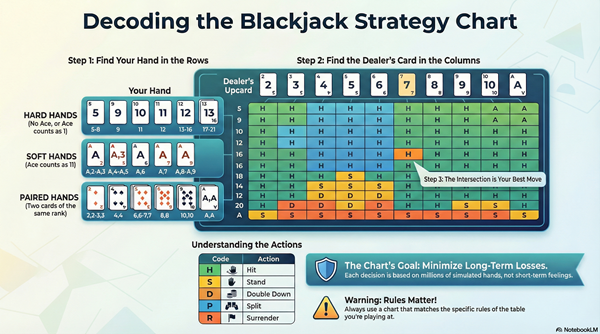
While betting systems promise control, blackjack basic strategy remains the only proven method that minimizes the house edge over time, which is why no system can outperform it in the long run.
🧠 The Illusion of Control That Blackjack Creates
Blackjack feels different from other casino games. You make decisions. You choose when to hit, stand, double, or split. That sense of choice tricks the brain into believing that outcomes are more controllable than they really are. Systems thrive in that space between choice and randomness.
Because players can influence how a hand is played, they assume they can influence what the long-term results will be. This is where systems take root. They promise structure, logic, and safety in a game that quietly punishes certainty.
The reality is that while your decisions affect individual hands, they do not alter the game’s long-term expectation. You can play smarter or dumber, but once you’re playing optimally, there is nothing left for a system to fix.
📉 The Mathematical Wall Every System Hits
Every blackjack hand has a built-in expected value. That value is slightly negative for the player, even with perfect basic strategy. When someone introduces a “system,” they are usually changing how much is bet, not the expected value of the hand itself.
That distinction matters more than most players realize. Betting more or less does not change the house edge. It simply scales the results. Losing faster can feel exciting. Losing slower can feel controlled. But losing is still the default outcome over time.
This is why betting systems collapse under scrutiny. They don’t eliminate losses; they redistribute them. A system might survive for an hour, a night, or even a week, but over thousands of hands the math always reasserts itself.
💰 Why Betting Progressions Feel Smart (Until They Aren’t)
Progression systems are especially seductive because they appear logical. If you lose, you bet more to recover. If you win, you press your advantage. The math feels clean and the results often look good in the short term.
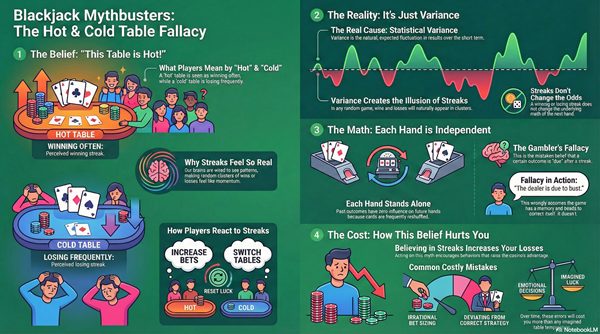
The problem is that blackjack doesn’t guarantee short-term outcomes. Losing streaks are not rare anomalies — they are statistically inevitable. When a progression system collides with a long losing streak, the required bets grow faster than most bankrolls or table limits allow.
When these systems fail, they don’t fail gently. They fail suddenly and decisively. That’s not a flaw from the casino’s perspective; it’s a feature. Casinos don’t need players to lose often. They only need players to lose big occasionally.
🎯 Why “Safer” Systems Still Lose
Some players abandon aggressive systems and turn to slower, more conservative approaches. These systems promise smaller swings, smoother sessions, and “locked-in” profits. They don’t rely on doubling endlessly, which makes them feel more mature and disciplined.
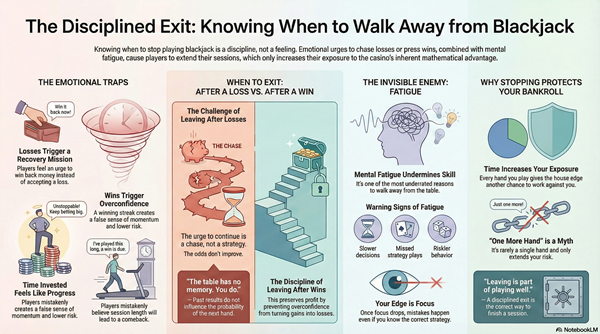
Unfortunately, they still rely on the same faulty assumption: that stopping early somehow protects you from the math. Quitting after a win doesn’t erase the house edge; it just postpones your next encounter with it.
These systems feel calmer, but calm doesn’t equal profitable. Over time, the house edge quietly drains the bankroll, one modest loss at a time.
🃏 Strategy Overrides and “Blackjack Tricks”
Beyond betting systems, many players adopt play-based rules that contradict basic strategy. These ideas often come from personal experience, superstition, or a belief that dealers follow predictable patterns.
The issue is simple. Basic strategy already represents the mathematically optimal way to play each hand. Deviating from it, even with confidence, always increases the house edge. The cards don’t respond to feelings, streaks, or table energy. They respond only to probability.
When a system tells you to ignore basic strategy, it is asking you to trade proven math for intuition. Casinos are very comfortable with that trade.
🧪 Why Systems Seem to Work in the Beginning
Perhaps the most dangerous thing about blackjack systems is that they often do work — briefly. Early success creates confidence, confidence creates larger bets, and larger bets magnify inevitable losses.
Humans are wired to remember wins more vividly than losses. A system that produces a few early successes feels validated, even if the long-term trajectory is negative. This selective memory keeps players committed long after the math has turned against them.
Casinos benefit enormously from this psychological loop. They don’t need systems to be perfect. They just need them to be convincing.
🔄 Card Counting: The Misunderstood Outlier
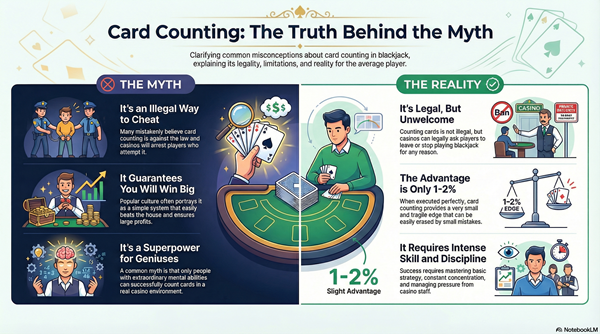
Card counting is frequently lumped in with betting systems, but it operates on a different principle. Instead of chasing losses or patterns, it tracks changes in deck composition and adjusts bets when the math shifts slightly in the player’s favor.
Even then, the advantage is small, fragile, and hard to maintain. Counting requires discipline, emotional control, perfect execution, and tolerance for long losing stretches. It also attracts attention from casinos, which limits its practical usefulness.
For most players, card counting doesn’t fail because it’s ineffective. It fails because it’s psychologically exhausting and financially unrewarding in the short term. Winning slowly feels suspiciously like losing.
🏛️ Why Casinos Quietly Encourage System Play
Casinos don’t advertise systems, but they don’t discourage them either. A player using a system stays longer, bets more erratically, and remains emotionally invested. That combination is ideal from a casino’s point of view.
A disciplined player flat-betting with basic strategy is predictable and low-risk. A system player chasing structure and certainty is volatile, optimistic, and loyal to the table. The math favors the casino either way, but the experience is far more profitable with the latter.
Systems don’t threaten casinos. They feed them.
🚪 The Honest Conclusion Most People Avoid
Blackjack systems don’t fail because they are poorly designed. They fail because they attempt to solve a problem that doesn’t exist. The house edge is not a pattern to be cracked or a streak to be timed. It is a constant.
No betting progression, no secret play rule, and no clever sequencing can change that. The only real choices players have are how fast they lose, how much entertainment they buy, and when they walk away.
Once you understand that, blackjack becomes simpler — and far less dangerous.
🔚 Final Thought: Systems Promise Certainty in an Uncertain Game
People don’t fall for blackjack systems because they’re naïve. They fall for them because humans crave structure in chaos. Systems offer comfort, rules, and the illusion of control in a game designed to reward patience and punish hope.
The casino doesn’t beat players with tricks. It beats them by letting them believe the next adjustment will fix everything.
And that belief is the most reliable system of all.