
Why Insurance Is Almost Always a Bad Bet in Blackjack
When the dealer shows an Ace, blackjack tables pause. Chips hover. A calm voice asks, “Insurance?” The offer sounds responsible — a way to protect yourself from a dealer blackjack. For many players, it feels like the safe move.
It isn’t.
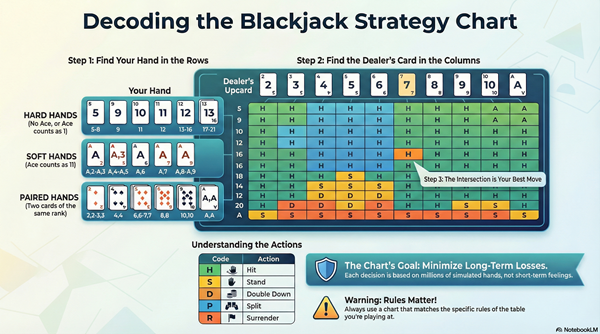
Insurance is one of the most misunderstood bets in blackjack and one of the most consistently unprofitable. As explained in our Blackjack Basic Strategy guide, blackjack rewards decisions that minimize expected loss, not decisions that feel protective. Insurance does the opposite for most players.
This article explains what insurance really is, why it feels smart, how the math works against it, and why taking insurance quietly increases the house edge.
🧠 What Insurance Actually Is
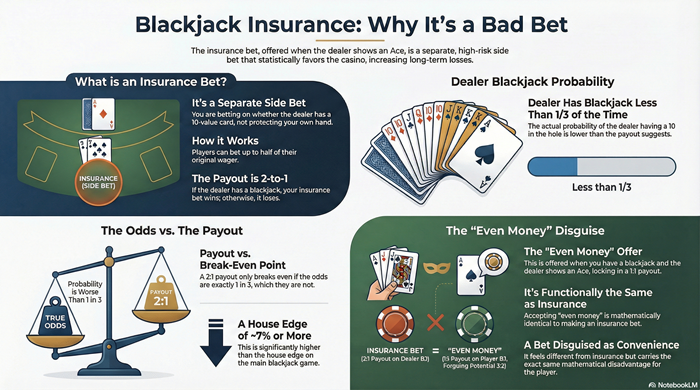
Insurance is a separate side bet, not part of the main blackjack hand.
When the dealer shows an Ace, players may bet up to half of their original wager that the dealer has a blackjack. If the dealer does have blackjack, the insurance bet pays 2:1. If not, the insurance bet loses.
Crucially:
- Insurance resolves independently of your hand
- Your main bet continues as normal if the dealer does not have blackjack
Despite the name, insurance does not protect your hand. It only bets on the dealer’s hole card.
🎯 Why Insurance Feels Like the Right Move
Insurance feels sensible for a few psychological reasons:
- Dealer blackjack feels devastating
- The offer sounds defensive, not aggressive
- A 2:1 payout feels generous
- The timing creates pressure
Players focus on the pain of losing to a dealer blackjack and overlook how often it doesn’t happen.
This emotional framing makes insurance feel prudent when it is not.
📊 How Often the Dealer Actually Has Blackjack
When the dealer shows an Ace, they have a blackjack less than one-third of the time.
The insurance bet requires the dealer to have a ten-value card underneath. There are many non-ten cards remaining in the deck, even with multiple decks in play.
Because insurance pays 2:1, the math would only break even if the dealer had blackjack one out of three times. In reality, it’s less frequent — giving the casino the edge.
📉 Why Insurance Has a Built-In House Edge
Insurance carries a house edge of roughly 7% or more, depending on deck count and rules.
That is:
- Far higher than the main blackjack bet
- Worse than many other poor decisions
- Comparable to some side bets
This edge exists even if you play your hand perfectly. Insurance does not care how good your strategy is.
🧪 Why Insurance Is Not “Protection”
Insurance does not reduce losses. It redistributes them.
If the dealer has blackjack:
- You lose your main bet
- You win the insurance bet
If the dealer does not:
- You keep playing your hand
- You lose the insurance bet
Over time, the insurance losses outweigh the occasional recoveries. The bet feels protective because it softens a dramatic loss — not because it saves money.
⚠️ The Most Common Insurance Mistake
Players often justify insurance by saying:
“I had a good hand — I didn’t want to lose it.”
But insurance doesn’t preserve good hands. It simply adds a new wager with bad odds.
Ironically, players who take insurance often:
- Increase total money at risk
- Add volatility
- Lose more during neutral dealer hands
Fear turns into overexposure.
🧠 Insurance vs Even Money (Important Distinction)
When a player has a blackjack and the dealer shows an Ace, casinos may offer even money.
Even money is functionally the same as insurance:
- You lock in a 1:1 payout
- You avoid losing to dealer blackjack
Mathematically, even money is just insurance disguised as convenience. It carries the same expectation and the same disadvantage.
It feels different. It isn’t.
🏛️ When (If Ever) Insurance Makes Sense
There is one narrow exception: skilled card counters.
When the remaining deck is unusually rich in ten-value cards, insurance can become profitable. This requires:
- Accurate count
- Favorable deck composition
- Discipline and precision
For non-counters, insurance is almost always a losing bet.
This distinction fuels confusion — but it does not change the recommendation for most players.
📉 How Insurance Increases the House Edge Over Time
Taking insurance repeatedly:
- Adds a high-edge wager
- Increases total money wagered
- Accelerates bankroll loss
A player who plays perfect basic strategy but routinely takes insurance will often lose faster than a player who makes small strategy errors but avoids it.
Insurance is expensive, not harmless.
🧠 Why Casinos Love Insurance
Casinos love insurance because:
- It feels optional and smart
- It doesn’t slow the game
- It increases average bet size
- It exploits fear
The bet is offered at exactly the moment players feel most vulnerable. That timing is intentional.
📌 What to Do Instead of Taking Insurance
The correct response to the insurance offer is simple:
- Ignore it
- Play your hand normally
- Accept that dealer blackjack happens
Blackjack strategy already accounts for dealer blackjacks. Adding a separate losing bet does not improve your situation.
🔚 Final Thought: Insurance Protects Feelings, Not Bankrolls
Insurance exists to make losses feel less painful — not to reduce them.
It replaces one sharp loss with many small ones and hides the cost in plain sight. Over time, that trade favors the casino every time.
In blackjack, the safest move is often the least comforting one.
Say no to insurance.
🔗 Recommended Internal Links