
How Keno Pay Tables Create the House Edge
This article is part of our complete guide on How Keno Really Works: Probability, Payouts, and Why “Almost Winning” Feels So Close, which explains keno probability, house edge, variance, and why common myths fail.
Introduction
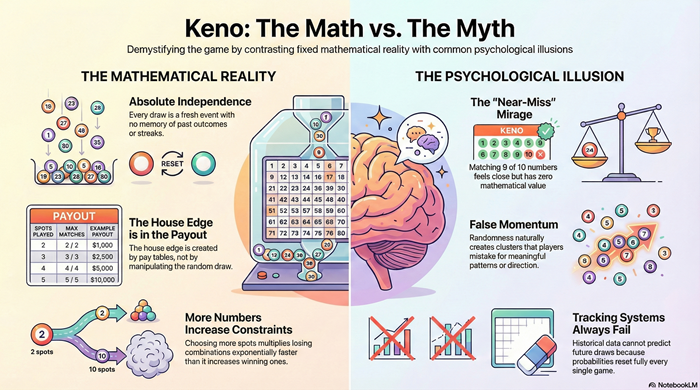
In keno, the disadvantage faced by players does not come from hidden adjustments or changing odds. The numbers are drawn randomly and independently every time. The house edge is created somewhere else entirely.
It is created by the pay table.
Understanding this distinction is essential, because many people assume the game itself must be altering probabilities to produce long-term losses. In reality, the probabilities remain fixed. What changes is how those probabilities are paid.
How Keno Pay Tables Create the House Edge
What a Keno Pay Table Really Is
A pay table is a list of outcomes and the payouts assigned to them. In keno, those outcomes are defined by how many of your chosen numbers match the numbers drawn.
Each pay table row represents:
- a specific spot count
- a specific number of matches
- a fixed payout for that result
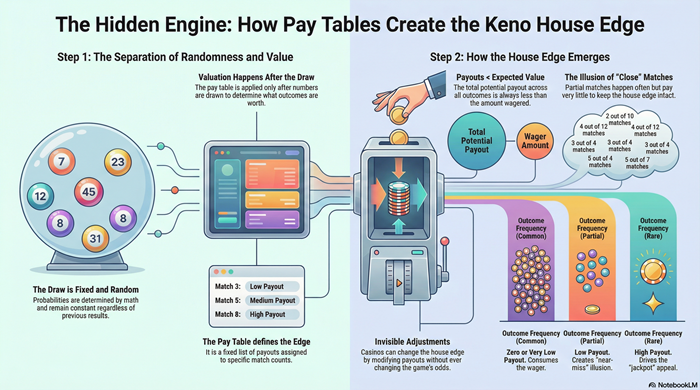
The pay table does not influence which numbers are drawn. It is applied after the draw has already occurred. The randomness happens first. The valuation happens second.
This separation is critical. The draw defines what is possible. The pay table defines what those possibilities are worth.
Probability Doesn’t Change — Payouts Do
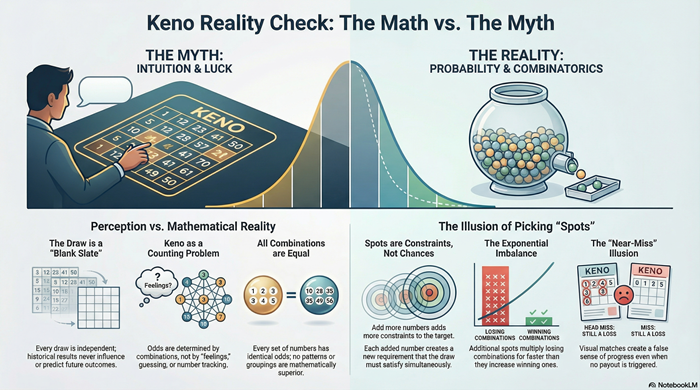
The probability of matching a given number of spots is determined by combinatorics and randomness. Once the game rules are set, those probabilities do not fluctuate.
What does fluctuate between games is the pay table.
Two keno games can use the same number pool, the same draw size, and the same probabilities, yet produce very different long-term results if their pay tables differ.
The house edge is therefore not a mystery or a hidden mechanism. It is openly defined by payout amounts relative to how often outcomes occur.
Expected Value Without Strategy
Expected value describes the average result produced when every possible outcome is weighted by how frequently it occurs.
In keno:
- most outcomes occur frequently and pay nothing or very little
- a small number of outcomes occur rarely and pay much more
When all outcomes are combined, the total expected payout is less than the amount wagered. That difference is the house edge.
Once the pay table is fixed, the expected value is fixed. No observation, timing, or number selection can change it.
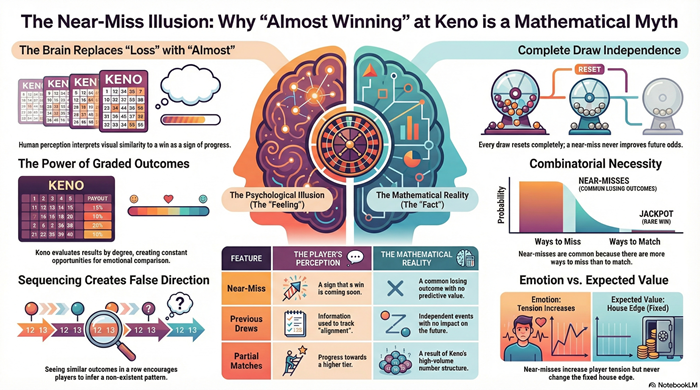
Why Partial Matches Feel Underpaid
Partial matches happen often, especially with higher spot counts. Because they happen often, they must pay relatively little.
This is where intuition breaks. Matching many numbers feels meaningful. The payout often feels disappointing by comparison.
But if frequent outcomes paid generously, the total payout would exceed the amount wagered. The pay table prevents this by concentrating most of the return into very rare outcomes.
The game does not reward closeness. It rewards specific outcomes.
How the House Edge Is Adjusted Without Changing the Game
Keno does not need to alter odds to change long-term return. The house edge can be adjusted simply by modifying payouts.
This can be done by:
- lowering top payouts
- reducing payments for partial matches
- removing paying tiers entirely
From the player’s perspective, the game looks the same. The draw behaves the same. The experience feels similar. But the expected value changes.
This is why visually identical keno games can perform very differently over time.
What the House Edge Means for Understanding Keno
The house edge is not something that appears because of bad luck or poor decisions. It is built into the structure of the game from the beginning.
Keno does not need to react to outcomes or correct itself. Over enough draws, the imbalance created by the pay table emerges naturally.
Understanding this explains why keno can feel fair in individual moments while remaining unfavorable over time. The system is consistent. The disadvantage is structural.