
Keno Variance Explained: Why Results Swing So Wildly
This article is part of our complete guide on How Keno Really Works: Probability, Payouts, and Why “Almost Winning” Feels So Close, which explains keno probability, house edge, variance, and why common myths fail.
Introduction
Many people understand that keno has long odds and a built-in house edge, yet still feel confused by how extreme the results can be. Long losing stretches feel excessive. Sudden wins feel outsized. The emotional swing often feels disconnected from what the math seems to imply.
That confusion comes from variance. Variance does not change probability, and it does not alter the house edge. It explains how unevenly outcomes are delivered over time, and in keno, that unevenness is especially pronounced.
Keno Variance Explained: Why Results Swing So Wildly
Probability and Variance Are Not the Same Thing
Probability describes how likely an outcome is on a single draw. Variance describes how outcomes are distributed across many draws.
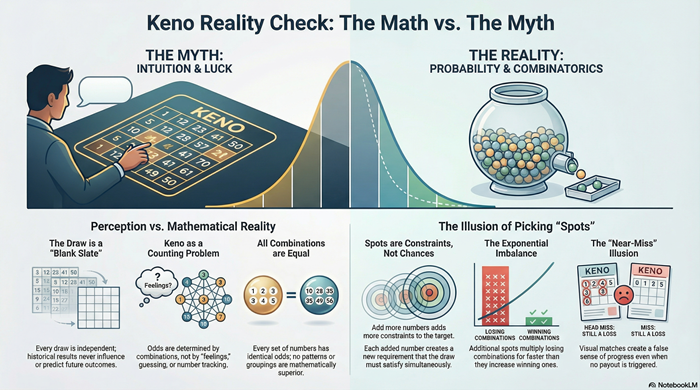
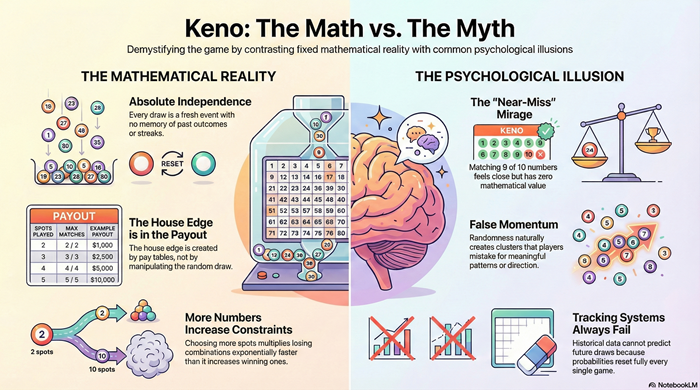
In keno, probabilities are fixed once the rules are set. The chance of matching a given number of spots does not improve, decline, or drift. What does change is when outcomes appear and how far apart they are.
A game can have stable probabilities and still produce highly unstable experiences. Keno is a clear example of this separation.
Why Keno Has Exceptionally High Variance
Keno combines two structural features that dramatically increase variance:
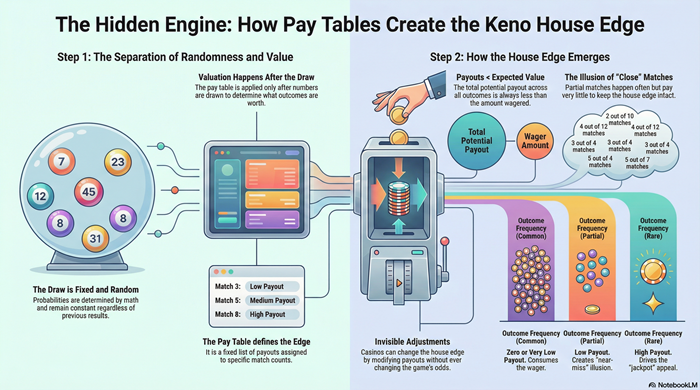
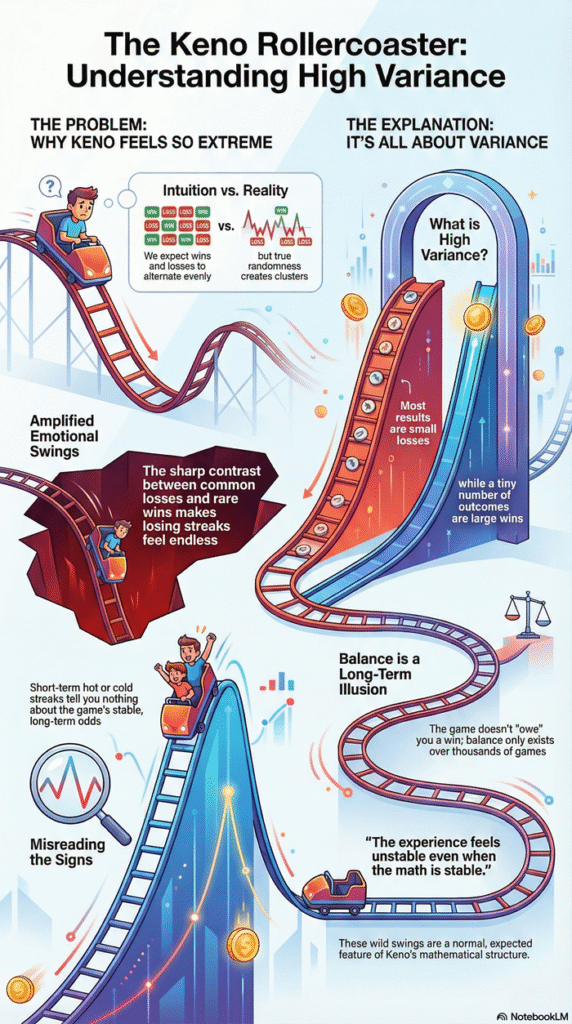
- most outcomes occur frequently and return nothing or very little
- a small number of outcomes occur rarely and carry most of the payout value
This creates a wide gap between ordinary outcomes and notable ones. When outcomes are distributed this way, long stretches of similar results are expected, and interruptions are rare.
That gap is variance.
Because higher payouts occur infrequently, long dry spells are not unusual. When a win finally appears, it stands out sharply against many routine losses, making it feel sudden and dramatic.
Losing Streaks Are a Structural Feature
In high-variance systems, losing streaks are not a sign of worsening odds or poor timing. They are a natural consequence of how outcomes are distributed.
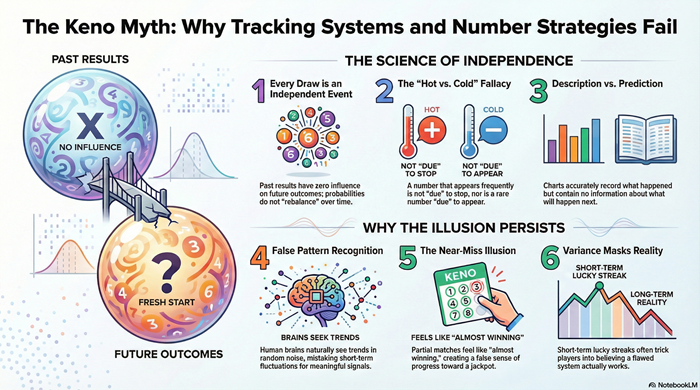
Random processes do not alternate neatly. They cluster. Keno’s structure makes those clusters particularly visible because most outcomes look the same: no payout or minimal return.
This often conflicts with intuition. People expect randomness to “smooth out” quickly. In reality, balance appears only across very large samples.
Why Wins Feel Larger Than the Math Suggests
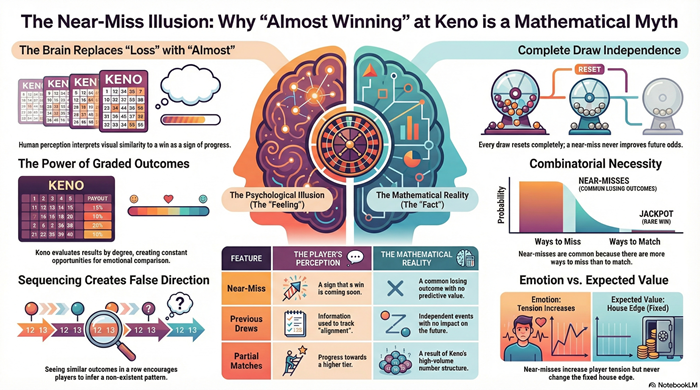
Losses in keno tend to blur together in memory because they are frequent and emotionally similar. Wins, especially larger ones, break that pattern.
This creates a distorted sense of frequency. A single notable outcome can feel more important than dozens of ordinary ones, even though it does not outweigh them mathematically.
Variance amplifies this effect by spacing wins far apart. Their rarity increases their emotional impact without changing their statistical role.
Short-Term Results Are Misleading by Design
Short sequences of keno results cannot reflect the true behavior of a high-variance system. A small sample can look unusually good or unusually bad without being unusual at all.
This is why interpreting recent history leads to false conclusions. A stretch of losses does not imply that a win is coming. A recent win does not imply improvement.
Variance explains why these impressions occur, not whether the game is fair.
What Variance Changes — and What It Doesn’t
Variance changes how keno feels. It affects:
- the length of losing streaks
- the emotional impact of wins
- the unevenness of experience
Variance does not change:
- the odds
- the house edge
- the independence of draws
- the expected value
Once variance is understood as a structural property, keno’s extremes stop looking suspicious. The game is not behaving erratically. It is behaving exactly as a high-variance system should.