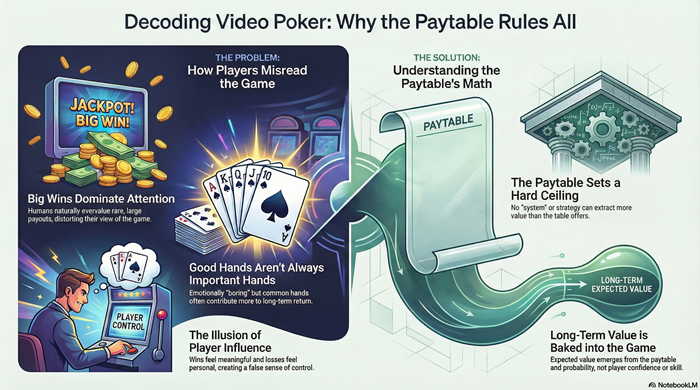

Common Video Poker Myths and Why They Persist
This article is part of our complete guide on How Video Poker Really Works: Paytables, Probability, and Why Myths Persist, which explains video poker paytables, expected value, probability, variance, and why common myths fail.
Why Video Poker Produces So Many Myths
Video poker is unusually good at generating myths. This is not because players are careless or uninformed. It is because the game combines elements that strongly encourage misinterpretation.
Those elements include:
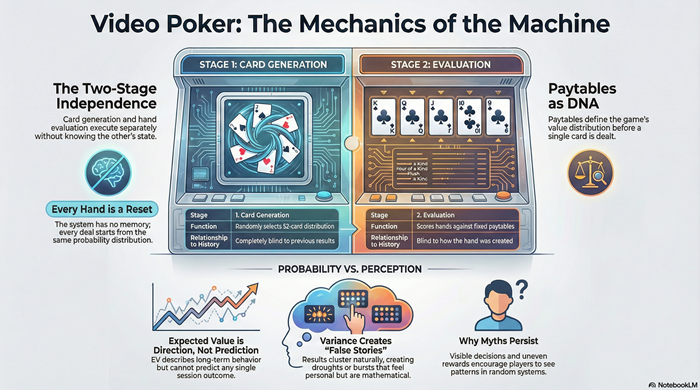
- Independent random outcomes
- Visible player decisions
- Fixed but opaque paytables
- Highly uneven payout distributions
Together, they create an environment where intuition feels useful — even when it is consistently wrong.
Myths are not accidents. They are a predictable response to how information is presented.
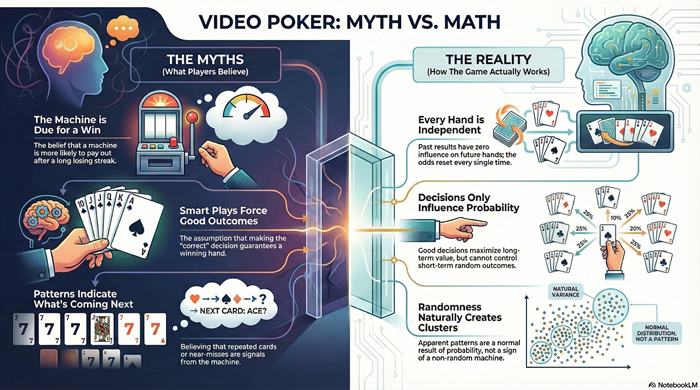
Myth 1: “The Machine Is Due”
One of the oldest beliefs in gambling is that outcomes balance themselves in the short term. In video poker, this belief is reinforced by long stretches without rare hands.
The reality is simple:
Independence prevents correction.
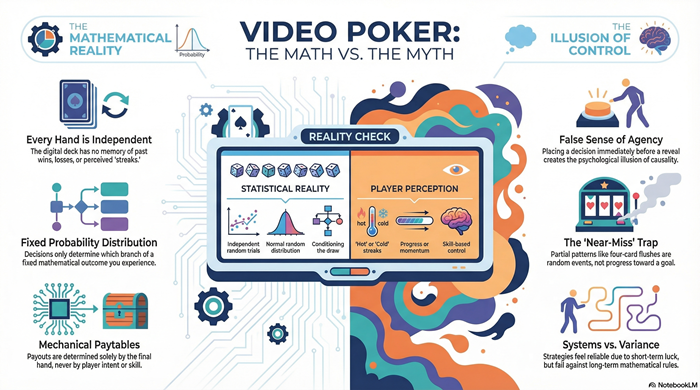
Each hand begins with the same probability distribution. Past outcomes do not increase or decrease the likelihood of future ones. A long run without a specific hand does not make that hand more likely to appear next.
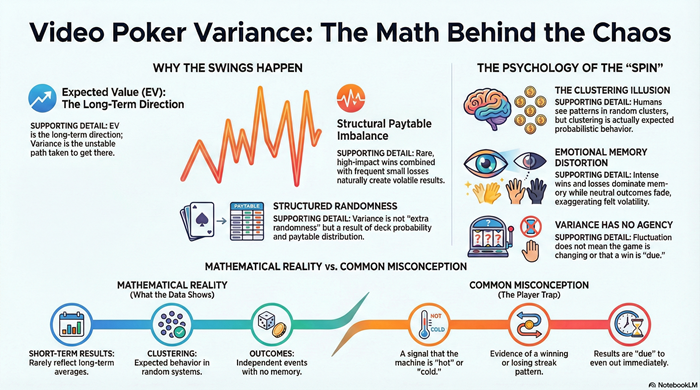
What feels like imbalance is simply variance playing out normally.
Myth 2: “Good Play Forces Better Outcomes”
Because video poker allows decisions, it feels natural to assume that better choices force better results.
This belief collapses under scrutiny.
Decisions condition which cards are drawn, but they do not rewrite probability. The paytable evaluates only completed hands, not intent or reasoning.
A well-considered decision can still lead to a losing outcome. A poor decision can still produce a win. Neither result validates the reasoning behind it.
Myth 3: “Short Sessions Reveal the Truth”
Players often trust recent experience more than abstract math. A winning session feels like confirmation. A losing session feels like exposure.
Both interpretations are flawed.
Short sessions are dominated by variance. They do not reliably reflect expected value or payout structure. Drawing conclusions from them is equivalent to judging a climate from a single afternoon.
Experience feels authoritative. Statistically, it is noisy.
Myth 4: “Patterns Appear Because Something Is Changing”
Repeated card shapes, recurring near misses, or familiar sequences invite pattern recognition. Humans are excellent at spotting repetition, even when it is meaningless.
In video poker, patterns appear because:
- The card set is finite
- Certain configurations are more common
- Randomness produces clusters
Patterns do not indicate memory, adjustment, or feedback. They indicate probability.
Myth 5: “Variance Explains Everything”
Variance explains why results fluctuate. It does not explain direction, fairness, or structure.
Some players treat variance as a catch-all explanation for outcomes they do not like. Others use it to justify belief in future correction.
Variance explains spread. It does not predict recovery or success. Without expected value and paytable structure, variance becomes a narrative tool rather than an explanatory one.
Why These Myths Survive Repeated Contradiction
Video poker myths persist because they are supported by experience, emotion, and selective memory.
Three forces keep them alive:
- Salience – Rare events are memorable
- Agency – Decisions feel meaningful
- Clustering – Randomness produces apparent structure
Each reinforces belief, even when belief is wrong.
Myths do not survive because they are true. They survive because they are convincing.
Why Myth-Busting Alone Is Not Enough
Simply stating that myths are wrong rarely works. Without understanding:
- Independence
- Paytables
- Expected value
- Variance
Myths reappear under new names.
This is why each prior article matters. Myth collapse requires a framework, not a correction.
How Understanding the Structure Ends the Myths
When video poker is understood as a system with fixed rules and probabilistic outcomes, myths lose their footing.
- “Due” disappears under independence
- “Skill forcing wins” disappears under fixed paytables
- “Short-term proof” disappears under variance
- “Patterns mean change” disappears under probability
The game does not argue. It does not respond. It simply executes its structure repeatedly.
What This Means Going Forward
Once myths are removed, discussion becomes clearer:
- Outcomes stop validating stories
- Experience stops acting as evidence
- Structure becomes the reference point
This does not make video poker exciting. It makes it understandable.
And understanding is the point.