
Expected Value in Video Poker Explained Without Strategy Myths
This article is part of our complete guide on How Video Poker Really Works: Paytables, Probability, and Why Myths Persist, which explains video poker paytables, expected value, probability, variance, and why common myths fail.
What Expected Value Actually Is
Expected value (EV) is one of the most misunderstood concepts in video poker. It is often treated as a prediction, a guarantee, or a measure of player skill. None of those interpretations are correct.
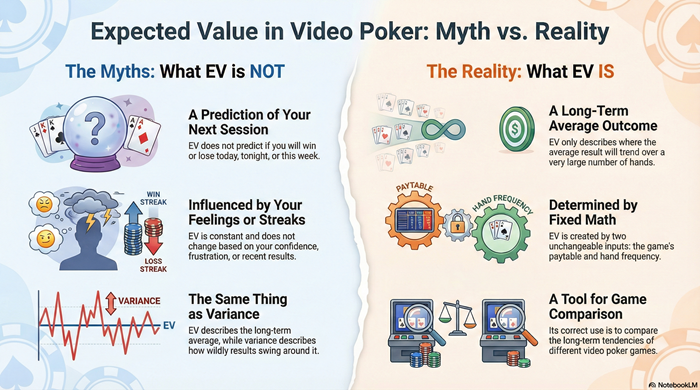
Expected value is a long-run average outcome defined by the structure of the game. It describes what would happen on average if the same conditions were repeated a very large number of times. It does not describe what will happen in a single session, a short run, or even many sessions.
EV answers one question only:
If this game were played repeatedly under identical conditions, where would the average result trend?
It does not answer when that trend appears, how smooth the path will be, or how any individual session will feel.
Where Expected Value Comes From
Paytables and Hand Frequencies
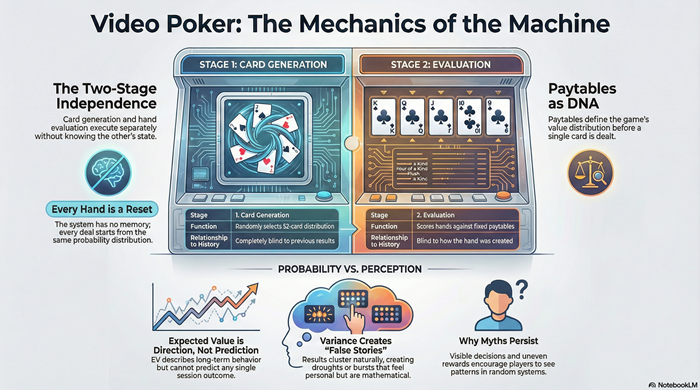
Expected value is not created by player experience or intuition. It comes from two fixed inputs:
- The paytable, which assigns payouts to completed hands
- The frequency with which those hands occur
The paytable defines what is paid. Probability determines how often each outcome appears. Expected value emerges from the combination of those two elements across a very large number of hands.
This is why EV exists even if no one understands it. The math does not depend on belief, confidence, or awareness. It is embedded in the structure of the game itself.
Why Player Experience Is Irrelevant to EV
Players often believe EV responds to how the game feels. Winning sessions feel like confirmation. Losing sessions feel like contradiction.
Neither reaction is relevant.
Expected value does not rise because a player is confident. It does not fall because a player is frustrated. It does not adjust to streaks, momentum, or emotion.
EV remains constant because the inputs that create it do not change.
Why EV Is Constant but Results Are Not
One of the most confusing aspects of expected value is the gap between stability and experience. EV is stable. Results are volatile.
This is not a contradiction. It is the expected behavior of probabilistic systems.
Why Convergence Takes Time
Expected value describes an average that becomes visible only across very large samples. Individual outcomes vary widely, but as more hands are observed, those variations begin to balance.
This balancing process is slow. It does not operate on the scale of sessions or moods. It operates on the scale of repeated trials.
When people say, “It should have evened out by now,” they are usually underestimating how much randomness exists in the short and medium term.
Why Short-Term Outcomes Can Violate Expectations
Short-term results regularly diverge from long-term averages. This does not invalidate EV. It demonstrates variance.
In a small sample, rare outcomes may cluster or disappear entirely. Common outcomes may dominate unexpectedly. These fluctuations are normal and unavoidable.
Expected value does not promise smoothness. It only describes direction over time.
Common Misinterpretations of Expected Value
“High EV Means I Should Win Today”
This is the most common mistake. EV does not predict sessions. It does not promise profit. It does not say anything about today, tonight, or this week.
Using EV as a short-term expectation tool guarantees confusion.
“EV Explains Variance”
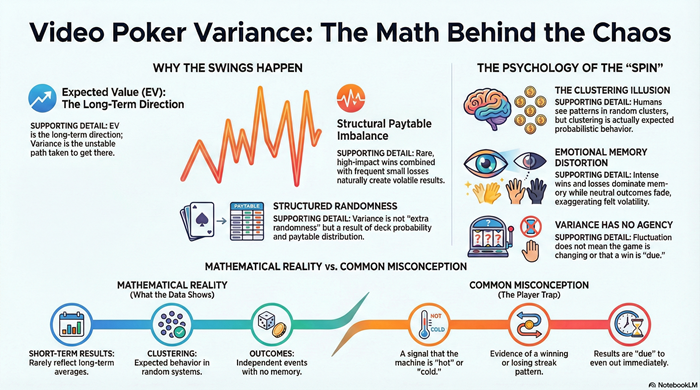
Expected value and variance are related, but they are not interchangeable. EV describes the long-term average. Variance describes how widely results spread around that average.
Confusing the two leads to false explanations for normal fluctuation.
“Changing How I Play Changes EV”
Player decisions can influence which outcomes occur more often, but they do not rewrite the payoff structure. EV is anchored to the paytable and probability distribution.
Unless those change, EV does not.
How Expected Value Should Be Used
Expected value is best understood as a structural descriptor, not a behavioral guide.
Correct uses of EV include:
- Comparing long-term tendencies under fixed rules
- Understanding why short-term experience is misleading
- Explaining why outcomes do not validate reasoning
Incorrect uses include:
- Predicting session results
- Justifying confidence or frustration
- Treating EV as feedback
EV does not tell players what will happen. It explains why what does happen often feels unintuitive.
How EV Connects to Variance
Expected value answers the question of where results trend. Variance explains how violently they get there.
In video poker, paytables distribute value unevenly across outcomes. This structure naturally produces volatility. Large payouts occur rarely. Smaller payouts occur frequently. The imbalance between the two drives wide swings.
Understanding EV without understanding variance leads to false certainty. Understanding variance without EV leads to confusion.
They must be understood together, but they are not the same concept.
Why EV Is So Often Misused in Video Poker
Video poker encourages EV misuse because it combines:
- Visible decision-making
- Clear outcomes
- Immediate feedback
This combination invites players to read meaning into short-term results. Expected value exists specifically to resist that impulse, not support it.
EV removes stories. It replaces them with averages.
How This Fits Into the Bigger Picture
Once expected value is correctly understood, several things fall into place:
- Winning sessions stop being proof
- Losing sessions stop being failure
- Streaks lose explanatory power
- Myths lose credibility
Expected value is not exciting. It is not reassuring. It is clarifying.
Everything that follows — variance, hand distribution, and myth persistence — builds on this understanding.