
What Video Poker Really Is: Random Hands, Fixed Paytables, and Player Illusions
This article is part of our complete guide on How Video Poker Really Works: Paytables, Probability, and Why Myths Persist, which explains video poker paytables, expected value, probability, variance, and why common myths fail.
Video Poker Is Not a “Strategy Game” (and Not Pure Chance Either)
Video poker is commonly described in extremes. Some players treat it as a skill-based game that rewards good decision-making. Others dismiss it as a slot machine with cards and buttons. Both views are incomplete.
The confusion comes from how video poker is constructed. Cards are dealt randomly, but the game allows visible decisions before the hand is finalized. That combination creates the impression that outcomes are shaped by judgment, even though the underlying probabilities remain fixed.
This distinction matters. Making a choice does not automatically imply control over outcomes. Seeing a decision does not mean that decision reshapes probability. Video poker allows decisions, but those decisions operate inside a probabilistic framework that does not adapt to player behavior.
Until this boundary is understood, everything else about video poker — paytables, expected value, variance, and myths — is easily misinterpreted.
Every Video Poker Hand Starts From a Fixed Probability Distribution
Cards Are Drawn From an Independent, Random Process
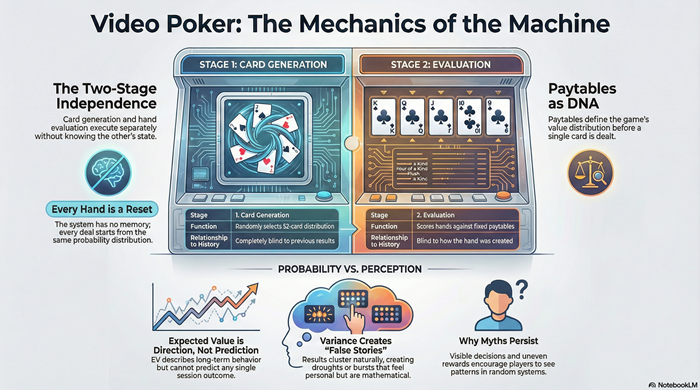
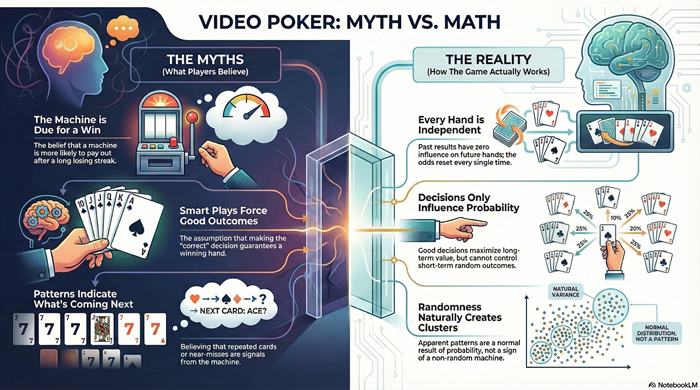
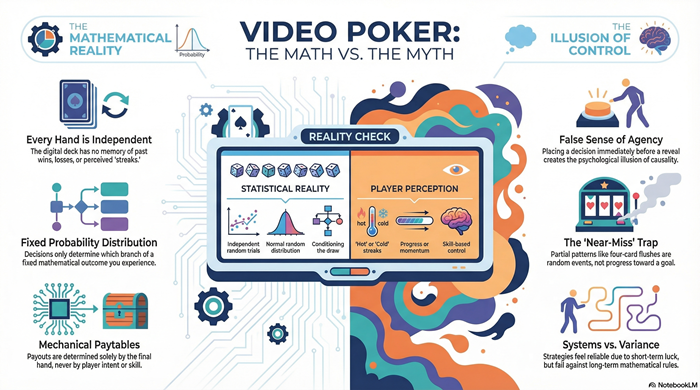
Each hand of video poker begins with a fresh, independent deal. The deck has no memory. It does not respond to wins, losses, near misses, or perceived streaks.
This independence means:
- A hand dealt after ten losses is mathematically identical to a hand dealt after ten wins.
- A machine that “feels cold” is no different from one that “feels hot.”
- Past outcomes provide no information about future ones.
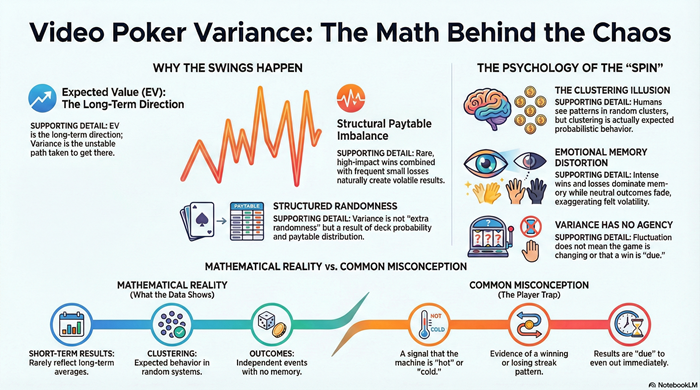
Independence explains why short sessions are so misleading. Humans are excellent at finding patterns, even when none exist. In video poker, this tendency is constantly reinforced by visible cards and repeated exposure to similar hand shapes.
The Paytable Does Not React to Your Play
The paytable defines how completed hands are evaluated. It does not change in response to player decisions, session length, or perceived skill.
Once the final five-card hand is formed:
- The hand is compared against fixed categories.
- The payout is determined mechanically.
- No earlier choice is revisited.
The game does not reward intent, creativity, or confidence. It only evaluates outcomes. This is why narratives about “playing smarter” often collapse when examined mathematically.
What Player Decisions Actually Affect — and What They Do Not
Holding and discarding cards does influence which cards are drawn next. What it does not do is change the probability structure governing those draws.
This distinction is subtle but critical.
- Decisions condition the draw.
- Decisions do not bend probability.
The deck remains random. The distribution of possible outcomes remains fixed. Decisions only determine which branch of that distribution the player experiences.
When this difference is missed, players begin attributing meaning to outcomes that are fully explained by chance.
Why Video Poker Feels Skill-Based
Visible Decisions Create a False Sense of Agency
Video poker places player action directly before the reveal of the outcome. This sequence strongly encourages causal thinking: I chose this, therefore this happened.
Psychologically, actions taken immediately before an outcome feel responsible for that outcome, even in systems governed by randomness. Video poker amplifies this effect because the decision is visible, deliberate, and repeatable.
The result is a powerful illusion of control. The player feels involved, even though the probabilistic rules never change.
Near Misses and “Almost Hands”
Video poker is rich in partial patterns: four cards to a flush, three to a straight, pairs that nearly improve. These outcomes are visually striking and emotionally memorable.
Near misses create two reinforcing illusions:
- They suggest progress toward a goal that resets every hand.
- They imply that a slightly different decision would have changed the result.
In reality, near misses are a normal feature of random distributions. They are not evidence of momentum, learning, or hidden structure.
Where Players Start Inventing Systems
Once outcomes feel influenced by choice, players begin creating rules to formalize those choices.
Examples include:
- Always holding high cards
- Always chasing four-card draws
- Never breaking certain hands
These systems feel reliable because they occasionally align with winning outcomes. What is missed is that favorable results do not confirm the reasoning behind them.
Systems fail in video poker because:
- Each hand is independent.
- Short-term variance is large.
- Outcomes do not validate logic.
A rule that “worked yesterday” carries no authority into the next deal.
Why These Illusions Persist
Video poker is uniquely effective at sustaining myths because it combines three elements:
- Random outcomes
- Visible decisions
- Clear visual patterns
This combination invites interpretation. The game looks understandable. It feels learnable. It rewards storytelling.
Probability, however, does not respond to stories. It responds only to large sample sizes and fixed rules.
How This Understanding Changes Everything That Follows
Once video poker is understood as a sequence of independent hands evaluated against fixed paytables, several conclusions become unavoidable:
- Expected value exists independently of intuition.
- Variance explains why results feel inconsistent.
- Paytables dominate long-term outcomes.
- Myths persist because the game encourages interpretation where none is warranted.
All advanced discussions — expected value, variance, hand distribution, and myth analysis — rest on this foundation.