
What Is Craps? Dice Mechanics, Outcomes, and Why the Table Looks So Complicated
This article is part of our complete guide on How Craps Really Works: Dice Probability, Bets, and Why Myths Persist, which explains craps probability, house edge, variance, and why common myths fail.
What Craps Actually Is (Before the Bets)
Craps is a game built on two physical dice. Every roll produces a total from 2 to 12, and every outcome is determined the moment the dice stop moving.
Nothing about craps depends on memory, patterns, or prior rolls. The game resets on every throw.
What makes craps feel confusing is not the dice—it is the table layout, which visually represents many different ways people can interact with the same underlying outcomes.
At its core:
- Two dice are rolled
- One total is produced
- That total maps to predefined outcomes
The rest of the game is structure layered on top of this simple engine.
How Two Dice Create Outcomes
The 36 Possible Dice Combinations
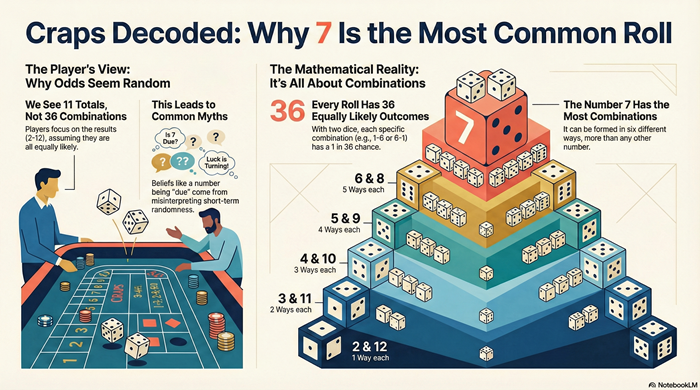
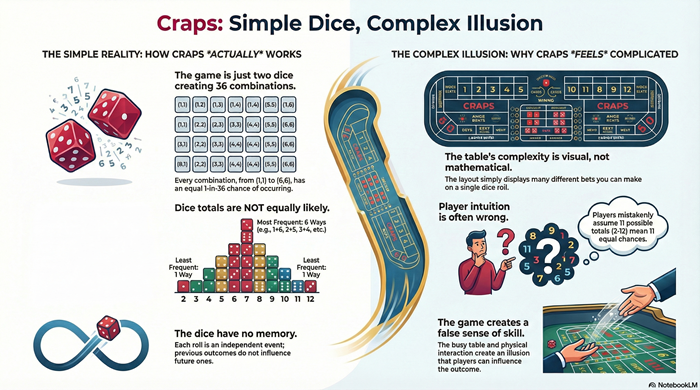
Each die has six faces. When rolled together, there are 6 × 6 = 36 equally likely combinations.
Examples include (1,1), (1,2), (1,3) through (6,6). Every one of these 36 combinations has the same probability of occurring: 1 in 36.
This is the most important mechanical fact in craps. Everything else flows from it.
Why Totals Are Not Equally Likely
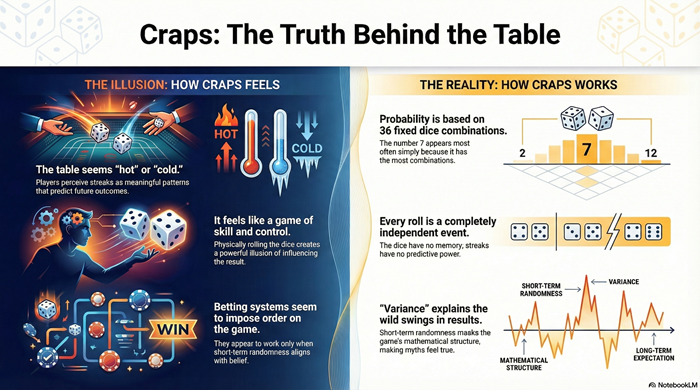
Although all combinations are equally likely, totals are not.
- A total of 7 can be formed in 6 different ways
- A total of 6 can be formed in 5 ways
- A total of 2 can be formed in 1 way
- A total of 12 can be formed in 1 way
This is why 7 appears more often than any other number, while 2 and 12 are the least frequent.
This uneven distribution is the mathematical backbone of the entire game.
Outcome Frequency vs Player Intuition
Most players intuitively assume that because there are 11 possible totals (2 through 12), each one should appear at roughly the same rate.
That intuition is wrong.
Craps is not driven by totals—it is driven by combinations. Totals are labels applied after the dice land.
This mismatch between how the game actually works and how players think about it is where many misunderstandings begin.
Why the Craps Table Looks So Complicated
One Roll, Many Contracts
Every roll produces one result, but the table allows players to enter into many different contracts tied to future outcomes.
The table is large because it supports many simultaneous wagers, all referencing the same dice in different ways.
Each marked area represents a predefined rule set, not a different game.
Complexity Is Visual, Not Mathematical
No matter how crowded the table looks:
- The dice still generate only 36 combinations
- Probabilities do not shift
- Outcomes do not interact with one another
The layout does not make the game deeper. It makes it feel deeper.
That feeling is intentional.
Independence of Dice Rolls (Introduced)
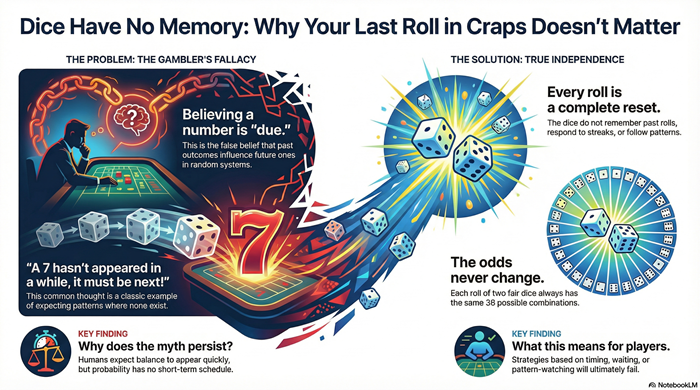
Each roll of the dice is independent.
Previous outcomes do not influence future ones. The dice have no memory.
If a 7 appears five times in a row, the probability of a 7 on the next roll is unchanged. The same is true for every other outcome.
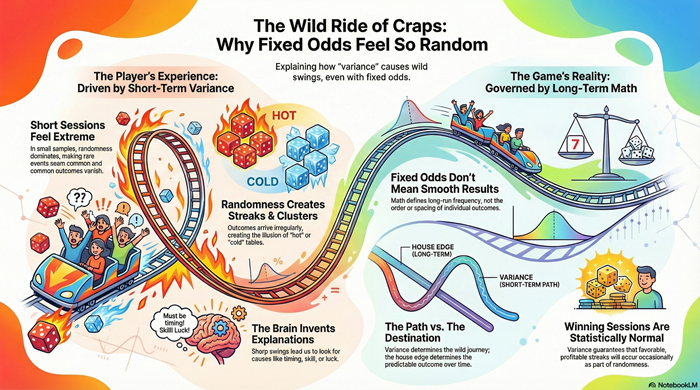
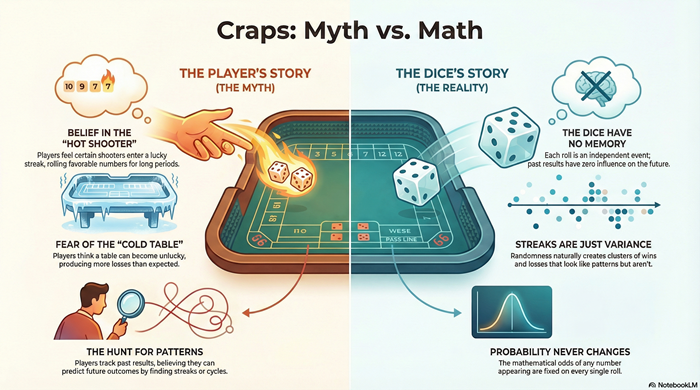
This principle is central to understanding why patterns, streaks, and “hot tables” are misleading.
The full explanation of independence is covered later in this guide.
Why Craps Feels More Complicated Than It Is
Craps combines three powerful psychological effects:
- Uneven probabilities
- High visual density
- Physical interaction with the dice
Together, these create the impression that skill, timing, or control might exist.
The underlying system, however, never changes.
What This Means Going Forward
Understanding craps begins by separating what the dice actually do from how the game presents itself.
With that foundation in place, the next articles explain probability, house edge, variance, and why common craps myths persist despite clear mathematics.
Related Pages
- How Craps Really Works: Dice Probability, Bets, and Why Myths Persist
- Craps Dice Probability Explained: Why 7 Appears More Often Than Other Number
- Are Dice Rolls Independent in Craps? Why Previous Rolls Don’t Matter
- Why Craps Looks Like a Skill Game (But Isn’t): Complexity, Rituals, and Control Illusions