
Why Craps Feels Like a Skill Game (But Isn’t)
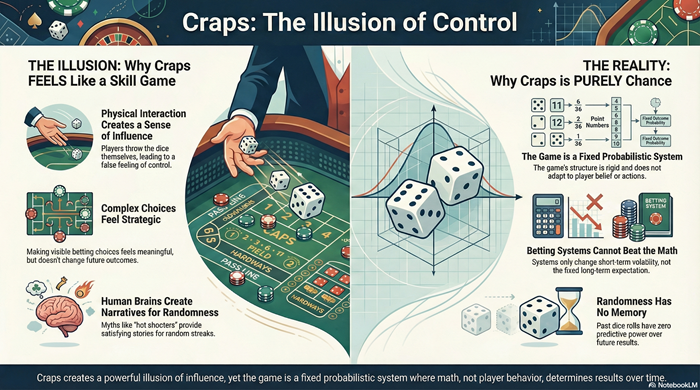
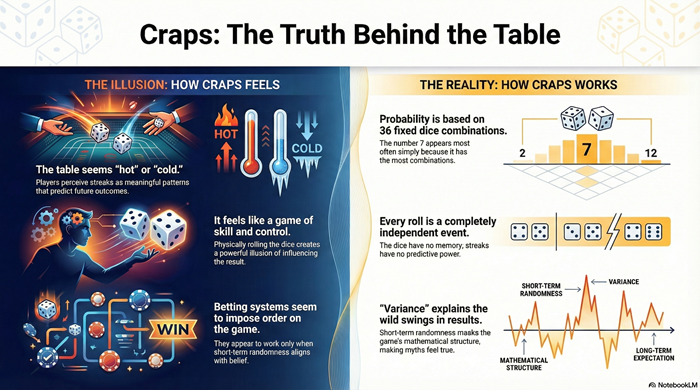
Craps feels different because players throw the dice, make visible choices, and experience outcomes socially.
Physical interaction, public outcomes, and table complexity combine to create the illusion of control.
Rituals and habits reduce anxiety during variance, but they do not influence probability. Choices select between predefined contracts—they do not change future outcomes.
Structure always dominates behavior.
Related deep dive:
Why Craps Looks Like a Skill Game (But Isn’t): Complexity, Rituals, and Control Illusions
Why Craps Systems Fail—Even When They Seem to Work
Craps systems attempt to impose order on randomness.
Progressions change volatility, not expectation.
Pattern-based systems react to the past, which has no predictive power.
Timing systems assume conditions that do not exist.
When systems appear to work, it is because variance temporarily aligns with belief. When they fail, execution is blamed instead of structure.
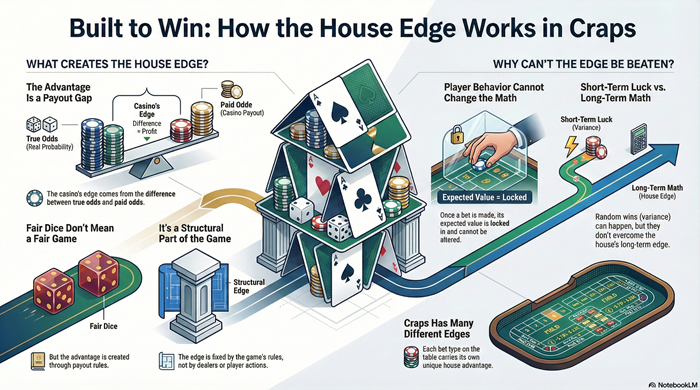
The game does not adapt. Expectation remains fixed.
Related deep dive:
Common Craps Systems Explained—and Why They Fail Mathematically
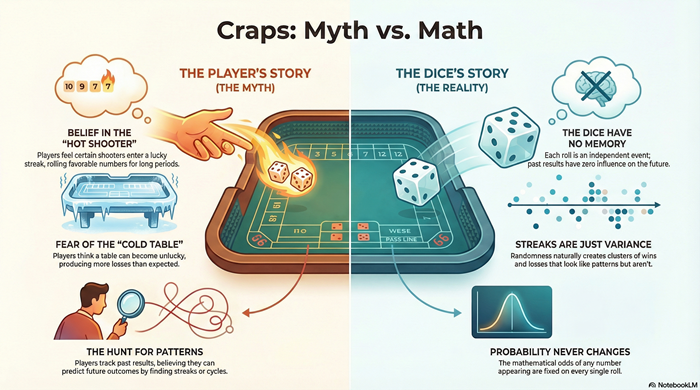
Why Craps Myths Persist—Even When the Math Is Clear
Craps myths are not foolish. They are human.
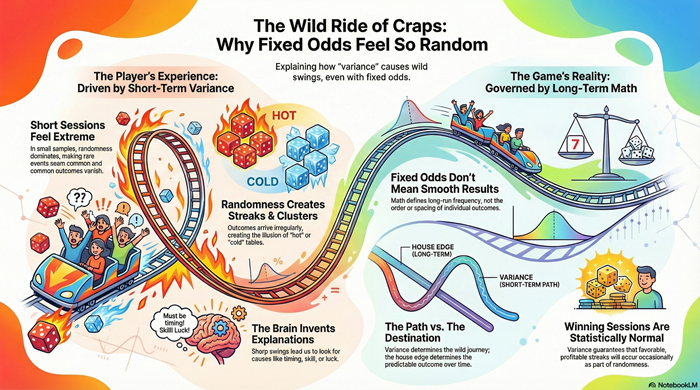
Streaks, reversals, and rare events demand explanation. Myths provide narratives where math feels unsatisfying.
Hot shooters, cold tables, and pattern watching all assume memory where none exists. Variance supplies just enough confirmation to keep belief alive.
Understanding craps does not remove emotion or enjoyment. It removes false explanations.
Related deep dive:
Myths About Craps That Refuse to Die: Hot Shooters, Cold Tables, Pattern Watching
Final Synthesis
Craps is not chaotic.
It is not adaptive.
It is not responsive to belief.
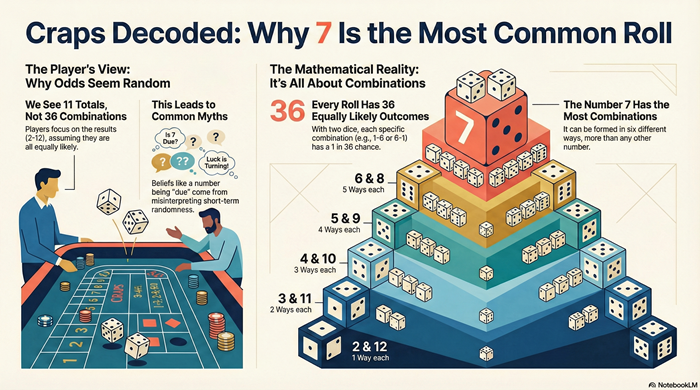
It is a fixed probabilistic system that feels complex because humans are not built to intuitively process randomness.
Once that is understood, everything else—systems, rituals, and myths—falls into place.