
How Dealer Rules Change the House Edge in Blackjack
🏛️ Most blackjack players focus on their own decisions — when to hit, stand, split, or double. What many overlook is that the dealer’s rules matter just as much, and sometimes more. Small rule variations that seem harmless can quietly increase the house edge, even when a player follows perfect basic strategy.
Before comparing tables or worrying about betting systems, it’s critical to understand how dealer rules shape the math of the game. As explained in our Blackjack Basic Strategy guide, every optimal decision assumes a specific set of rules. When those rules change, the house edge changes with them — often in ways players don’t notice until it’s too late.
This article explains the most important dealer rules, how they affect the house edge, and why rule awareness is one of the easiest ways to protect your bankroll.
🧠 Why Dealer Rules Matter More Than Most Players Realize
In blackjack, the dealer does not make strategic decisions. The dealer follows strict, fixed rules set by the casino. These rules determine when the dealer must draw cards, when they must stop, and how ties and blackjacks are handled.
Because players act before the dealer, any rule that gives the dealer more opportunities to improve their hand increases the casino’s advantage. Even a small shift — just a fraction of a percent — adds up over hundreds or thousands of hands.
🂡 Dealer Hits or Stands on Soft 17 (H17 vs S17)
This is the most important dealer rule in blackjack.
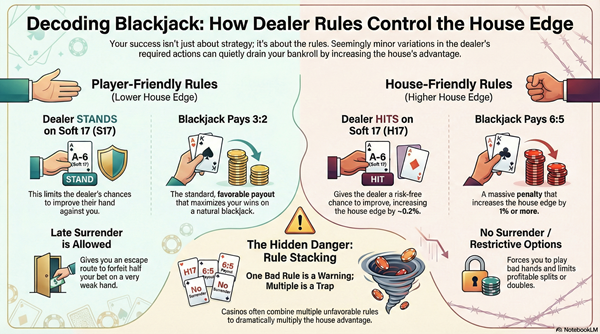
A soft 17 is a hand like A-6, where the Ace can count as 11 without busting.
🔴 H17 (Hit Soft 17)
The dealer must take another card on soft 17.
🟢 S17 (Stand on Soft 17)
The dealer must stand on all 17s, including soft hands.
Why it matters:
Hitting on soft 17 gives the dealer extra chances to improve their hand without risk of busting. This increases the house edge by roughly 0.2% compared to S17 games.
That may sound small, but in a low-edge game like blackjack, it’s significant.
🃏 Dealer Blackjack Check (Hole Card Rules)
Some casinos check for dealer blackjack immediately when showing an Ace or 10-value card. Others wait until after players complete their hands.
Early Check (Hole Card Game)
- Dealer checks immediately
- Player doubles and splits are protected if dealer has blackjack
Late Check / No Hole Card
- Dealer waits
- Player can lose extra money on doubles or splits before dealer reveals blackjack
Impact on house edge:
Late-check rules increase the house edge because players risk more money in hands that are already dead. This is one of the most punishing rules for unaware players.
💰 Blackjack Payout Rules (Dealer-Related but Critical)
While not a “dealer action,” payout rules are set by the house and directly affect outcomes.
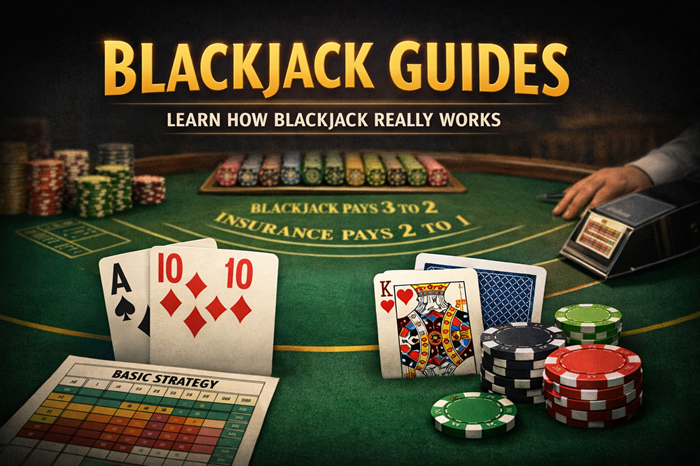
3:2 Payout
Standard, player-friendly blackjack payout.
6:5 Payout
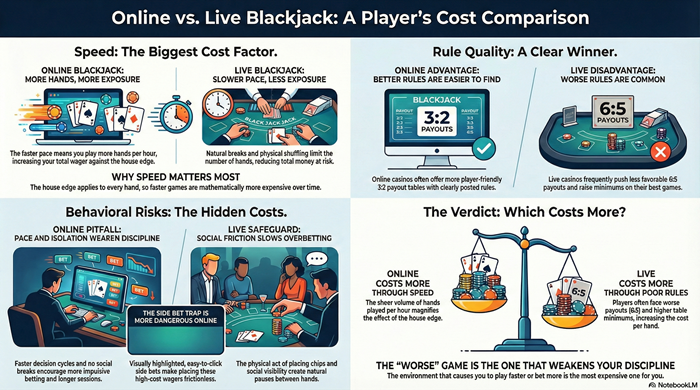
Reduced payout that significantly increases the house edge — often by 1% or more.
A 6:5 table combined with H17 rules creates one of the worst blackjack games available, even if everything else looks standard.
➕ Dealer Rules After Player Actions
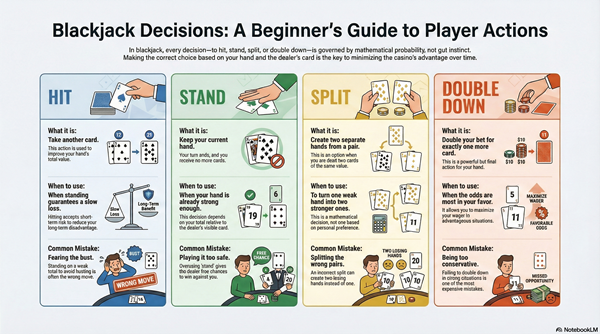
Dealer rules also interact with player options like doubling and splitting.
Important variations include:
- Whether doubling after split (DAS) is allowed
- Whether re-splitting is permitted
- Whether the dealer draws only one card to split Aces
Restrictive rules reduce the value of strong player hands and raise the house edge by limiting profitable situations.
🚪 Dealer and Surrender Rules
Surrender allows players to give up half their bet in certain situations.
Late Surrender
Allowed only after the dealer checks for blackjack.
No Surrender
Player must play out the hand, even when the odds are poor.
Late surrender reduces the house edge slightly when used correctly. Games without surrender force players into high-risk hands that would otherwise be mathematically better to abandon.
🧪 How Multiple Dealer Rules Stack the Edge
The real danger isn’t one bad rule — it’s rule stacking.
A table with:
- H17
- 6:5 payout
- No surrender
- No double after split
…can have a house edge several times higher than a player-friendly table, even when basic strategy is followed perfectly.
Many players never notice this because the game feels the same.
📉 Why Basic Strategy Alone Is Not Enough
Basic strategy minimizes losses under specific rules. Using the wrong strategy chart for the dealer rules in play is a hidden mistake that increases the house edge without any obvious error.
This is why understanding dealer rules comes before memorizing charts or worrying about systems. Strategy must match the game you are actually playing.
📌 How to Use Dealer Rules to Your Advantage
Smart players use dealer rules as a filtering tool.
Before sitting down:
- Check whether the dealer hits or stands on soft 17
- Confirm blackjack payout (3:2 vs 6:5)
- Look for surrender availability
- Review doubling and splitting restrictions
Choosing the right table can be worth more than playing perfectly at the wrong one.
🔚 Final Thought: Rules Are the Real Opponent
In blackjack, you are not fighting the dealer — you are playing against the rules. The dealer simply enforces them.
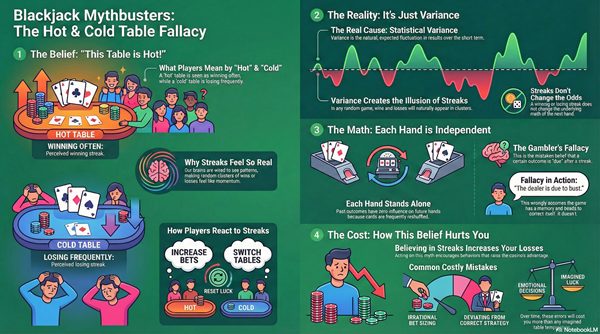
Players who ignore dealer rules blame luck, streaks, or variance for their losses. Players who understand the rules quietly reduce the house edge before the first card is dealt.
That awareness doesn’t make blackjack beatable — but it makes it fairer, calmer, and far less expensive.
🔗 Recommended Internal Links