
What Is the House Edge in Roulette?
🎯📉 The house edge is the single most important concept in roulette — and the one most players misunderstand. People talk about lucky numbers, smart bets, or systems that “manage risk,” but none of that explains why roulette consistently favors the casino.
The reason is simple: every roulette wheel is built with a mathematical advantage that never goes away. That advantage is called the house edge. To understand roulette honestly, you have to understand what the house edge is, where it comes from, and why no betting strategy can remove it.
This article is part of our complete guide on how roulette really works, which explains roulette odds, house edge, wheel types, and why betting systems fail.
What the House Edge Actually Means
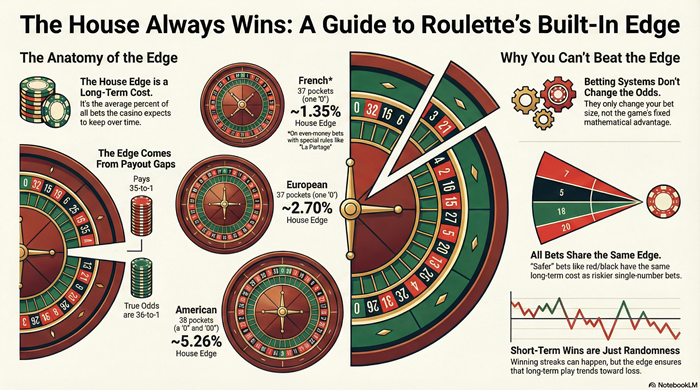
The house edge is the average percentage of every bet the casino expects to keep over time. It is not a fee, a rule you see posted, or something applied after you lose. It is embedded directly into the game’s payouts.
If a roulette game has a 2.7% house edge, that means:
- For every $100 wagered over the long run
- The casino expects to keep about $2.70
- The remaining $97.30 is returned to players as winnings
This does not mean:
- You will lose 2.7% of your bankroll every session
- Losses will be smooth or predictable
- Wins and losses will alternate evenly
The house edge describes long-term cost, not short-term outcomes.
Where the House Edge Comes From in Roulette
Roulette’s house edge exists because payouts do not match true odds.
On a European roulette wheel:
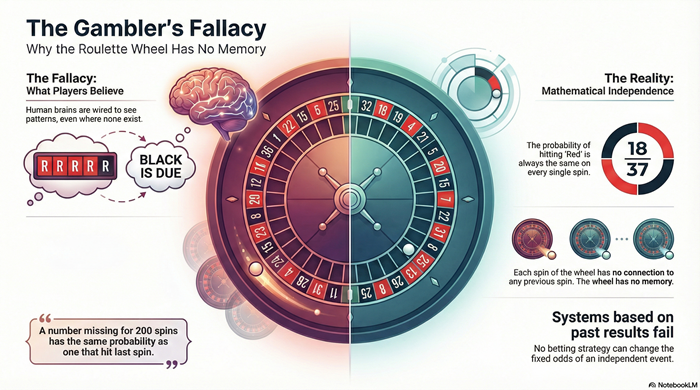
- There are 37 numbers (0–36)
- Each number has a 1 in 37 chance of appearing
A straight-up bet pays 35 to 1, but true odds are 36 to 1. That missing unit is where the casino’s advantage comes from.
This gap exists on every bet, not just single numbers. Whether you bet on red, black, dozens, columns, or corners, the payouts are all slightly worse than the true probability.
That difference is the house edge.
House Edge by Roulette Wheel Type
Not all roulette wheels are equal. The house edge depends primarily on how many zeroes the wheel has.
European Roulette
- 37 numbers (0–36)
- House edge: ~2.70%
- Lowest standard roulette edge
American Roulette
- 38 numbers (0, 00, 1–36)
- House edge: ~5.26%
- Nearly double the cost of European roulette
French Roulette (with special rules)
- Same wheel as European
- Certain rules (like La Partage or En Prison) reduce the edge on even-money bets
- House edge on those bets can drop to about 1.35%
The wheel type matters far more than how you bet.
Why Bet Selection Does Not Change the House Edge
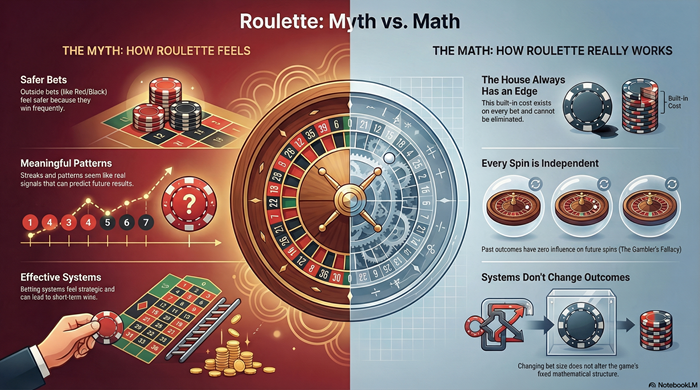
Many players believe that outside bets (red/black, even/odd) are “safer” and therefore better.
They are safer in terms of variance, not value.
All standard roulette bets on the same wheel:
- Share the same house edge
- Differ only in how wins and losses are distributed
Inside bets lose rarely but lose slowly.
Outside bets win often but still lose over time.
No bet eliminates the edge.
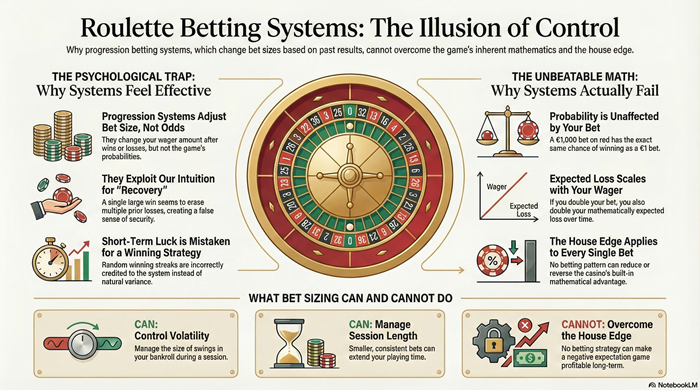
Why Betting Systems Can’t Beat the House Edge
Roulette betting systems attempt to exploit perceived patterns or manage losses. Common examples include:
- Martingale
- Fibonacci
- Labouchere
All of them fail for the same reason: they do not change the underlying odds.
Betting systems can:
- Change bet size
- Increase volatility
- Delay losses
They cannot:
- Eliminate the house edge
- Guarantee profit
- Prevent eventual large losses
Progression systems concentrate risk. When losses arrive — and they always do — they arrive faster and larger.
Short-Term Wins vs Long-Term Cost
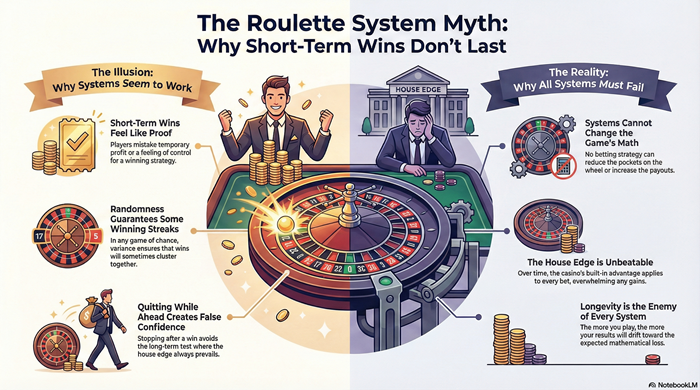
Players often object to the house edge concept by pointing out real wins:
- “I was up for hours.”
- “I hit a big streak.”
- “The system worked last night.”
All of that can happen.
The house edge does not prevent winning sessions. It ensures that long play trends toward loss. Randomness allows for wins; math determines direction.
Short sessions are noisy. Long sessions are expensive.
Why the House Edge Is Unavoidable
The house edge in roulette:
- Is fixed by design
- Applies to every spin
- Does not change with strategy or timing
You cannot “play better” to remove it. You can only:
- Choose a lower-edge wheel
- Limit exposure
- Stop sooner
Understanding the edge does not make roulette beatable. It makes it understandable.
Final Thought: The Edge Is the Game
Roulette doesn’t need tricks to win. The house edge does the work quietly, automatically, and relentlessly.
Once you understand that, roulette stops being a puzzle to solve — and starts being what it actually is: a game with a fixed cost, disguised by randomness.
Related Articles in This Roulette Series