
Beyond the Spin: The Surprising Truth About Why Roulette Wheels Don’t Have Memories
1. Introduction: The Psychology of the Wheel
Roulette is ultimately a game of physics and fixed mathematics, yet watching the ball circle the rim often triggers a deep, instinctive reaction in our minds. We often feel as though we can sense where it might land next, as if the mounting tension in the air provides a secret clue to the coming result. This constant friction between our human desire for intuition and the cold reality of mechanical randomness is what makes the game so captivating and, at times, deeply misleading.
2. The “Due” Factor: Why Streaks Are Just a Mirage
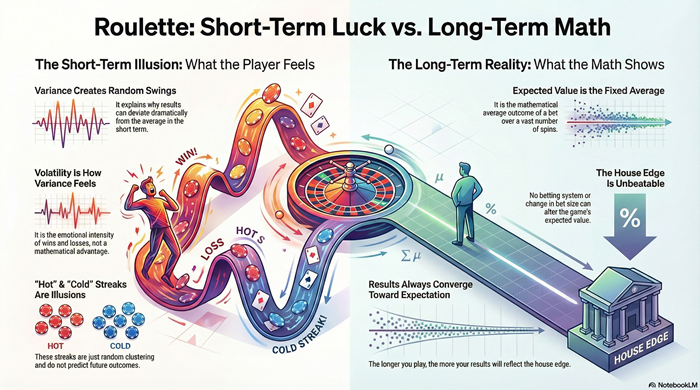
It’s a feeling we’ve all had at the table: the board shows eight blacks in a row, and your brain starts screaming that red is “due.” You might even feel a physical pull to slide your chips onto red because the streak looks “wrong,” as if the wheel is building up pressure that needs to be released. I’ve seen players get genuinely frustrated when a streak continues, but the hard truth is that the wheel doesn’t feel that pressure and it certainly isn’t trying to be “fair.” Any long-term balance you see over thousands of spins happens because of the sheer repetition of the same odds, not because the wheel makes a short-term adjustment to “fix” a lopsided score.
- Each spin is a completely independent event, meaning the physical and mathematical process resets every time the dealer launches the ball.
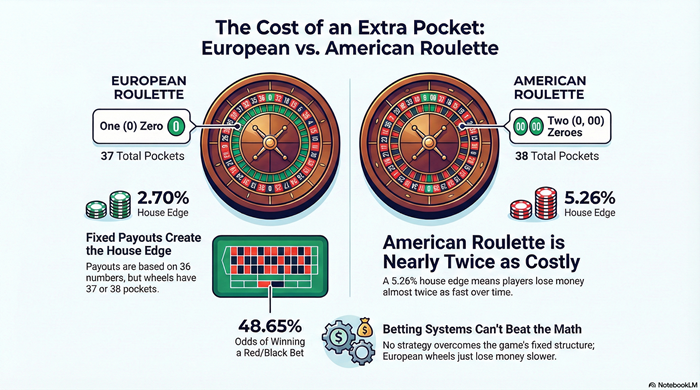
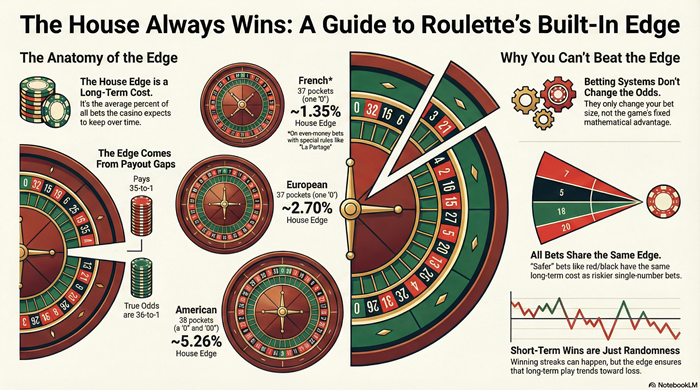
- Because there are 18 red, 18 black, and either one or two green pockets, the presence of that green space ensures that red is always slightly less likely than “not red.”
3. The Trap of the “Flawless” Betting System
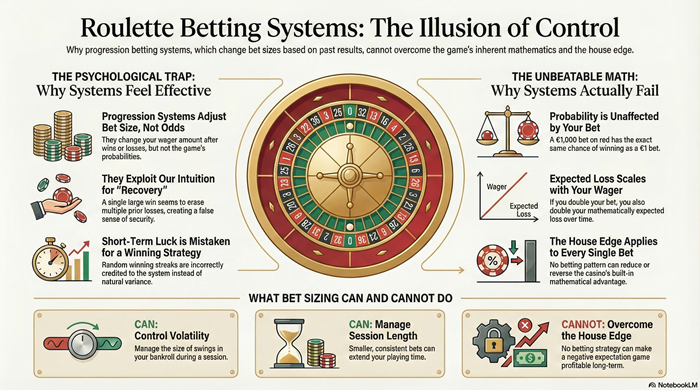
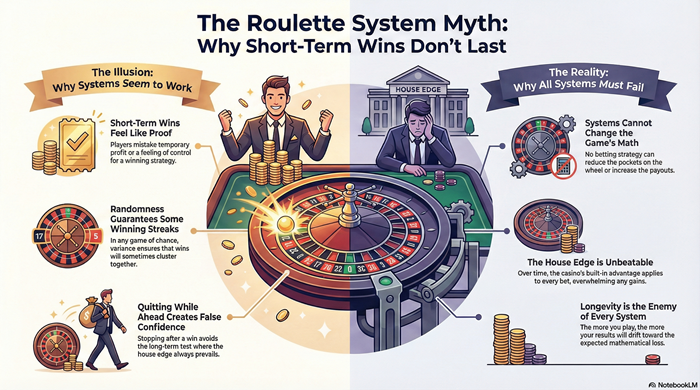
Many players gravitate toward famous strategies like the Martingale or Fibonacci systems because they offer a sense of structure and control in an unpredictable environment. However, while these systems change your “variance”—the size and rhythm of your swings—they can’t touch the house edge that is built into the physical wheel. It’s a tough lesson to learn, but doubling your bet from $10 to $20, then $40, and $80 doesn’t make the next spin more likely to go your way; it simply doubles your exposure to the same mathematical disadvantage. These systems are essentially just reorganizing when you risk your money, rather than changing the fundamental probabilities of the game.
- Rapidly escalating your bets during a losing streak often leads to hitting table limits, which are specifically designed by casinos to stop these “infinite” doubling strategies.
- Managing your bankroll is a helpful way to stay in the game longer and handle your emotions, but it never alters the underlying math of the pockets.
4. Patterns on the Board vs. Reality on the Wheel
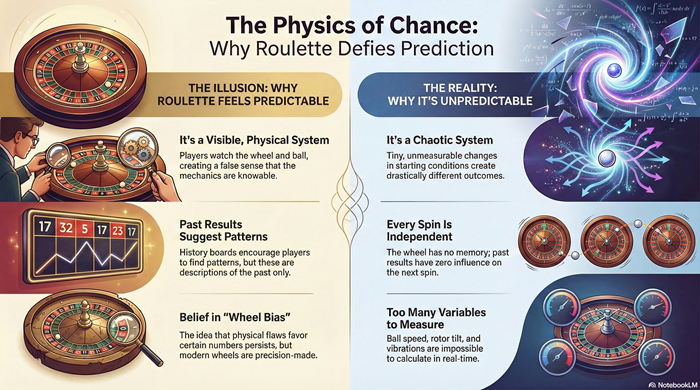
It is a common sight to see players staring at the electronic results board, searching for “zigzags” or clusters as if they were reading a map to a hidden treasure. We are naturally hardwired to find order in chaos—a trait that helps us in daily life but leads us astray when we’re looking at a random distribution of numbers. I’ve watched people track dozens of spins in notebooks, convinced they’ve found a “mode,” but that board is merely a historical record of where the ball has been, not a forecasting tool for where it is going. When you think you see a pattern forming, you’re usually just witnessing your own brain trying to turn a chaotic system into a story.
- Pattern Recognition Bias leads us to believe a specific “zone” on the wheel is active or “hot” when we are actually just seeing normal, random clusters of results.
5. The Myth of the “Hot” Table or Dealer Influence
You might hear someone whisper that a certain dealer can “target” a section of the wheel, but the physics of a modern roulette wheel make that virtually impossible. These wheels are precision-engineered with metal deflectors—often called “diamonds”—and pocket separators that are designed specifically to ensure the ball’s bounce is chaotic and unpredictable. Even if a dealer had a very consistent release, tiny, invisible variations in friction and ball speed change the outcome the moment the ball strikes those deflectors. It’s a classic case of attribution bias, where we want to credit a human for an outcome that is actually decided by the chaotic interaction of wood, metal, and gravity.
- The “human element” of the dealer cannot override the physics of the wheel because micro-variations in speed are too small for the human eye to measure or control.
- Randomness naturally creates clusters of repeated numbers that look like “luck” but are actually statistically normal features of any random sequence.
6. Added Information
An ebook called “Top 10 Myths About Roulette: Streaks, Systems, and the Truth About the Wheel” with more details on this subject is also available for FREE.