
Why Progression Systems and Bet Sizing Can’t Change Roulette Outcomes
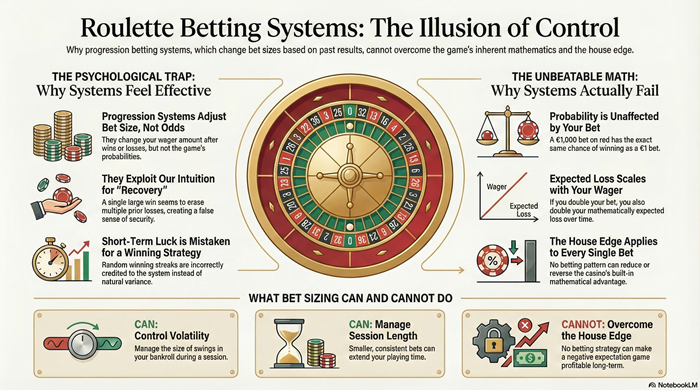
Progression systems feel logical because they focus on when and how much to bet rather than what to bet on. By adjusting stake size after wins or losses, these systems promise to manage risk, recover losses, or lock in gains. The appeal is intuitive—and mathematically irrelevant.
This article is part of our complete guide on How Roulette Really Works: Odds, House Edge, and Why Systems Fail, which explains roulette odds, house edge, wheel types, and why betting systems fail.
What Progression Systems Actually Do
Progression systems change bet size over time based on previous results. They do not change probabilities, payouts, or the structure of the wheel.
Common categories include:
- Increasing bets after losses
- Increasing bets after wins
- Alternating stake size based on streaks
- Resetting after recovery targets
All of these systems operate outside the game’s probability engine.
Bet Size Does Not Affect Probability
In roulette, probability is determined solely by the wheel.
- The chance of red does not change with bet size
- A larger wager does not “push” probability
- Smaller bets do not reduce the house edge
Whether €1 or €1,000 is wagered, the expected loss rate remains the same percentage of the amount bet.
Expected Value Scales Linearly With Bet Size
Expected value grows in proportion to the size of the wager.
- Double the bet → double the expected loss
- Halve the bet → halve the expected loss
Progression systems often feel safer or smarter because losses are delayed or disguised, but the underlying expectation scales exactly with exposure.
Why Loss-Based Progressions Feel Convincing
Loss-based progressions feel logical because they exploit the gambler’s intuition about fairness and recovery. If losses are followed by larger bets, a single win appears to erase multiple losses.
What actually happens:
- Risk is concentrated into fewer, larger bets
- Variance is amplified
- Rare losses become catastrophic
The system does not improve odds. It merely rearranges when losses appear.
Why Win-Based Progressions Feel “Disciplined”
Win-based progressions appeal to restraint. They claim to grow profits slowly while cutting losses early.
In practice:
- Wins during positive variance feel validating
- Losses during negative variance arrive abruptly
- Long-term expectation remains unchanged
Discipline affects emotional experience, not mathematical outcome.
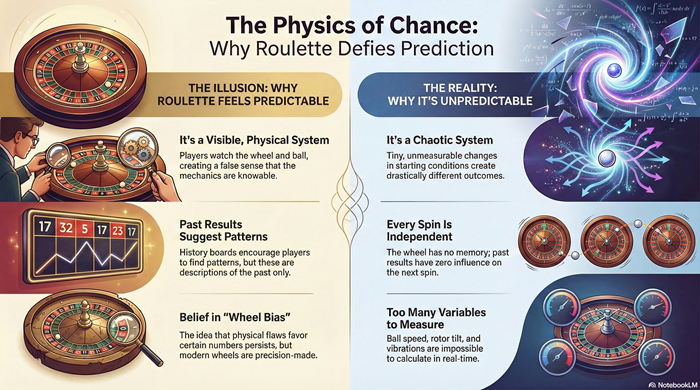
Progressions Confuse Variance With Control
Progression systems often perform well briefly because variance allows favorable runs. Early success is misattributed to structure rather than randomness.
This confusion persists because:
- Short-term wins are vivid
- Long-term losses are abstract
- Systems are abandoned after failure, not tracked
Survivorship bias keeps the illusion alive.
Table Limits Are Not a Design Flaw
Casino table limits are often described as unfair constraints. In reality, they simply expose the risk already present in progression systems.
Limits exist because:
- Bet sizes can grow exponentially
- Losses escalate faster than capital
- Progressions concentrate risk
Limits do not break a winning system. They reveal the absence of one.
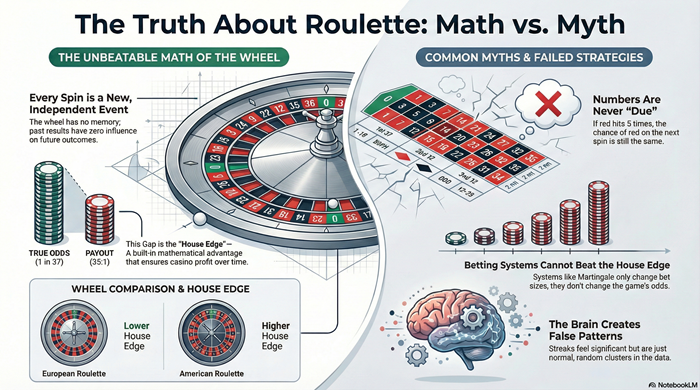
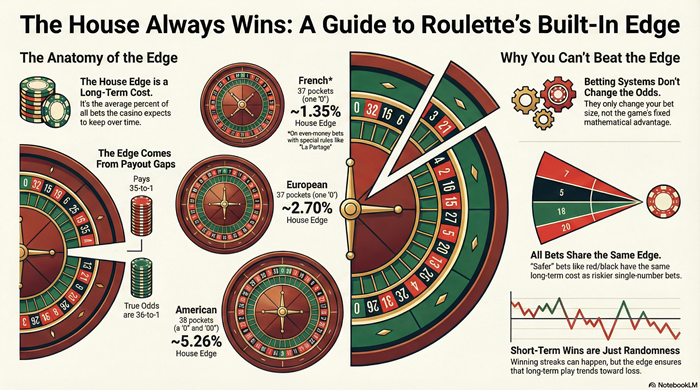
Why No Progression Escapes the House Edge
The house edge is applied to every unit wagered, regardless of timing or size.
Progressions cannot:
- Reduce the house edge
- Reverse expected value
- Exploit independence
They can only change volatility and the distribution of losses.
What Progression Systems Actually Optimize
Progression systems optimize experience, not outcomes.
They may:
- Smooth losses temporarily
- Increase engagement
- Create a sense of method
They do not create advantage.
Why This Matters for Understanding Roulette
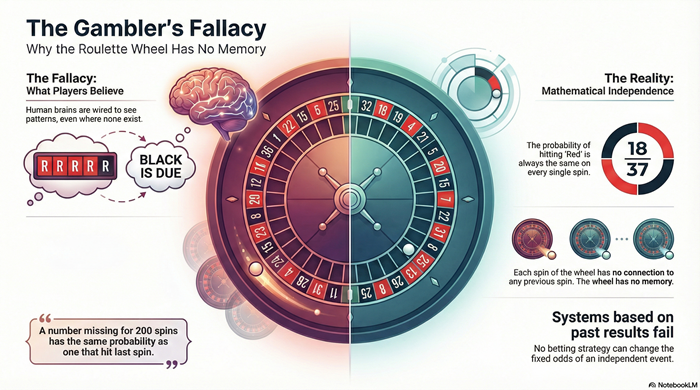
Progression systems persist because they feel rational in a game that feels almost predictable. Understanding why they fail clarifies a broader truth about roulette.
Roulette does not respond to:
- Timing
- Bet size
- Persistence
It responds only to structure.
What Bet Sizing Can and Cannot Do
Bet sizing can:
- Control volatility
- Shape emotional comfort
- Manage session length
Bet sizing cannot:
- Change probability
- Improve expectation
- Overcome the house edge
Recognizing this boundary ends the search for mechanical solutions.