
Myths About Craps That Refuse to Die: Hot Shooters, Cold Tables, and Pattern Watching
This article is part of our complete guide on How Craps Really Works: Dice Probability, Bets, and Why Myths Persist , which explains craps probability, house edge, variance, and why common myths fail.
Why Craps Myths Are So Persistent
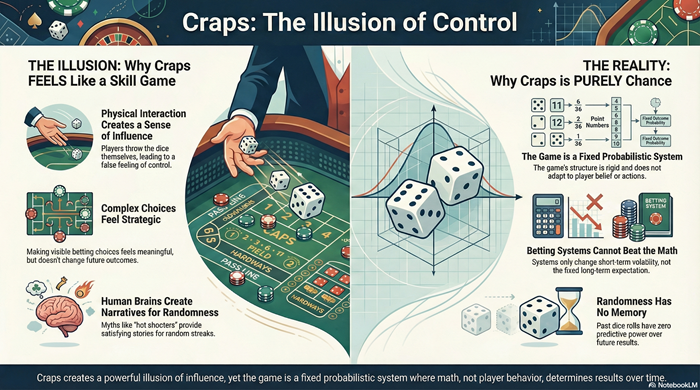
Craps myths do not survive because players fail to understand the math. They survive because the game produces experiences that feel contradictory, emotional, and meaningful.
Uneven probability, high variance, and social reinforcement combine to create outcomes that demand explanation. When randomness feels unsatisfying, narrative fills the gap.
Myths are not errors of intelligence. They are responses to uncertainty.
The Myth of the Hot Shooter
What Players Believe
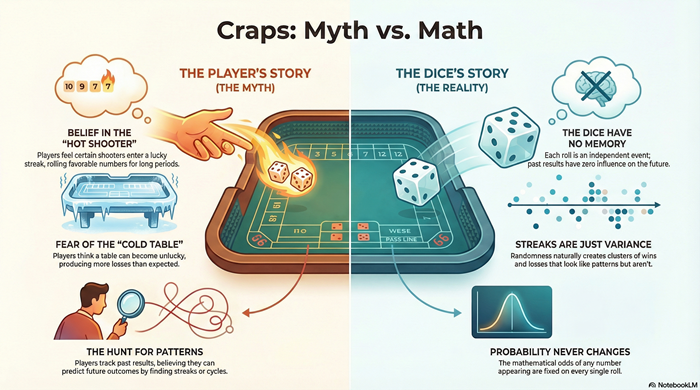
The hot shooter myth holds that certain shooters enter a state where they are more likely to roll favorable numbers for an extended period.
Long rolls, clustered outcomes, and group excitement reinforce this belief.
Why the Myth Feels Convincing
Long sequences without a seven are rare but inevitable in a high-variance environment.
When such sequences occur:
- they feel extraordinary
- they are socially amplified
- they are remembered far longer than ordinary rolls
The shooter becomes the focal point, even though nothing about the dice has changed.
The Mathematical Reality
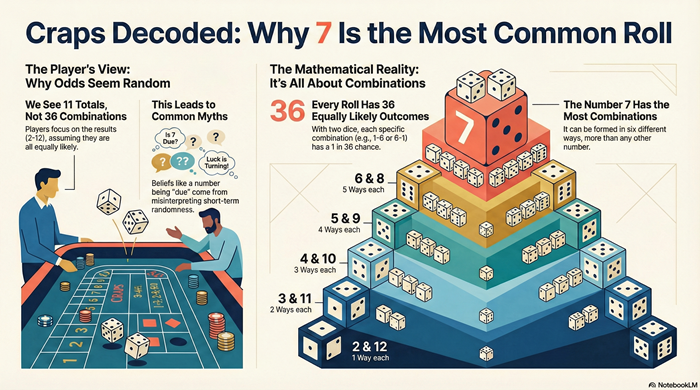
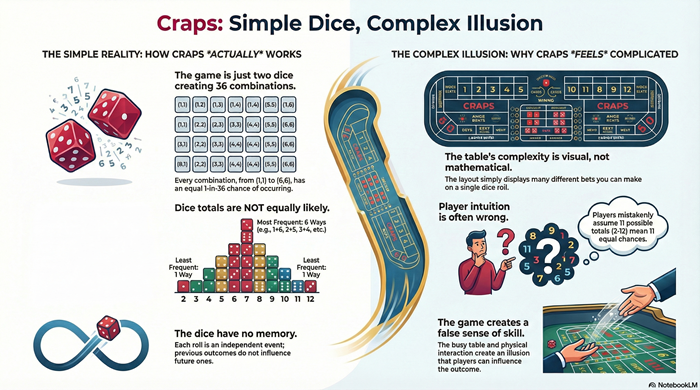
Dice have no memory.
The probability of each outcome remains fixed on every roll, regardless of who throws the dice or what has happened previously.
A long roll does not make the next roll more likely to continue. It only makes the past look impressive.
The Myth of the Cold Table
What Players Believe
A cold table is believed to be one where unfavorable outcomes occur more frequently than expected, signaling that players should avoid participation or wait for conditions to improve.
Why the Myth Persists
Variance naturally produces clusters of negative outcomes.
In short sequences:
- losses can stack quickly
- favorable outcomes can temporarily disappear
- results can feel hostile or “stuck”
When this happens publicly and repeatedly, players infer intent.
Why the Table Cannot Be Cold
The table has no state.
Dice rolls are independent. A run of losses does not increase the likelihood of future losses, nor does it require correction.
What players call a cold table is simply variance expressed unevenly.
Pattern Watching and Number Tracking
The Illusion of Cycles
Pattern watching involves tracking recent outcomes to predict future ones—looking for repetitions, alternation, or missing numbers.
This behavior is inevitable. The human brain is a pattern-detection system.
Why Patterns Are Misleading
Random sequences always contain apparent patterns.
Given enough rolls:
- streaks will appear
- gaps will form
- clusters will develop
These patterns describe history, not probability.
Why Tracking Fails Predictively
In an independent system:
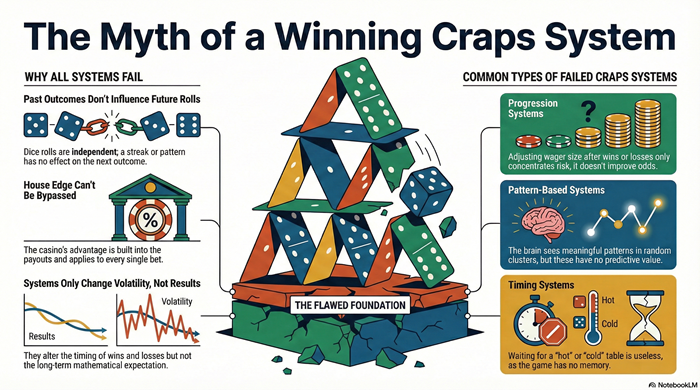
- past outcomes provide no information about future ones
- absence does not create obligation
- repetition does not reduce likelihood
Tracking produces data without leverage.
Why Evidence Rarely Eliminates Belief
Even when players intellectually understand independence and probability, belief survives because:
- variance occasionally confirms expectation
- wins are emotionally memorable
- losses are reframed or discounted
This selective reinforcement allows myths to persist without being consistently tested.
The Social Reinforcement Effect
Craps myths are shared publicly.
Group reactions, collective wins, and table energy amplify belief. Confidence is rewarded socially, while skepticism is quiet.
When belief is communal, it becomes resistant to correction.
What All Craps Myths Have in Common
Every major craps myth depends on denying or softening at least one core truth:
- dice rolls are independent
- probability does not self-correct
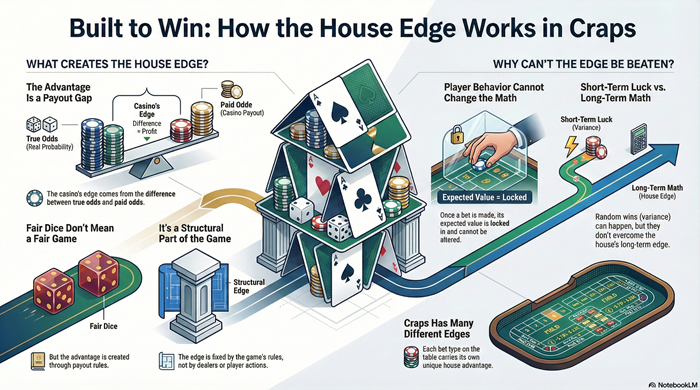
- house edge is structural
- variance dominates short-term experience
The stories differ. The misunderstanding does not.
Understanding Myths Without Dismissing Players
Myths are not foolish. They are human.
People prefer stories to statistics, agency to randomness, and meaning to noise.
Understanding craps requires replacing narrative with mechanism, not ridicule.
What Understanding Actually Changes
Understanding craps does not eliminate variance, emotion, or unpredictability.
It removes false explanations.
The game does not change. Perspective does.
Related Pages
- How Craps Really Works: Dice Probability, Bets, and Why Myths Persist
- Are Dice Rolls Independent in Craps? Why Previous Rolls Don’t Matter
- Variance in Craps: Why Results Swing Wildly Even When Odds Are Fixed
- Why Craps Looks Like a Skill Game (But Isn’t): Complexity, Rituals, and Control Illusions
- Common Craps Systems Explained—and Why They Fail Mathematically