
STOP GAMBLING ON GHOSTS: The Truth About the Craps Table

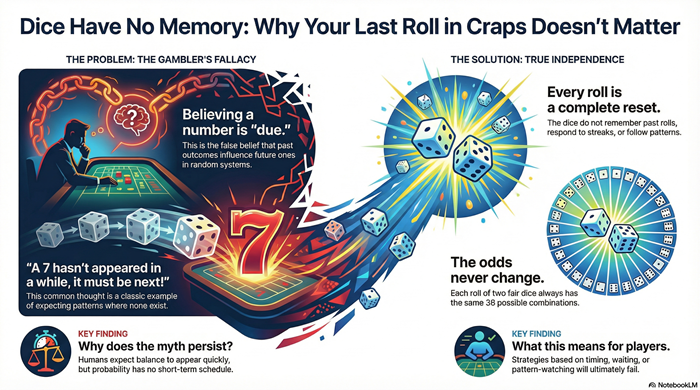
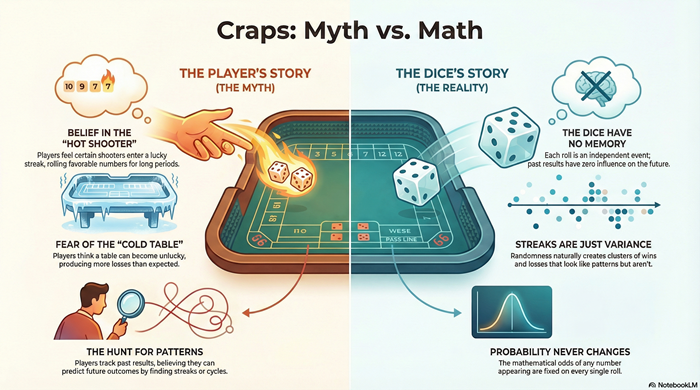
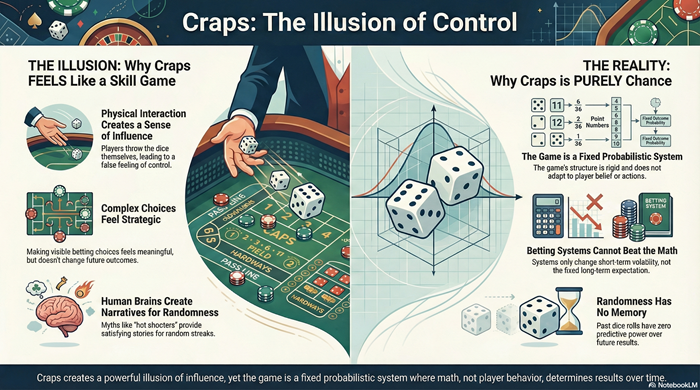
You’re standing at the rail. The table is screaming. The “hot shooter” has held the dice for twenty minutes, and the chips are piling up. You feel it—that electric “momentum” telling you the next roll must be a winner.
Stop right there.
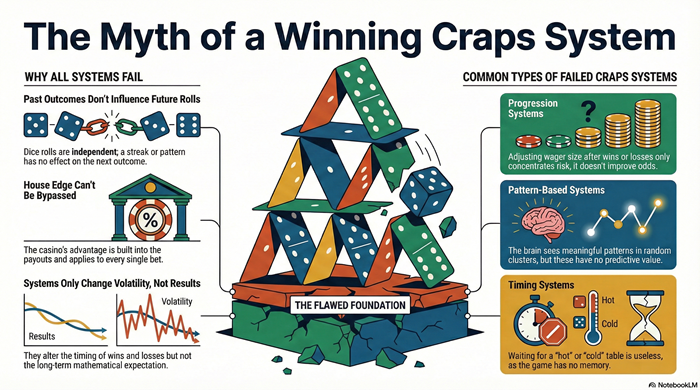
That feeling is exactly what the casino counts on. While you’re riding the emotional high, your bankroll is being bled dry by an illusion of control that has no basis in physics or math. To survive the pit, you must shatter the “casino floor wisdom” that leads to certain failure. To win, you must first unlearn the lies.
The Conflict: Emotion vs. Mechanical Reality
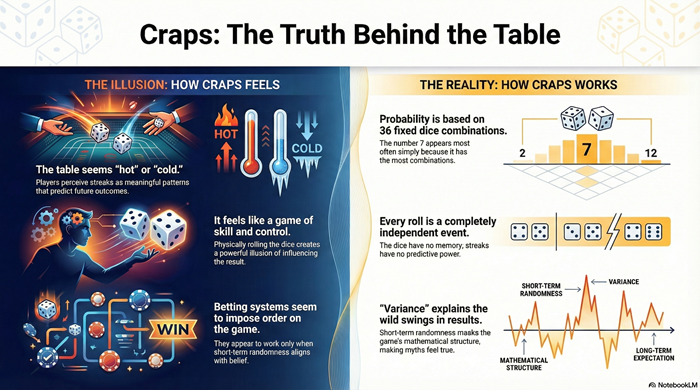
The human brain is biologically wired to find patterns where none exist. In the high-stakes environment of a craps pit, this psychological trait is a liability. Players fail because they cannot distinguish between “Table Energy” (social noise) and “Mechanical Reality” (fixed math).
This book dismantles the psychological death traps that sabotage your bankroll:
- The Gambler’s Fallacy: Believing the dice “owe” you a result.
- Streak Clustering: Mistaking normal randomness for a “wave” of luck.
- External Attribution Bias: Blaming the dealers for a “cold table” instead of the 1-in-6 probability of a seven.
These misconceptions feel convincing when the crowd is roaring, but they evaporate against fixed probabilities.
The Myth-Busting Breakdown: What You’ll Learn
This book is your diagnostic tool for survival. We strip away the superstition to reveal the game’s actual architecture.
- Myth 1: The “Hot Shooter” Delusion. Every roll is an independent event. The dice have no memory. Bottom Line: Chasing “momentum” is the fastest way to over-leverage your position on a roll that resets every time it leaves the hand.
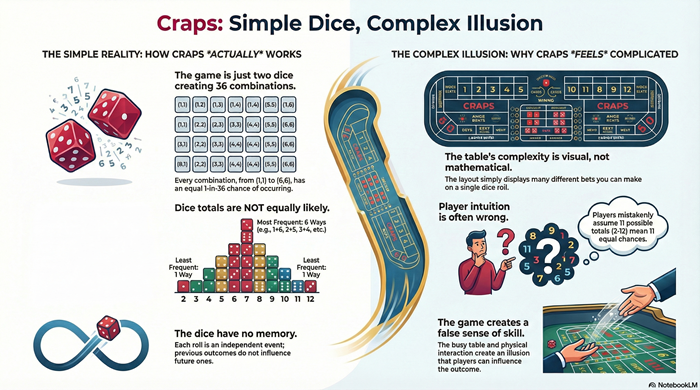
- Myth 2: The Dice Control Trap. Proponents claim “skill” can beat the house. Bottom Line: The casino’s back wall is weaponized randomness. The rubber pyramids are engineered specifically to ensure every rebound is chaotic.
- Myth 3: The Starting “Set” Fallacy. Lining up the faces of the dice looks disciplined. Bottom Line: The orientation doesn’t survive the tumble, the felt, or the back wall. The starting face is irrelevant to the final result.
- Myth 5: The “Due” Seven. Probability does not have a balancing scale. Bottom Line: The odds of a seven are 1 in 6 on every single roll. It is never “due” just because it has been absent.
- Myth 8: The Hardways Value Trap. The 9-to-1 payout is a siren song for suckers. Bottom Line: These bets carry a punishing house edge of 9%+, making them a “social tax” compared to smarter base bets.
- Myth 9: The “Bad Karma” Bet. Don’t let social pressure dictate your strategy. Bottom Line: Betting “Don’t Pass” is a mathematically superior bet with a 1.36% house edge compared to the Pass Line’s 1.41%.
The Architecture of the House Edge
Mastery is found in the numbers, not the noise. The house doesn’t need “luck”—they have Back Wall Mechanics.
The physical design of the table is your greatest adversary. Those rubber pyramids on the back wall are specifically shaped to break up any smooth bounce or predictable spin. This mechanical reality proves that “dice setting” is a fantasy; the house has engineered the table for maximum disruption of predictability.
When you realize the mathematical truth that a Hardway (9%+) is nearly seven times more expensive than a Don’t Pass bet (1.36%), you stop playing for the thrill and start playing for the win.
Conclusion: Change How You See the Roll
The dice have no memory, but a prepared player must. This book does not offer a “system” to beat the house; it provides the exceptional clarity needed to separate social noise from statistical truth.
Stop paying the “ignorance tax” at the table. Stop betting on ghosts. also see more on this topic with teh FREE Google Book “Top 10 Myths About Craps: Hot Shooters, Dice Control, and the Truth About the Roll” and also out on Audiobook.