
What a Sports Bet Really Is
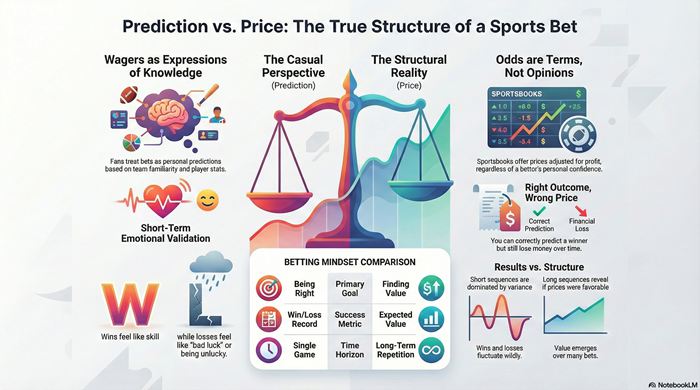
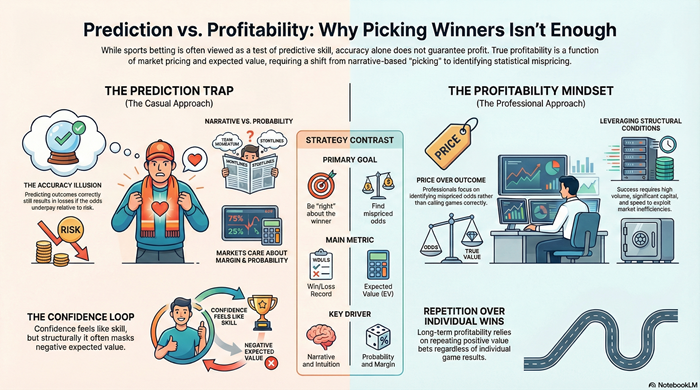
Most people think a sports bet is a prediction. You look at a matchup, decide who you believe will win, and place a wager to express that belief.
Structurally, that is not what a sports bet is.
A sports bet is a priced probability. The prediction already exists before the bettor arrives. The odds represent a number assigned to an outcome, adjusted to include a margin in favor of the sportsbook. When a bet is placed, the bettor is not testing whether they are right about the game. They are accepting a price.
This distinction matters because confusion between prediction and pricing drives most long-term losses in sports betting.
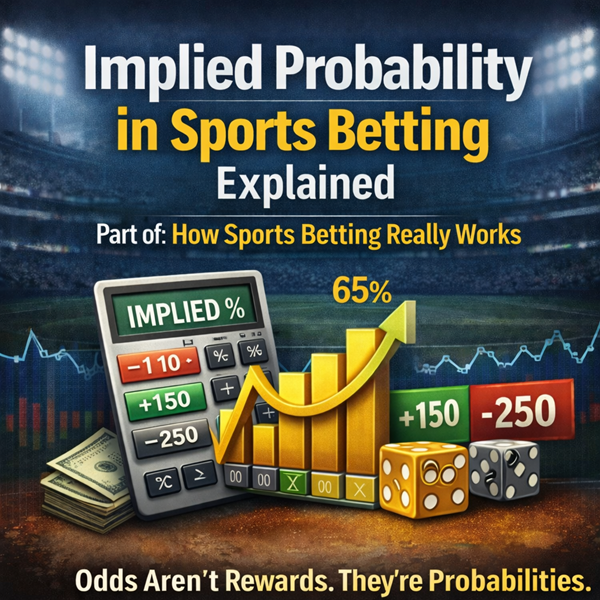
This article is part of a broader educational guide explaining how sports betting works at a structural level, including odds pricing, expected value, variance, and why certain bets are inherently risky. For the full overview, see How Sports Betting Really Works: Odds, Expected Value, and Why Parlays Are So Dangerous.
Odds Are Prices, Not Opinions
When sportsbooks post odds, they are not asking for opinions. They are offering terms.
Those terms are created by estimating how often an outcome is likely to occur and then adjusting that estimate to ensure profitability. Once posted, odds are adjusted based on betting activity, not belief in the outcome itself.
This means two important things are true at the same time:
- A bettor can correctly predict the outcome and still accept a bad price
- A bettor can lose a wager even when the price itself was reasonable
The outcome determines whether a bet wins or loses. The price determines whether the bet makes sense over time.
Why Being Right Feels Like the Goal
Sports are familiar. Fans spend years forming opinions about teams, players, and situations. When betting is layered on top of that familiarity, it feels natural to treat wagers as expressions of knowledge.
If the team wins, the bet feels validated. If the team loses, the bet feels unlucky.
What this framing misses is that betting is not scored by accuracy alone. It is scored by whether the odds offered enough compensation for the risk taken. That question is rarely asked in casual betting.
Pricing Exists Before the Bettor
A key structural feature of sports betting is that prices exist independently of individual bettors.
The odds do not change because one person believes strongly in an outcome. They change when enough money enters the market to require adjustment. By the time most bettors place a wager, the price already reflects a wide range of information and assumptions.
This is why confidence does not translate into advantage. Confidence affects the decision to bet, not the terms of the bet.
Outcomes Are Short Term, Prices Are Long Term
A single game result is a short-term event. Prices are designed to work over repetition.
This is why it is possible to win often and still lose money, or to lose frequently and still make sound decisions. Short sequences are dominated by variance. Long sequences reveal whether prices were favorable.
When betting decisions are evaluated only by outcomes, this distinction disappears. Everything becomes emotional and immediate. When decisions are evaluated by price, structure becomes visible.
Why This Reframing Matters
Once a sports bet is understood as a priced probability rather than a prediction, many common frustrations begin to make sense.
- Winning does not always mean a good bet was made
- Losing does not always mean a mistake occurred
- Confidence and effort do not override pricing
- Short-term results are unreliable indicators
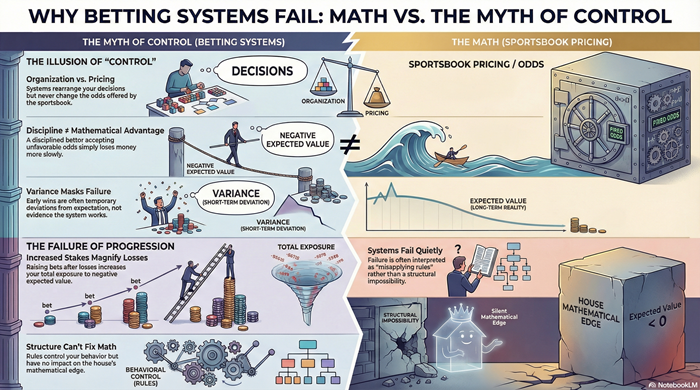
This reframing does not make betting profitable. It makes betting comprehensible.
Understanding what a sports bet really is is the foundation for understanding odds, vig, expected value, variance, and why certain bets—especially parlays—are structurally dangerous.