
Why Betting Systems Fail in Sports Betting
Betting systems are everywhere. Some promise discipline. Others promise structure. Many claim to remove emotion by replacing judgment with rules.
What they all share is a common assumption: that organization can overcome pricing.
It can’t.
Betting systems fail not because bettors apply them incorrectly, but because systems do not change the underlying mathematics of sports betting. They rearrange decisions without altering expectation.
This article is part of a broader educational guide explaining how sports betting works at a structural level, including odds pricing, implied probability, expected value, variance, and why certain bets are inherently risky. For the full overview, see How Sports Betting Really Works: Odds, Expected Value, and Why Parlays Are So Dangerous.
What Betting Systems Actually Do
A betting system is a set of rules that determines when and how bets are placed. It may dictate stake size, selection filters, timing, or progression.
What it does not do is change the price offered by the sportsbook.
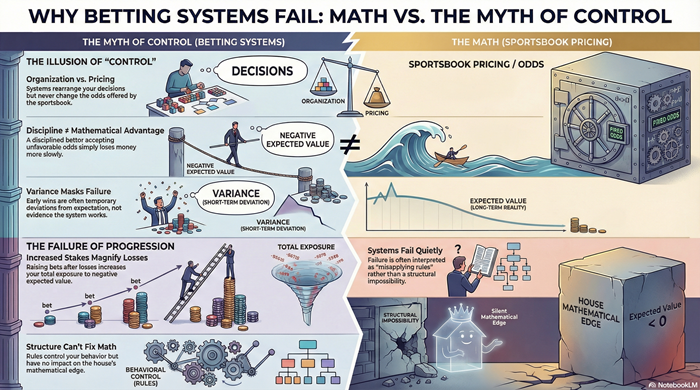
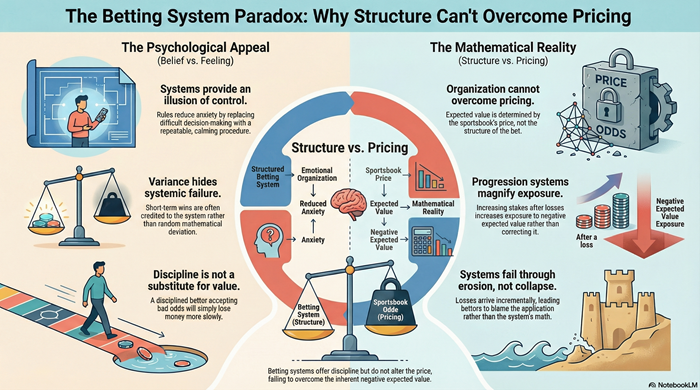
Odds remain the same regardless of how disciplined, consistent, or logical the system feels. Expected value is determined by pricing, not by structure.
Systems organize bets. They do not improve them.
Why Structure Feels Like Control
Sports betting is emotionally noisy. Wins and losses arrive constantly. A system feels calming because it replaces decision-making with procedure.
This sense of control is compelling.
- Rules reduce anxiety
- Consistency feels responsible
- Losses feel part of a plan
- Wins feel validated by discipline
Unfortunately, emotional comfort has no relationship to mathematical advantage.
Why Progression Systems Are Especially Misleading
Many betting systems focus on stake progression. Losses trigger increased bets. Wins reset the cycle.
These systems feel logical because they mirror everyday problem-solving: apply more effort after failure, relax after success.
Structurally, they do nothing to improve odds.
Increasing stakes increases exposure to negative expected value. Over time, progression systems magnify losses rather than correcting them.
Variance may delay failure. It cannot prevent it.
Why Systems Appear to Work Temporarily
Betting systems often appear successful at first. This is not because they work. It is because variance allows short-term deviation from expectation.
Early wins reinforce belief. Near misses feel encouraging. Losses are explained as temporary drawdowns.
The system is credited for success. Variance is blamed for failure.
This reversal sustains belief long enough for losses to accumulate gradually rather than dramatically.
Why Discipline Does Not Equal Value
Discipline is often presented as the missing ingredient in betting success. Bet less emotionally. Follow the rules. Stick to the system.
Discipline controls behavior. It does not change pricing.
A disciplined bettor accepting unfavorable odds will lose money more slowly, not avoid losses altogether. Reduced chaos is mistaken for improvement.
Why Systems Fail Quietly
Betting systems rarely collapse in obvious ways. They erode.
Losses arrive incrementally. Confidence fades slowly. Adjustments are made. New systems replace old ones.
Because there is no single breaking point, failure is interpreted as misapplication rather than structural impossibility.
The system is abandoned. The belief in systems survives.
Why Understanding This Matters
Once it is clear that systems cannot overcome pricing, many familiar patterns become obvious.
- Rules do not change expectation
- Progression increases risk, not value
- Discipline controls emotion, not outcomes
- Variance masks failure long enough to sustain belief
Betting systems do not fail because they are poorly designed. They fail because they attempt to solve a problem that structure does not allow to be solved.
Understanding this does not make betting profitable. It makes belief unnecessary.
And removing belief is often the first step toward clarity.