
How Sportsbooks Set Odds
Sportsbook odds often feel like predictions. When a line looks sharp or accurate, it’s easy to assume the sportsbook “knew” what was going to happen.
That assumption is wrong.
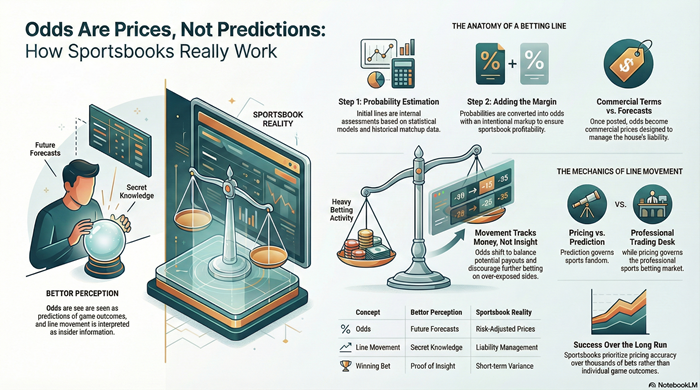
Sportsbooks are not in the business of predicting outcomes. They are in the business of pricing risk. Odds are tools used to manage exposure, balance markets, and ensure a margin over time — not forecasts of the future.
This article is part of a broader educational guide explaining how sports betting works at a structural level, including odds pricing, expected value, variance, and why certain bets are inherently risky. For the full overview, see How Sports Betting Really Works: Odds, Expected Value, and Why Parlays Are So Dangerous.
Odds Start as Probability Estimates
Every betting line begins with an estimate of probability. That estimate may come from statistical models, historical data, matchup factors, or combinations of all three.
At this stage, the number represents an internal assessment of how often an outcome is expected to occur. It is not yet a betting price. It is a starting point.
Crucially, this estimate does not need to be perfect. It only needs to be good enough to support pricing once adjustments are made.
Pricing Comes After Estimation
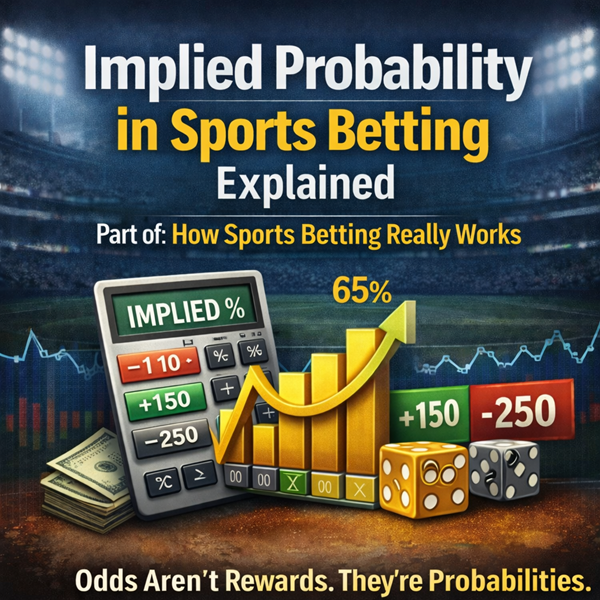
Once an estimated probability exists, it is converted into odds. This conversion introduces a margin in favor of the sportsbook.
That margin is intentional and unavoidable. It ensures that, regardless of which outcome occurs, the sportsbook collects more in wagers than it pays out over time.
At this point, odds stop being neutral descriptions of likelihood and become commercial terms.
Why Odds Move After They’re Posted
Odds do not remain static. They move in response to betting activity.
If a large amount of money is placed on one side of a market, the sportsbook may adjust the line. This adjustment is not a reaction to new insight about the game. It is a response to risk exposure.
Line movement serves several purposes:
- It discourages additional money on the same side
- It attracts money to the opposing side
- It balances potential payouts
This is why line movement reflects market behavior, not secret knowledge.
What Line Movement Actually Means
When odds shift, many bettors interpret the movement as confirmation. If the line moves in their direction, they feel validated. If it moves against them, they feel late or wrong.
Structurally, neither reaction is justified.
Line movement indicates that money entered the market. It does not indicate that the new price is more accurate or more favorable for bettors. In fact, reacting after a move often means accepting worse terms than were previously available.
Why “Sharp” and “Public” Narratives Mislead
Sports betting culture often divides money into “sharp” and “public” categories. Sharp money is assumed to be informed. Public money is assumed to be emotional.
While these labels are popular, they are frequently overstated. Sportsbooks adjust lines based on volume and liability, not moral judgments about bettors.
By the time a bettor notices a narrative about smart money, the market has already responded. The price reflects the activity, not the identity of the participants.
Odds Are Designed for the Long Run
Sportsbooks do not need odds to be perfect for individual games. They need pricing to work over thousands of bets.
This is why sportsbooks can be wrong about specific outcomes and still profitable. The margin embedded in prices ensures that short-term errors do not threaten long-term results.
Understanding this helps explain why sportsbooks tolerate occasional losses and do not panic when favorites win or underdogs cover.
Why This Matters for Bettors
Believing that odds are predictions leads to frustration. Believing they are prices leads to clarity.
Once odds are understood as tools for managing risk rather than forecasts of outcomes, several misconceptions fall away:
- A winning bet does not prove insight
- A losing bet does not imply ignorance
- Line movement does not signal certainty
- Timing affects price, not truth
This understanding does not create an edge. It creates perspective.
Pricing governs sports betting. Prediction governs sports fandom. Confusing the two is costly.