
Expected Value vs Being Right in Sports Betting
One of the most common frustrations in sports betting sounds like this: “I keep picking the right teams, but I’m not making money.”
That frustration comes from a misunderstanding of what betting actually rewards.
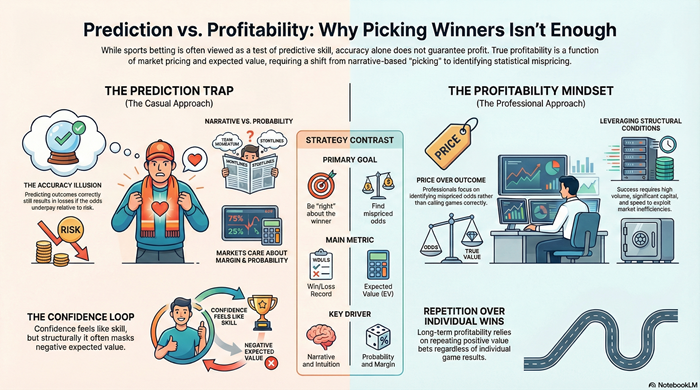
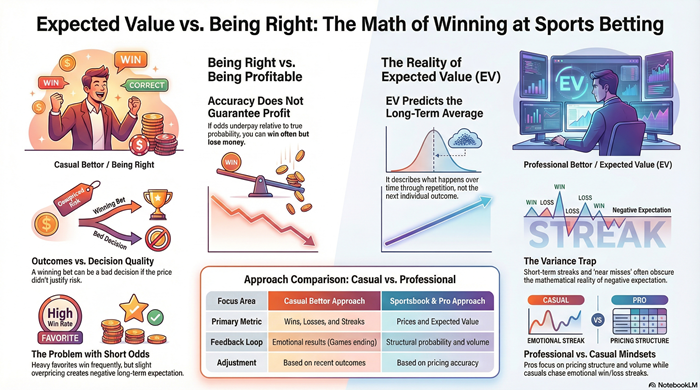
In sports betting, being right and making a good bet are not the same thing. Outcomes determine whether a wager wins or loses. Expected value determines whether betting decisions make sense over time.
This article is part of a broader educational guide explaining how sports betting works at a structural level, including odds pricing, implied probability, variance, and why certain bets are inherently risky. For the full overview, see How Sports Betting Really Works: Odds, Expected Value, and Why Parlays Are So Dangerous.
What Expected Value Actually Means
Expected value describes the average result of a bet if it were placed repeatedly under the same conditions.
It does not predict what will happen next. It does not guarantee outcomes. It describes what happens over time.
If a bet has negative expected value, it will lose money on average across repetition, even if it wins frequently in the short term. If a bet has positive expected value, it will generate profit on average, even if it loses often in the short term.
This is uncomfortable because it separates decision quality from immediate results.
Why Being Right Isn’t Enough
Sports betting feels like it should reward accuracy. If you predict winners more often than losers, profit feels deserved.
The problem is pricing.
Odds determine how much you are paid when you are right. If the odds underpay relative to true probability, correct predictions can still produce negative results.
This is especially visible with short odds:
- Heavy favorites win often
- Payouts are small
- Even slight overpricing creates negative expectation
A bettor can feel skilled, confident, and accurate while slowly losing money.
Winning Bets Can Still Be Bad Bets
A winning bet feels validating. It feels like proof.
Structurally, it isn’t.
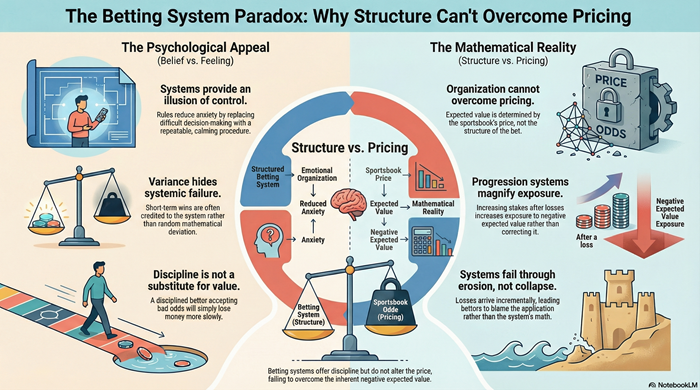
A bet can win today and still be a losing decision if the odds did not justify the risk taken. The outcome does not retroactively change the price.
This is why short winning streaks are such poor indicators of betting quality. Variance dominates short sequences. Expected value only reveals itself over longer horizons.
Losing Bets Can Still Be Good Decisions
The opposite is also true, and far harder to accept.
A bet can lose and still be a sound decision if the price fairly compensated for the probability. Loss does not imply error.
This distinction is why professional betting ignores individual outcomes. Results are noisy. Pricing is structural.
Casual betting often reverses this logic, treating wins as validation and losses as mistakes. That reversal reinforces misunderstanding.
Why Expected Value Is So Often Ignored
Expected value is abstract. It offers no emotional reward in the moment.
Sports betting provides constant feedback. Games end. Results arrive. Emotion fills the gap between decision and outcome. Expected value does not participate in that cycle.
Because of this, many bettors acknowledge expected value intellectually while ignoring it behaviorally.
- They track wins and losses, not prices
- They chase streaks, not expectation
- They adjust based on outcomes, not structure
Sportsbooks do the opposite. They ignore outcomes and focus entirely on expectation across volume.
The Role of Variance in Confusion
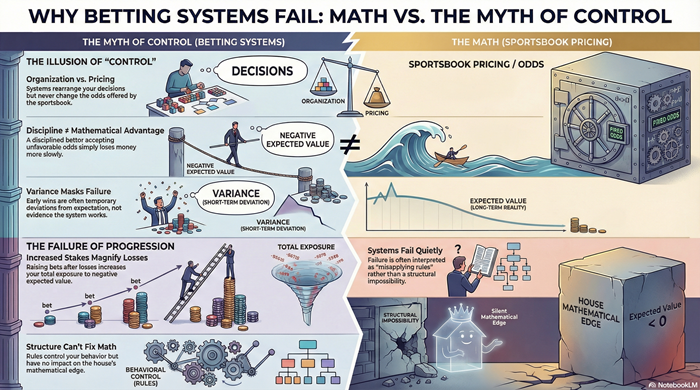
Variance obscures expected value in the short term.
Negative expectation does not produce immediate losses. It produces eventual losses. Along the way, variance creates winning streaks, near misses, and confidence spikes.
This is why many bettors believe expected value is theoretical rather than practical. Their lived experience contradicts the math—temporarily.
Over enough repetition, that contradiction disappears.
Why This Distinction Changes Everything
Once expected value is understood, many long-standing frustrations lose their mystery.
- Winning does not prove skill
- Losing does not prove ignorance
- Confidence does not override pricing
- Accuracy does not guarantee profitability
Sports betting stops being a referendum on intelligence and becomes what it actually is: a pricing system governed by probability.
Understanding expected value does not make betting profitable. It makes outcomes interpretable.
And interpretation is the first step toward clarity.