
Variance in Sports Betting Explained
One of the most confusing aspects of sports betting is how inconsistent results feel. Long winning streaks appear without warning. Extended losing stretches arrive just as confidence peaks. Outcomes seem to contradict logic, effort, and experience.
This confusion is not a flaw in sports betting. It is the result of variance.
Variance explains why results fluctuate, why bad bets can win, why good bets can lose, and why confidence often rises at exactly the wrong time.
This article is part of a broader educational guide explaining how sports betting works at a structural level, including odds pricing, implied probability, expected value, and why certain bets are inherently risky. For the full overview, see How Sports Betting Really Works: Odds, Expected Value, and Why Parlays Are So Dangerous.
What Variance Actually Is
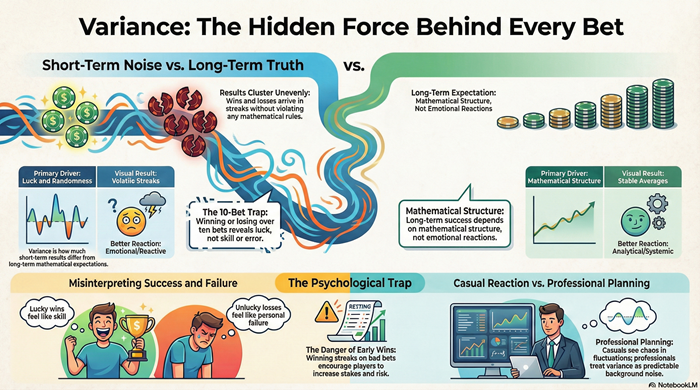
Variance describes how much short-term results can differ from long-term expectation.
It does not change probabilities. It does not alter expected value. It determines how outcomes are distributed over time.
Even when odds are fixed and expectation is stable, results will cluster unevenly. Wins arrive together. Losses arrive together. Long stretches deviate from the average without violating any mathematical rules.
This is why betting outcomes feel emotional rather than mechanical.
Why Variance Feels Personal
Sports betting produces constant feedback. Every game ends. Every bet resolves. Each result feels like commentary on the decision that preceded it.
Variance turns this feedback into noise.
- A lucky win feels like skill
- An unlucky loss feels like failure
- A streak feels meaningful even when it isn’t
Because variance operates invisibly, bettors often assign meaning where none exists.
Why Losing Strategies Can Look Successful
Variance allows negative expected value strategies to produce winning streaks.
This is one of the most dangerous aspects of sports betting. Early success feels earned, especially when it aligns with research, confidence, or intuition. That success encourages increased stakes, added complexity, or riskier bets.
The problem is not that the wins are fake. The problem is that they are temporary.
Variance delays the appearance of expected value. It does not cancel it.
Why Short-Term Results Are Misleading
Short-term results are dominated by variance, not expectation.
This is why judging betting performance over small samples leads to false conclusions. Winning over ten bets does not imply skill. Losing over ten bets does not imply error.
Expected value reveals itself slowly. Variance reveals itself immediately.
Most bettors respond to what they can see rather than what governs outcomes.
Why Variance Reinforces Bad Habits
Variance does not operate evenly. It rewards persistence emotionally while punishing it mathematically.
- Wins arrive sporadically and reinforce belief
- Losses arrive in clusters and feel unfair
- Near-misses create motivation without reward
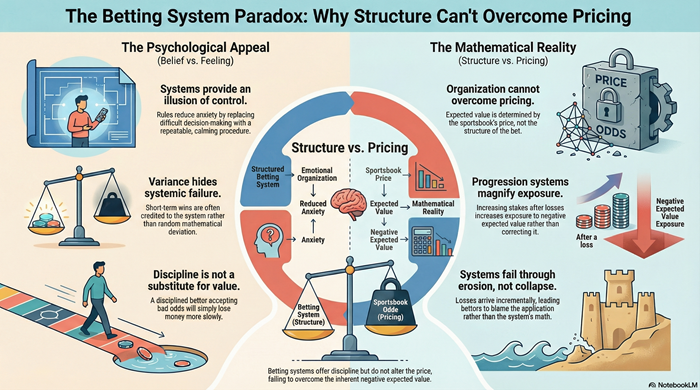
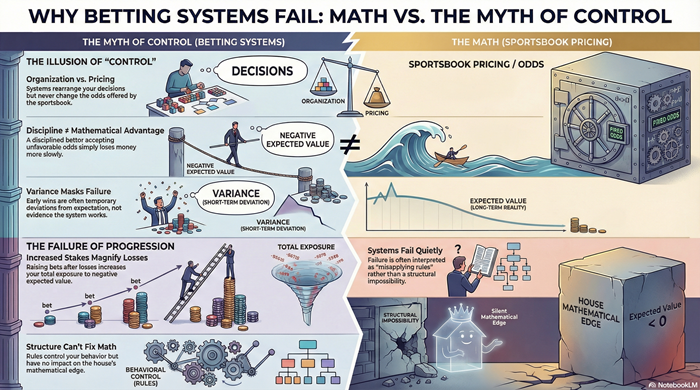
This uneven reinforcement keeps bettors engaged even when long-term results are negative. It also explains why systems, streak-based betting, and progression strategies feel compelling despite structural failure.
Why Professionals Treat Variance Differently
Professional betting does not eliminate variance. It plans for it.
Rather than reacting emotionally to results, professional models assume variance as a given. Decisions are evaluated by pricing, not outcomes. Volume is used to smooth fluctuations.
For casual bettors, variance feels like chaos. For pricing models, it is background noise.
This difference in interpretation explains why identical results can produce clarity in one context and confusion in another.
Why Understanding Variance Changes Perspective
Once variance is understood, many emotional reactions lose their authority.
- Winning streaks stop proving anything
- Losing streaks stop feeling personal
- Confidence becomes less meaningful than structure
- Short-term outcomes lose explanatory power
Variance explains why betting feels unpredictable even when the math is stable.
Understanding it does not improve results. It improves interpretation.
And interpretation is what prevents confusion from becoming conviction.