
Why the “Sure Thing” Isn’t: 10 Sports Betting Myths Debunked

We’ve all been in those group chats or listened to those podcasts where someone claims they’ve finally discovered a “can’t-miss” system or a legendary hot streak. These stories always sound incredibly logical on the surface, making it easy to feel like you’re just one “smart” bet away from a big win. However, there is usually a massive gap between how we perceive these situations and the cold, hard math that sportsbooks use to stay in business.
The Compounding Risk of Parlays
It’s tempting to think that stacking a few picks together is a savvy way to “diversify” or spread your risk across multiple games, but it is actually the opposite. In the betting world, parlays function more like a lottery ticket than a strategic investment because they are compounding rather than additive. Instead of protecting your money, you are essentially multiplying the difficulty of ever seeing a return.
- Two games that each have a 50% win chance individually only have a 25% chance of winning together (0.5 x 0.5).
- Adding more “legs” to a ticket simply multiplies the number of independent things that must go perfectly right for you to win.
The high payout you see on your screen isn’t a gift or an “opportunity”—it is simply the math reflecting how unlikely the outcome is. When we see a massive potential return, our brains often ignore the shrinking probability in favor of the excitement, but we have to remember that a higher payout always reflects a higher risk, never a better chance.
Why Favorites Aren’t “Safe” Bets
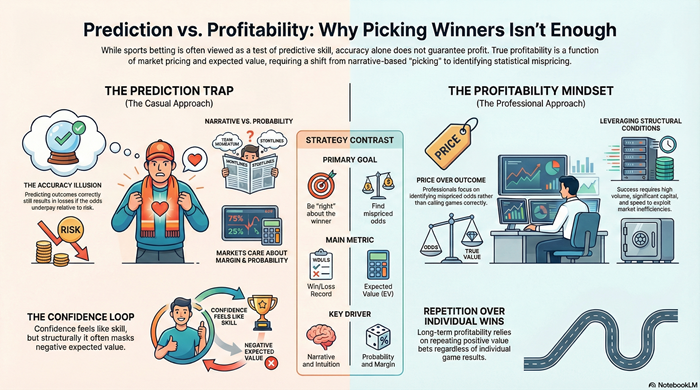
We often fall for the “Certainty Effect,” where a team with a 70% chance of winning feels like a 100% lock in our minds. It feels comfortable and responsible to back the better team on paper, but being a “frequent winner” isn’t the same thing as being a “profitable winner.” Sportsbooks set prices to balance their own financial risk and manage the market, not to signal a “safe” pick for the user.
Real value isn’t found in a team’s reputation, but in the relationship between the price and the true probability of the outcome. For example, if a favorite is priced at -200, it means you must risk $200 just to win $100. This implies the team has about a 67% chance of winning; if their actual chance is only 60%, you are paying a premium for a bad deal. Neither favorites nor underdogs are automatically “safer” bets—safety only exists when the price is right.
The Illusion of Momentum and Hot Streaks
We’ve all seen a team “shooting the lights out” for three games and felt certain they’ll do it again on Saturday. This is classic “recency bias”—the mental trap where we think what happened yesterday is more likely to happen tomorrow. In reality, every game is an independent event influenced by new travel, fresh injuries, and specific matchups that don’t care about last night’s score.
- Sportsbooks already bake “current form” and popular “systems” into the price, meaning bettors usually pay a premium to follow a popular narrative.
- Extreme results usually move back toward the average over time, a concept known as regression. If a team is playing way above their talent level, they are eventually going to come back down to earth.
While a winning streak feels like a physical force, it doesn’t change the underlying math of the next matchup. Riding a “hot” team often means you are buying into a story at its most expensive price point.
Reading the Room: Line Movement and Public Pressure
Watching a line shift from -3 to -4.5 can feel like you are watching insiders trade secret information, but it is rarely that dramatic. A shifting line is primarily a risk management tool used by sportsbooks to balance the money on both sides so they don’t face too much liability. Many bettors believe they can find an edge by “live betting” or “fading the public,” but the house’s algorithms are adjusting in real-time to ensure their margin remains intact.
It is vital to remember that the scoreboard doesn’t care how many tickets or how much money is placed on one side; the players on the field are completely unaffected by betting volume. The smartest move we can make is understanding whether the price is fair, rather than simply trying to guess what the crowd or “insiders” might know. Following the movement without understanding the “why” is just another way of guessing.
Added Information
Navigating the world of sports betting is much easier when you stop looking for “sure things” and start looking at the mechanics of the game. If you want to explore the full list of misconceptions we deal with every day, there is a lot more to learn.
An ebook called “Top 10 Myths About Sports Betting” with more details on this subject is also available for FREE on Google Books.