
Keno Secrets Revealed: Why Your “Lucky” Numbers Aren’t Doing What You Think
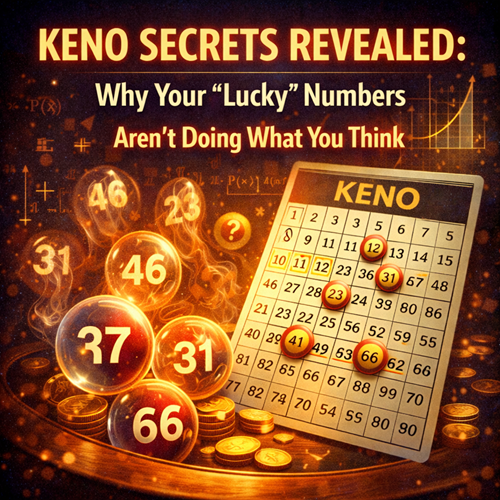
Keno looks like the ultimate “common sense” game where a sharp eye can spot a trend, but that simplicity is actually a clever trap. While the board feels like it’s inviting you to crack a code, the reality is a cold, hard world of fixed math and independent draws. Underneath the friendly surface, the game is governed by rigid rules that don’t care about your strategy or your “feel” for the numbers.
The Psychology of the “Near Miss”
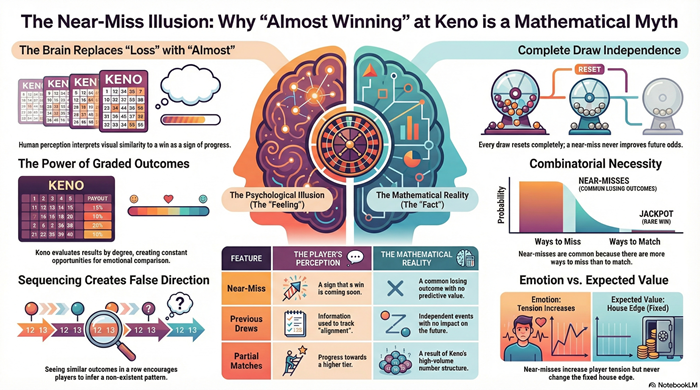
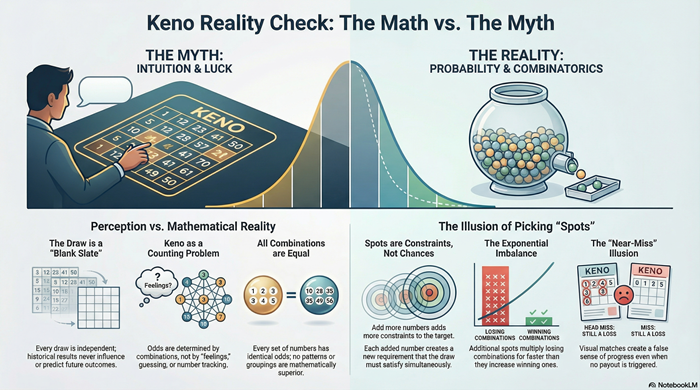
I’ve seen players circle the same board for three shifts straight because they “almost” hit their numbers, feeling like they’re just inches away from a payday. This is the “near-miss effect,” a psychological hook where your brain treats a number landing right next to your pick as progress toward a win. It feels like a basketball shot that rims out—it’s an emotional sting that makes you think you’re getting warmer, but in the casino, an “almost” has the exact same value as a total airball. The board might feel like it is teasing you personally, but the machine doesn’t have a sense of humor or a sense of proximity.
- The keno system is built to recognize only exact matches, meaning a number sitting one spot away on the grid carries zero mathematical weight.
- A near miss provides an emotional spike but offers no predictive signal for the next draw, which resets without any memory of how close you were.
The Illusion of Hot and Cold Streaks
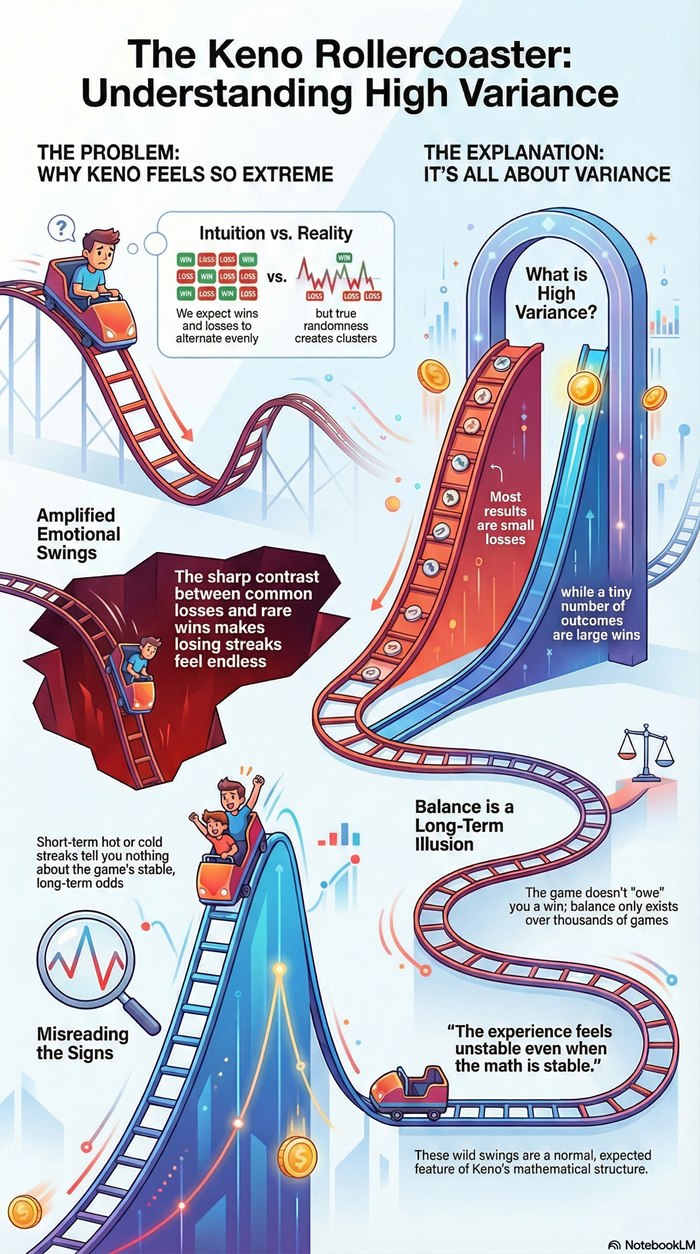
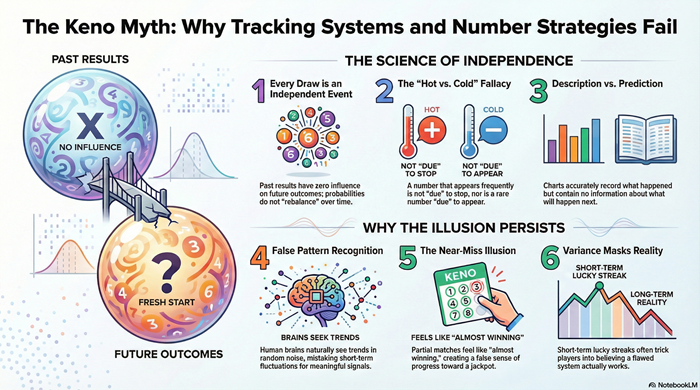
We’ve all seen it: the number 17 hits three times in a row, or a perfect diagonal starts forming across the display. It’s natural to think a number is “running hot,” but those are just random clusters—the same way a coin flip can land on heads five times in a row without the coin being “due” for tails. Your brain is wired to see patterns in the noise, but every draw is an independent event where the history is erased and the odds remain identical to the very first round. Randomness isn’t a smooth, even distribution; it naturally includes streaks and clusters, meaning the system doesn’t avoid repetition just to look “random” to us.
- Tracking past results is a wasted effort because the probability of any number appearing remains exactly the same every time the board resets.
- Apparent trends like “hot” or “cold” zones are just short-term statistical noise behaving normally rather than a shift in the game’s mechanics.
Manual Picks vs. Quick Pick: Does Control Matter?
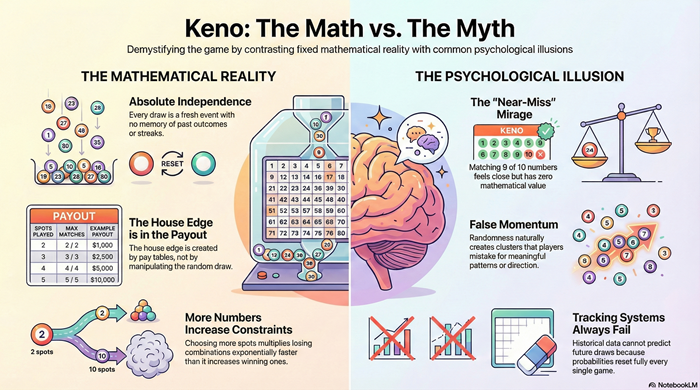
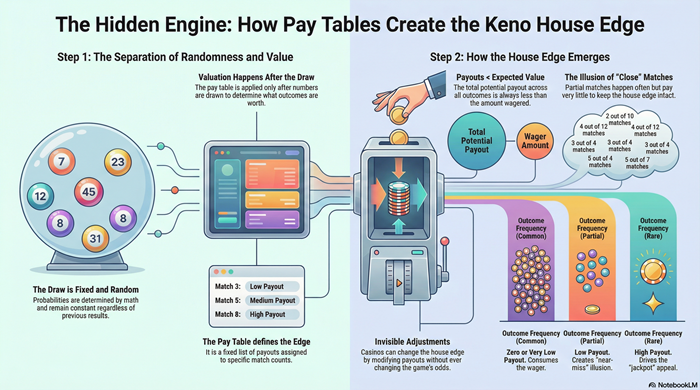
There’s a certain comfort in playing family birthdays or anniversaries, as if our personal intent can somehow nudge the numbers in our favor. This is the classic “illusion of control,” but the truth is that the machine doesn’t care if a number represents your wedding day or a random digital blip. I often hear players whisper that the Quick Pick button is rigged, but the house doesn’t need to cheat when the profit is already baked into the payout table. For example, if the true mathematical odds of a hit should pay 100-to-1, the casino simply pays 80-to-1; that’s how they make their money regardless of whether you picked the numbers or the computer did.
Choosing Your Spots: Is More Actually Better?
You might think picking fewer numbers is a “safer” way to play, or that picking more numbers “casts a wider net,” but neither approach is a loophole. When you choose fewer spots, you’re essentially signing up for frequent small wins, whereas more spots move you into the territory of rare, massive jackpots. This doesn’t change the house edge; it simply defines your “Experience Profile,” which is the way you choose to experience the game’s volatility. Whether you want a steady drip of small hits or the long-shot chase of a large jackpot, the math stays working for the casino in the background.
- Changing the number of spots you play alters the frequency and size of your payouts, but it never shrinks the mathematical advantage the house holds.
- Your choice of spot size is about selecting a specific “Experience Profile” rather than finding a strategy to bypass the game’s structural difficulty.
Keno vs. The Rest of the Casino
Keno feels like a calm oasis compared to the high-energy chaos of the slot floor, largely because of the visibility of the numbers being drawn right in front of you. That transparency creates a false sense of security, leading many to believe keno is easier to beat than a slot machine with its hidden, chaotic reel mechanics. In reality, keno often carries a much higher house edge than the flashiest slots on the floor. Don’t fall for the old myth that casinos “tighten” the draw during busy weekends or “loosen” them for late-night draws; the game operates on a fixed, regulated structure that doesn’t react to how many people are in the room or what time it is.
Added Information
An ebook called “Top 10 Myths About Keno: Near Misses, Lucky Numbers, and the Truth About the Draw” with more details on this subject is also available for FREE on Google Books and AudioBook.