
Baccarat Reality Check: Why Your “Winning Pattern” Is Just Math
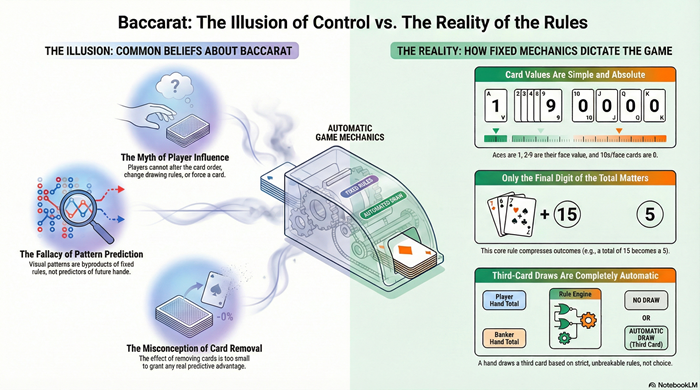
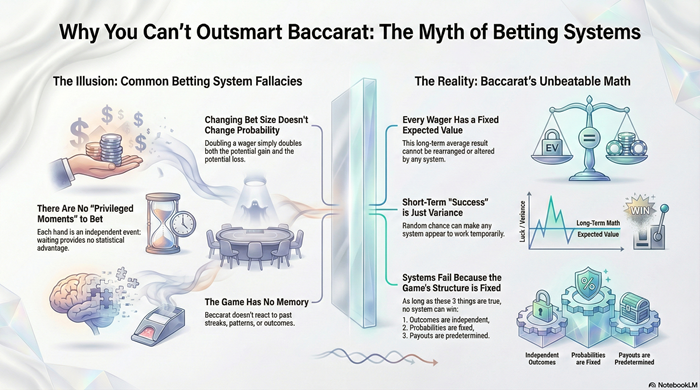
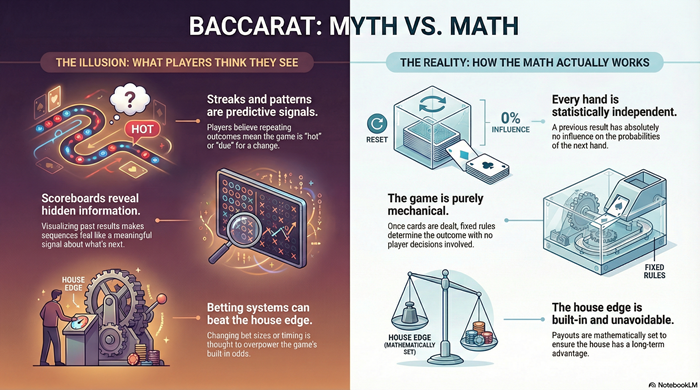
Baccarat is fundamentally a simple game where players choose between two primary hands, governed by fixed drawing rules that leave no room for player decision-making. The visual allure of casino scoreboards often suggests a deep narrative of streaks and trends, leading many to believe the next outcome is predictable. In reality, every hand is a strictly independent mathematical event where past results have zero influence on future cards.
The Banker Bet Isn’t a Safety Net
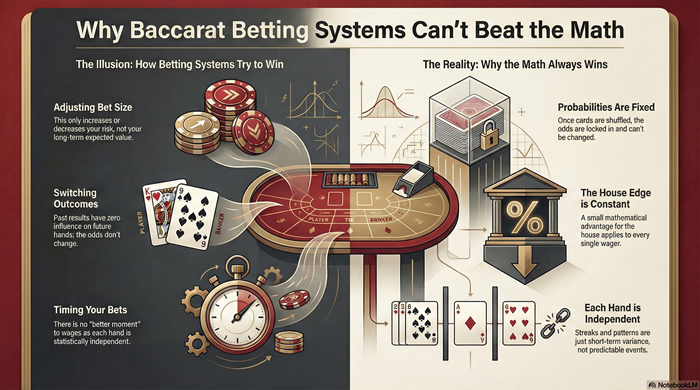
I’ve seen countless players sit down with a “disciplined” plan to only flat bet the Banker, thinking it acts as a safety net for their bankroll. It is true that the Banker wins slightly more often—hitting approximately 45.8% of the time due to the structural advantage of drawing second in specific scenarios. However, once you factor in the 5% commission the house takes on those wins and the 1.06% house edge, it becomes clear that this bet isn’t a magical shield against losing. Many players swear by flat betting as if it changes the game’s nature, but the house edge doesn’t care about your discipline; it only cares about your total action. Flat betting doesn’t make the game “safe,” it simply makes your journey toward the mathematical destination a bit more linear.
- Safety in gambling is an illusion of house edge, not win frequency.
- Flat betting on the Banker doesn’t change the mathematical destination of the session.
Scoreboards and the Illusion of Patterns
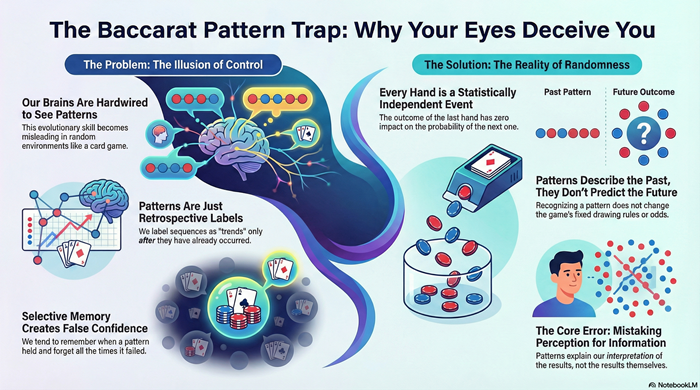
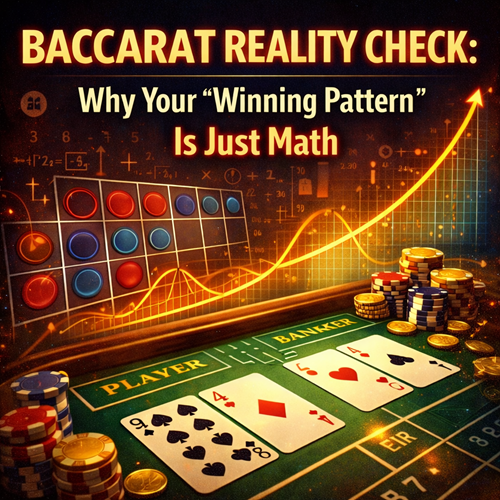
Step into any high-limit room and you will see players leaning in, squinting at the “bead roads” and “dragon runs” glowing on the digital displays. They are searching for a “choppy” shoe or a “zig-zag” pattern, trying to find a rhythm in what is actually a randomized sequence of cards. These scoreboards are fascinating to look at, but they are historical data records rather than forecasting tools. Your brain is naturally wired for pattern recognition, which often tricks you into seeing intentional order in the chaos. It is a common emotional trap to believe a visual trend has momentum, but the click of the chips and the glow of the board shouldn’t distract you from the fact that the cards have no memory of what happened five minutes ago.
Why the “Due” Hand Never Arrives
The Gambler’s Fallacy is a frequent guest at the baccarat table, convincing players that after a long streak of Banker wins, the Player side is finally “due.” I have watched the energy at a table shift as everyone bets big against a streak, convinced the game has a built-in need to balance itself out. The reality is that the shoe does not know a streak exists, and probability has no memory to correct short-term imbalances. Each hand is an independent event; the probability of the next result remains essentially the same regardless of how many red or blue circles are already on the board.
- Probability does not rush to correct short-term imbalances.
The High Cost of the Tie Bet
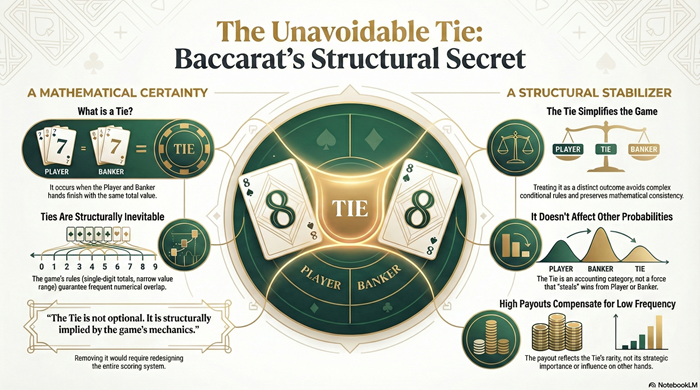
The Tie bet is the most seductive spot on the layout, usually offering an 8:1 payout that promises to multiply your chips in a single hand. While that payout looks generous, the probability of a tie occurring is only about 9.5%, which is dwarfed by a massive 14% house edge. As a consultant, I always highlight the massive gap between the Banker’s 1.06% and the Tie’s 14%; you are essentially paying a massive premium for a long shot. You have to be cautious with this bet; a big payout does not equal high value, and over time, the Tie bet is one of the most expensive wagers on the casino floor.
Online Baccarat: Faster, Not Rigged
It is easy to get suspicious when you see a strange streak occur on a digital screen, but licensed online baccarat is not rigged to react to your bets. These games use certified Random Number Generators (RNG) or live dealers that follow the exact same drawing rules found in a physical casino. The reason online play can feel more “aggressive” is the absence of physical reassurance—you aren’t watching a manual shuffle or hearing the cards slide. Because the speed is so much higher online, you are exposed to variance much faster, which can make a normal string of losses feel like a targeted anomaly. Understanding this math removes the illusion of a “rigged” game, though it doesn’t remove the house edge.
Added Information
Understanding the underlying math of the game removes the illusion, but it doesn’t have to remove the fun. You can still enjoy the drama of the table, but with the quiet confidence of a player who knows the board is a record, not a map.
An ebook called “Top 10 Myths About Baccarat” with more details on this subject is also available for FREE on Google Books and AudioBook.