
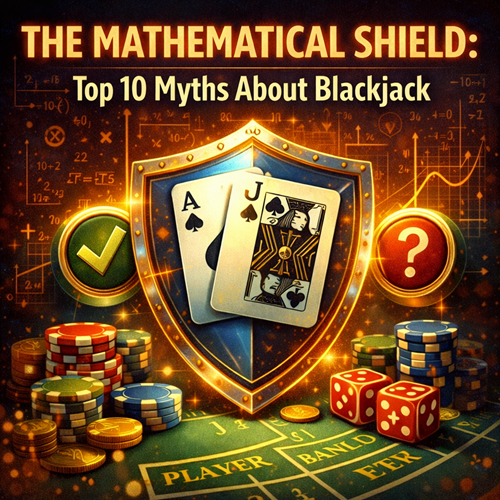
The Mathematical Shield: Top 10 Myths About Blackjack
The High-Stakes Hook: Stop Being the Casino’s Favorite Customer
The tension at a blackjack table is electric, but for most players, it is also expensive. You’ve seen it happen: the dealer shows a weak six, the table leans in with hungry anticipation, and then—with agonizing precision—the dealer flips a ten and draws a five for a perfect 21. As the groans of your fellow players fill the air, a creeping suspicion takes root. You feel the game is rigged, or perhaps you’re just “unlucky.” The psychological cost of playing on “gut feeling” is immense, leading to emotional exhaustion and a rapidly depleting bankroll. Every superstitious pivot and emotional reaction shifts the competitive landscape further in the casino’s favor. To survive, you must separate the heat of the moment from the cold reality of mathematics. This guide provides the logical shield you need to stop the cycle of frustration and start playing with the clarity of a professional.
The Core Conflict: Math vs. Myth
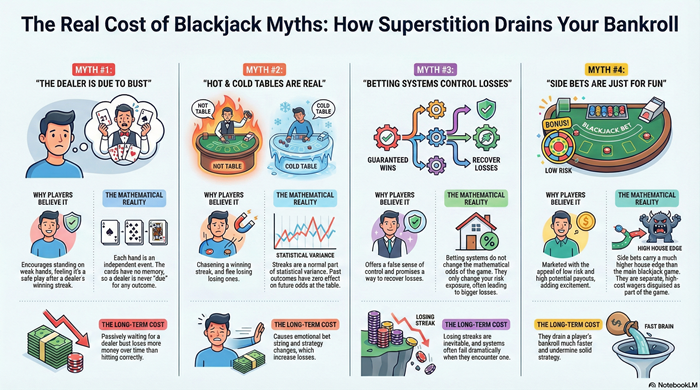
At its heart, every hand of blackjack is a struggle between fixed math and human superstition. While players fall victim to “selective memory”—vividly recalling the sting of a dealer’s 21 while forgetting their own routine wins—the casino relies on the “Slow Math” of the house edge. This advantage isn’t born of luck or “momentum”; it is a structural reality built directly into the rules. When you ignore basic strategy, you aren’t just gambling—you are voluntarily donating your capital to the house.
| The Illusion of Influence (Rules > People) | The Strategic Reality (Math > Intuition) |
| Seating position dictates the table’s outcome. | Basic strategy is a non-negotiable requirement. |
| The dealer’s “tells” reveal the next card. | Million-hand simulations prove the math. |
| A “gut feeling” can predict a winning streak. | Random distribution governs every shuffle. |
| The order of cards is fragile and easily disrupted. | Fixed probability remains constant regardless of the player. |
The “So What?” Layer: The casino relies on your superstition to pay for the lights and the “free” drinks. Ignoring the mathematical reality transforms a slim 0.5% house edge into a certain long-term loss. By mastering the facts, you shift from being a victim of “luck” to an operator of logic.
Inside the Book: 10 Myths Exposed
This guide deconstructs the most persistent fallacies found at the blackjack table, replacing table talk with proven mechanics:
- The Dealer Always Wins: While the house has a structural edge because players act first, the dealer does not have “momentum.” The House Edge is a Slow Statistical Advantage, not an automatic victory every round.
- Third Base Control: The last player to act does not “take the dealer’s card.” The card order is fixed after the shuffle; a hit simply causes a “Sequence Shift,” which is just as likely to help the table as it is to hurt it.
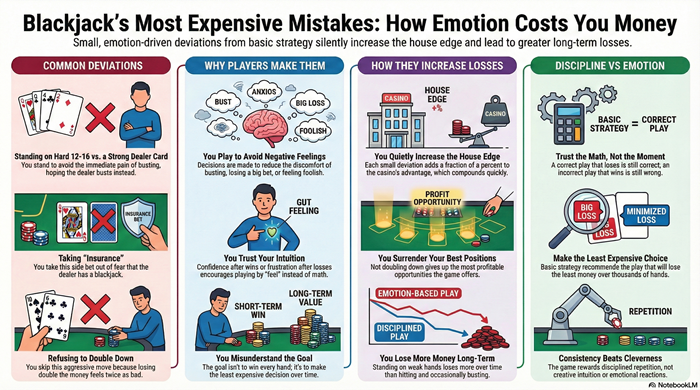
- Playing Your Gut: Feelings do not change the composition of the deck. Basic Strategy is Built from Millions of Simulations to ensure the move with the highest probability, which always outperforms intuition.
- The Insurance Trap: Insurance is a Negative Expectation Bet. The probability of a dealer blackjack is less than one in three, while the 2:1 payout is mathematically worse than the actual odds.
- Splitting 10s: Risking a Statistically Superior 20 to “go big” is a critical error. A 20 is so strong that only a dealer 21 can beat it; standing is mathematically safer than risking two weaker hands.
- The Card Counting Fantasy: Movies suggest counting is a magic guarantee, but it actually provides only a Small Statistical Edge (0.5% to 1.5%). It requires extreme discipline and does not eliminate short-term variance.
- The “Cheating” Dealer: The house relies on math, not manipulation. Dealers follow Strict, Scripted Procedures (like hitting until 17) because the built-in house edge ensures casino profitability without the need for cheating.
- New Deck Reset: A fresh shuffle restores Baseline Randomness but never changes the fundamental house edge. The odds are determined by the rules of the game, not the “age” of the cards.
- Optional Strategy: “Personal style” is a recipe for bankruptcy. Deviating from Basic Strategy Doubles Expected Losses, as small errors compound into significant financial hits over time.
- Reading the Dealer: Unlike poker, physical “tells” are irrelevant. The dealer is a System Operator, not a participant in the outcome; they do not know the next card and have no choice in how to play their hand.
The Value Proposition: Why This Guide?
This book is a high-level educational and informational resource designed to strip away the jargon and reveal the “slow math” of the casino floor. By mastering these ten myths, you gain the ultimate player advantage: Clarity over Confusion. You will no longer be distracted by table heat or “streaks,” but will instead move with the confidence of a player who understands the structural reality of the game. As the source material confirms: “Clarity is always an advantage.”
Final Call to Action and Disclaimer
Stop playing against “luck” and start playing with the math. It is time to evolve from a “gambler” into a “player” who operates with a mathematical shield. For details and more check out my FREE Google Book “Top 10 Myths About Blackjack: Strategy, Superstition, and the Truth About the Dealer” and Audiobook.
What You’ll Gain:
- Mathematically Optimal Decisions: Know the right move in every scenario.
- Reduced House Edge: Shrink the casino’s advantage to its absolute minimum.
- Emotional Discipline: Maintain a cool head when the table gets loud.
- Bankroll Protection: Stop making the high-cost errors that casinos love.
Legal Disclaimer: This book is for educational and informational purposes only. It does not provide gambling advice, betting strategies, or financial guarantees. Casino games involve risk. Always play responsibly and within your limits. Blackjack rules vary by casino and region; these explanations describe general mechanics and common rule structures.