
How Blackjack Payouts Really Work (3:2 vs 6:5 Explained)
💰Blackjack payouts look like a small detail. Two numbers on a felt. A line of text on a placard. Something easy to ignore while focusing on cards and decisions. In reality, payout rules are one of the single biggest factors determining how expensive a blackjack game is.
The difference between 3:2 and 6:5 payouts doesn’t change how the game feels hand to hand — but it dramatically changes how much players lose over time. As explained in our Blackjack Basic Strategy guide, blackjack’s reputation as a low-house-edge game only exists under certain conditions. Payout structure is one of them.
This article explains how blackjack payouts work, what 3:2 and 6:5 actually mean, why casinos switched formats, and why payout rules matter more than most strategy mistakes.
🧠 What Blackjack Payouts Mean
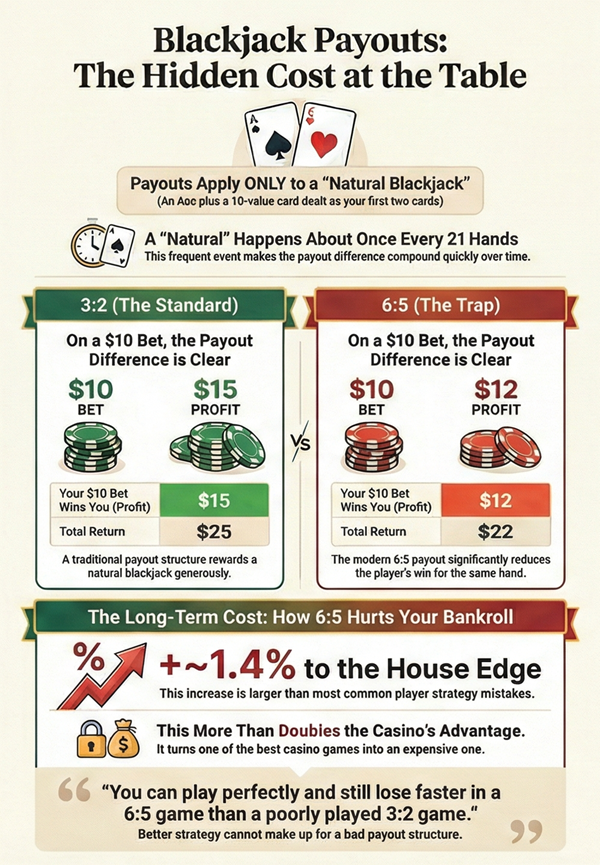
A blackjack payout determines how much a player is paid when they receive a natural blackjack — an Ace plus a ten-value card on the initial deal.
This payout applies only to natural blackjacks, not regular wins.
Common payout formats include:
- 3:2 — the traditional standard
- 6:5 — a reduced modern payout
The numbers describe how much profit the player receives relative to their bet.
🎯 How 3:2 Payouts Work
A 3:2 payout means that for every $2 wagered, the player receives $3 in profit.
Example:
- $10 bet → $15 profit
- Total return: $25
This payout has been the blackjack standard for decades. It properly compensates players for the relative rarity of a natural blackjack.
Games offering 3:2 payouts are the foundation of low-edge blackjack.
⚠️ How 6:5 Payouts Work
A 6:5 payout means that for every $5 wagered, the player receives $6 in profit.
Example:
- $10 bet → $12 profit
- Total return: $22
At first glance, the difference feels small — just $3 less on a $10 bet. That perception is exactly why 6:5 games are so dangerous.
The reduced payout applies every time a blackjack occurs.
📊 Why the Difference Is Bigger Than It Looks
Natural blackjacks occur roughly once every 20–21 hands.
That means:
- Players experience blackjacks regularly
- Reduced payouts happen repeatedly
- The cost compounds over time
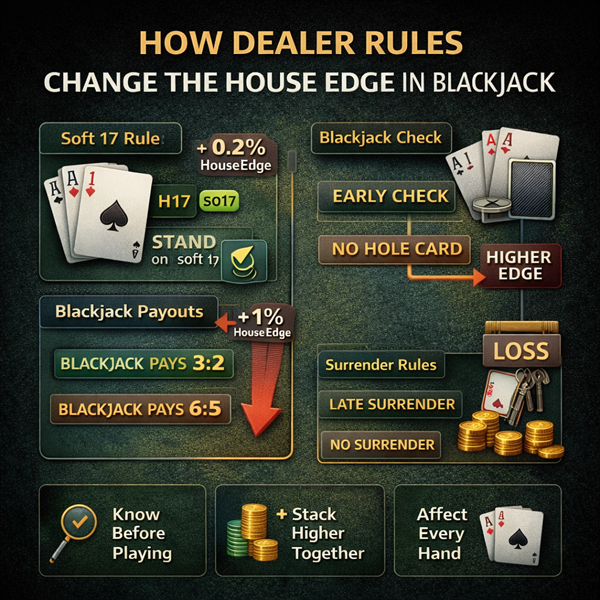
Switching from 3:2 to 6:5 dramatically increases the house edge, often more than any single strategy mistake a player can make.
This isn’t a subtle change. It’s structural.
📉 How 6:5 Payouts Increase the House Edge
In a typical 3:2 game played with perfect strategy, the house edge may sit below 1%.
A 6:5 payout:
- Adds roughly 1.3–1.4% to the house edge
- More than doubles the casino’s advantage
- Turns a low-cost game into an expensive one
No betting system, strategy adjustment, or discipline can offset this increase.
🧪 Why Strategy Can’t Fix a Bad Payout
Players sometimes assume they can “play better” to compensate for a worse payout. This is not possible.
Why:
- Payouts affect win value, not decision value
- Basic strategy already assumes optimal decisions
- Reduced rewards lower expected value across all hands
You can play perfectly and still lose faster in a 6:5 game than a poorly played 3:2 game.
🏛️ Why Casinos Introduced 6:5 Games
Casinos didn’t introduce 6:5 payouts by accident.
They did it because:
- Players focus on minimum bets, not payouts
- 6:5 allows lower minimums with higher margins
- Tables appear more “friendly” to beginners
- The change is easy to hide
A $5 minimum 6:5 game often looks more attractive than a $15 minimum 3:2 game — even though the $5 game is far more expensive per dollar wagered.
🧠 Why Players Miss the Payout Sign
Payout information is usually displayed:
- In small print
- On the table felt
- On signage away from eye level
Players are trained to look at cards, chips, and dealer actions — not rules posted above the table.
Casinos rely on inattention, not deception.
📊 3:2 vs 6:5 Compared Over Time
Over short sessions:
- The difference may feel minor
- Variance can mask the cost
Over long sessions:
- Fewer meaningful wins
- Faster bankroll erosion
- Higher average losses
This is why experienced players refuse to play 6:5 games regardless of table minimums.
⚠️ Why 6:5 Is Worse Than Most “Bad Strategy”
Many common strategy mistakes add a fraction of a percent to the house edge.
6:5 payouts add more than a full percentage point instantly.
In practical terms:
- A perfect player at a 6:5 table often loses faster
- A flawed player at a 3:2 table may last longer
Payouts matter more than most decisions.
🧠 How to Spot a 6:5 Game Quickly
Before sitting down, look for:
- “Blackjack pays 6 to 5” wording
- Extra-large “LOW MINIMUM” signage
- Tables marketed to casual players
If the payout isn’t clearly stated, assume the worst until confirmed.
Walking away is always the correct move.
📌 What Payouts Tell You About a Table
Payout rules signal how player-friendly a game is.
- 3:2 → casino expects informed players
- 6:5 → casino expects casual players
Choosing tables based on payouts is one of the easiest ways to control cost without changing how you play.
🔚 Final Thought: Payouts Decide the Game Before It Starts
Blackjack payouts don’t affect how cards are dealt — they affect how much your wins are worth.
A 6:5 table isn’t harder to beat.
It’s more expensive to play.
Players who care about long-term results should treat payout rules as non-negotiable.
If the payout is wrong, the game is wrong.
🔗 Recommended Internal Links