
Hit, Stand, Split, or Double: What to Do and When in Blackjack
🎯 Every blackjack hand forces a decision. Sometimes it’s simple. Sometimes it feels uncomfortable. Hit or stand. Split or don’t. Double or play it safe. These choices happen quickly, often under pressure, and with real money at stake.
What makes blackjack unique is that these decisions are not subjective. They are not based on gut instinct, confidence, or recent results. They are based on probability. As explained in our Blackjack Basic Strategy guide, the optimal choice for every situation has already been solved mathematically. The challenge for players is not inventing better decisions — it’s trusting the ones that already exist.
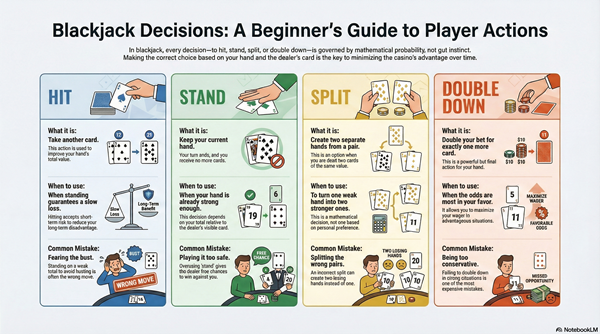
This article breaks down the four core blackjack decisions, what each one actually means, when it is typically correct, and why misunderstanding these options quietly increases the house edge.
🂡 What It Really Means to Hit
To hit is to take another card in hopes of improving your hand. Many players treat hitting as a last resort, something done only when standing feels hopeless. In reality, hitting is often the least costly option — even on hands that feel risky.
The key mistake players make is focusing on the chance of busting instead of the outcome of standing. For example, standing on a weak total like 12, 13, or 16 may avoid an immediate bust, but it often leads to losing anyway when the dealer completes a stronger hand.
Hitting is not about chasing perfection. It is about reducing expected loss. In many marginal situations, hitting loses less over time than standing, even if it occasionally leads to a bust.
✋ What Standing Actually Does (and Doesn’t Do)
To stand is to keep your current hand total and end your turn. Standing feels safe because it avoids immediate failure. That emotional comfort is exactly why it is so often misused.
Standing is correct when:
- Your hand is already strong relative to the dealer
- The dealer’s upcard suggests a high likelihood of busting
- The cost of hitting outweighs the benefit
Standing is not correct simply because you are afraid of busting. Blackjack punishes passive decisions just as harshly as aggressive mistakes. Standing on weak hands often hands control to the dealer and guarantees a slow loss rather than a dramatic one.
The math behind standing decisions assumes long-term play, not individual outcomes. A decision that loses quietly but consistently is worse than one that loses occasionally but performs better overall.
🔀 Understanding When and Why to Split
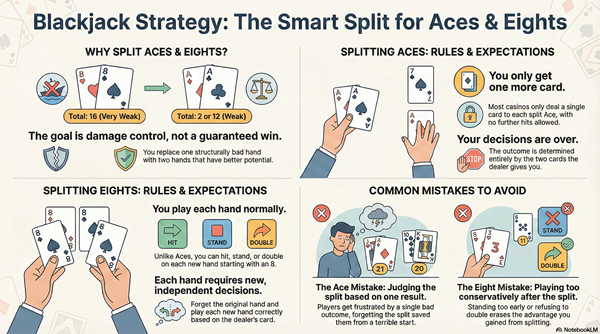
When dealt two cards of the same value, players may have the option to split, creating two separate hands. Splitting is one of the most misunderstood options in blackjack because it feels counterintuitive to break up a “decent” hand.
Splitting is not about preference. It is about expected value. Some pairs gain value when split because they create two favorable starting hands. Others lose value because splitting removes strength without sufficient upside.
Players often make two major mistakes with splits:
- Splitting pairs that should remain intact
- Refusing to split pairs that are mathematically strong splits
Correct splitting decisions depend heavily on the dealer’s upcard and table rules. Done correctly, splitting can turn a losing situation into two profitable opportunities. Done incorrectly, it magnifies losses.
💰 Why Doubling Down Is So Important
To double down is to double your original bet in exchange for receiving exactly one additional card. This option exists because there are moments in blackjack where the player has a statistical advantage — and the casino allows players to capitalize on it.
Many players avoid doubling because:
- It increases variance
- Losses feel more painful
- It appears aggressive
Ironically, failing to double in strong situations is one of the fastest ways to increase the house edge. Doubling is not reckless. It is targeted aggression at moments where the odds are most favorable.
When players skip doubles, they are effectively choosing to underbet their strongest hands while betting normally on weaker ones — the opposite of what the math recommends.
🧠 Why the Dealer’s Upcard Changes Everything
No blackjack decision exists in isolation. Your hand must always be evaluated against the dealer’s visible card. The dealer’s upcard provides information about:
- Likelihood of dealer busting
- Probability of dealer reaching a strong total
- Whether defensive or aggressive play is correct
For example, a hand that is strong against a dealer 5 may be weak against a dealer 10. The same player total can require completely different actions depending on the dealer’s position.
This is why simplified rules like “always stand on 16” or “never split tens” fail. Blackjack decisions are conditional, not absolute.
📊 Soft Hands vs Hard Hands in Decision-Making
Soft hands contain an Ace counted as 11, giving them flexibility. This flexibility allows for more aggressive play because the risk of busting is reduced.
Many players treat soft hands too cautiously, standing when they should hit or double. This wastes the built-in safety that the Ace provides.
Hard hands, by contrast, offer no buffer. Decisions involving hard hands are often emotionally difficult because busting is immediate and final. The math behind these decisions accepts that discomfort in exchange for better long-term performance.
Understanding whether a hand is soft or hard is essential to choosing correctly.
⚠️ How Small Decision Errors Increase the House Edge
No single mistake ruins a session. But repeated small errors quietly stack against the player.
Common examples include:
- Standing too often on weak totals
- Refusing to double in favorable situations
- Splitting pairs incorrectly
- Treating fear as a strategy
Each error increases the house edge slightly. Over hundreds of hands, those increases compound into significant losses. Most players never realize this because the damage happens gradually.
Correct decisions don’t guarantee winning sessions. They prevent avoidable losses from piling up.
📌 Discipline Beats Creativity in Blackjack
Blackjack rewards consistency, not originality. The game does not care how confident you feel, how long you’ve played, or how strong your instincts are.
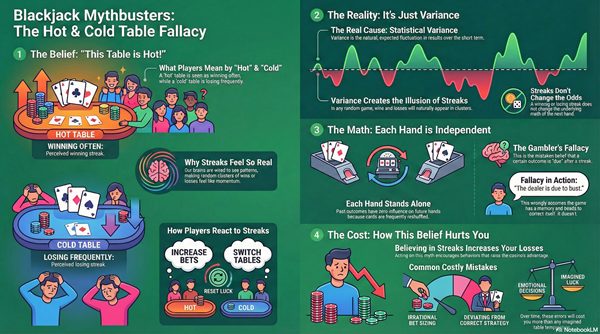
When players abandon optimal decisions after a loss or override strategy because something “feels wrong,” they are not adapting — they are guessing.
The strongest blackjack players are not the most daring. They are the most boring. They repeat correct decisions regardless of short-term results.
🔚 Final Thought: The Choice Has Already Been Made
Every blackjack decision you face has already been tested millions of times in simulations. The correct answer exists whether you like it or not.
Your role as a player is not to outthink the game. It’s to avoid making it more expensive than it already is.
When you stop treating hit, stand, split, and double as emotional choices and start treating them as structural ones, blackjack becomes simpler, calmer, and far more honest.
🔗 Recommended Internal Links