
Blackjack Variants Ranked by House Edge
🧮♠️ Not all blackjack games are created equal. Two tables can look almost identical — same cards, same dealer motions, same rules posted nearby — yet one quietly costs players far more than the other. The difference isn’t luck or difficulty. It’s the variant.
Blackjack variants change rules, payouts, and options in subtle ways that significantly affect the house edge. As explained in our Blackjack Basic Strategy guide, strategy only works within the structure of the game you’re playing. Some structures are forgiving. Others are expensive by design.
This article ranks common blackjack variants by house edge, explains what makes each one cheaper or more costly, and shows players how to recognize which games are worth sitting down at — and which are not.
What “House Edge” Really Means for Variants
The house edge represents the casino’s average profit per dollar wagered over time. When comparing blackjack variants, the house edge reflects:
- Rule differences
- Payout structures
- Player options
- Dealer behavior
A small change — like how the dealer handles soft 17 or whether surrender is allowed — can significantly alter long-term cost. Variants are best compared by structure, not branding.
Lowest House Edge Variants (Best for Players)
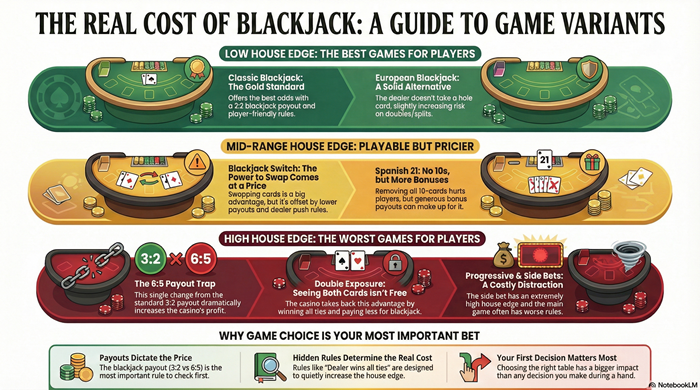
Classic Blackjack (3:2, S17, Surrender Allowed)
This is the gold standard.
Features:
- 3:2 blackjack payout
- Dealer stands on soft 17
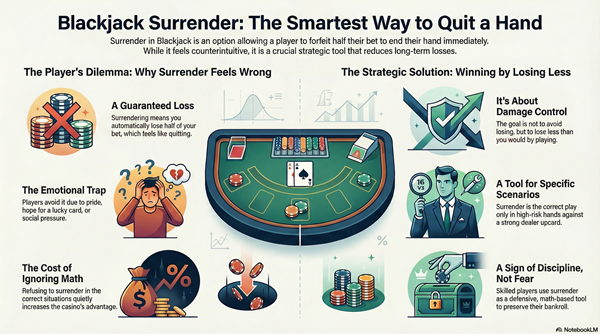
- Late surrender available
- Double after split allowed
When played with correct strategy, this variant offers one of the lowest house edges available in any casino game.
This is the benchmark all other variants should be compared against.
European Blackjack (Dealer No Hole Card)
European blackjack removes the dealer hole card but keeps otherwise solid rules.
Pros:
- 3:2 payouts
- Reasonable doubling and splitting rules
Cons:
- Increased risk on doubles and splits if dealer later has blackjack
The lack of a hole card slightly increases the house edge, but this variant remains player-friendly compared to many modern alternatives.
Mid-Range House Edge Variants (Acceptable but Costlier)
Blackjack Switch
Blackjack Switch allows players to swap cards between two hands, which feels powerful.
However:
- Blackjacks often pay even money
- Dealer pushes on 22
These rule changes offset the advantage of switching, resulting in a moderate house edge. It’s playable, but far from optimal.
Spanish 21
Spanish 21 removes all tens from the deck, which sounds terrible — but compensates players with generous rules.
Pros:
- Bonus payouts
- Liberal doubling and splitting
- Player blackjacks often always win
Cons:
- Higher complexity
- Variant-specific strategy required
Spanish 21 can be reasonable if played correctly, but mistakes are common and costly.
High House Edge Variants (Bad for Players)
6:5 Blackjack
6:5 blackjack looks like standard blackjack but pays less on natural blackjacks.
Problems:
- Dramatically increased house edge
- No strategy adjustment can fix it
- Often paired with low minimums to attract casual players
This is one of the most expensive blackjack variants commonly offered.
Double Exposure Blackjack
In this variant, both dealer cards are exposed — which feels like a massive advantage.
The catch:
- Dealer wins all ties
- Blackjacks pay even money
- Rule restrictions offset visibility
Despite the transparency, the house edge is higher than standard blackjack.
Specialty and Novelty Variants (Usually the Worst)
Progressive Blackjack
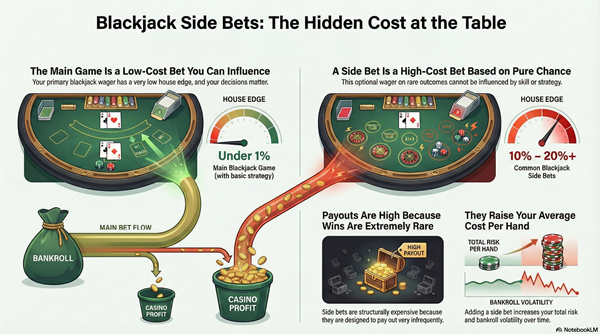
Progressive tables add a jackpot side bet.
Issues:
- Extremely high house edge on side wagers
- Main game often paired with inferior rules
- Players focus on jackpots, not cost
These games are designed for excitement, not efficiency.
Continuous Shuffling Machine (CSM) Blackjack
CSM blackjack constantly reshuffles cards, eliminating deck penetration.
Consequences:
- Card counting impossible
- Variance feels smoother
- Casino control increases
While not always the worst house edge mathematically, CSM games remove any chance of advantage play and encourage longer sessions — increasing losses.
Why Casinos Offer So Many Variants
Variants exist because they:
- Differentiate tables visually
- Allow worse rules without obvious changes
- Target casual players
- Increase revenue per hour
Casinos don’t need players to understand the differences — they only need them to sit down.
Why Players Choose Bad Variants Anyway
Players are often drawn to:
- Lower minimum bets
- Familiar branding
- Bonus features
- Simpler rules
Unfortunately, these conveniences usually come with a higher house edge. What feels welcoming often costs more.
How to Evaluate Any Blackjack Variant Quickly
Before sitting down, check:
- Blackjack payout (3:2 vs 6:5)
- Dealer action on soft 17
- Surrender availability
- Side bet emphasis
- Table signage clarity
If the rules aren’t easy to find, that’s usually a warning sign.
Why Strategy Alone Isn’t Enough
Even perfect strategy cannot overcome a bad variant.
A player using flawless strategy at a high-edge table will often lose faster than a slightly flawed player at a good table.
Game selection matters more than most decisions made during play.
Choosing the “Best” Variant Is About Cost Control
There is no “winning” blackjack variant — only less expensive ones.
Good variants:
- Minimize the house edge
- Reward discipline
- Respect correct decisions
Bad variants:
- Inflate costs quietly
- Distract with novelty
- Undermine strategy value
The difference shows up over time.
Final Thought: Variants Decide the Game Before the Cards Are Dealt
Once you sit down, the variant’s rules are locked. Every hand that follows operates within that structure.
Choosing the right variant doesn’t guarantee success — but choosing the wrong one guarantees higher losses.
In blackjack, the most important decision often happens before the first card is dealt.
🔗 Recommended Internal Links