
Do Hot and Cold Slots Exist?
🎰🔥 The idea of “hot” and “cold” slots is one of the most persistent beliefs in casino gambling. Players routinely describe machines as being on a streak, due to pay, or temporarily dead. Stories circulate about switching machines at the right moment or catching a slot just after it “wakes up.”
These beliefs feel convincing because slot play is emotional, streaky, and visually reinforced. But belief is not evidence. To understand whether hot and cold slots actually exist, you have to examine how outcomes are generated and whether past results can influence future ones. As explained in our guide on how slot machines really work, slot outcomes are governed by fixed probabilities applied independently on every spin.
This article explains why the hot-and-cold slot idea exists, how randomness creates streaks naturally, and why the belief persists despite being mathematically unsupported.
What Players Mean by “Hot” and “Cold” Slots
When players describe a slot as hot or cold, they are usually referring to recent outcomes.
A “hot” slot is believed to:
- Pay frequently
- Hit bonuses often
- Be in a generous phase
A “cold” slot is believed to:
- Go long stretches without paying
- Drain bankrolls quickly
- Be temporarily unwinnable
The key assumption behind both labels is that recent history affects future results.
That assumption is the entire problem.
Why Slot Outcomes Feel Streaky
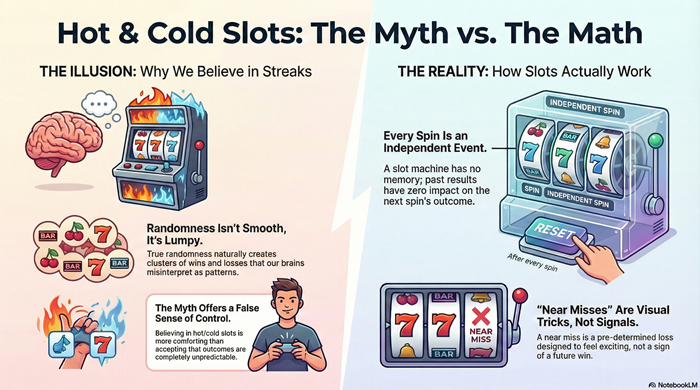
Slot outcomes are random, but randomness does not produce smooth, evenly spaced results.
Instead, randomness naturally produces:
- Clusters of wins
- Extended losing streaks
- Irregular patterns
Humans are uncomfortable with randomness that doesn’t “look random.” We expect balance — a win after losses, a loss after wins. When outcomes violate that expectation, we assign meaning to the streak.
The streak feels real. The cause is not.
Independence of Spins: The Core Concept Most Players Miss
Every slot spin is independent.
This means:
- A win does not make another win more likely
- A loss does not increase the chance of a win
- The slot has no memory
Independence is not intuitive. Humans naturally think in sequences and momentum. Slot machines operate on probability.
A slot that has lost for 200 spins has the same odds on the 201st spin as it did on the first.
Why “Due” Is a Dangerous Word in Slots
Many players believe a slot is “due” to pay.
This belief assumes:
- Losses accumulate credit
- Wins are delayed, not random
- Persistence is rewarded
In reality, slots do not track losses in a way that creates obligation. There is no balancing mechanism that forces a payout after a dry spell.
“Due” is a human concept applied to a non-human system.
Why Players Notice Hot Slots More Than Cold Ones
Confirmation bias plays a major role.
Players remember:
- Big wins
- Exciting streaks
- Times belief seemed correct
They forget:
- Long losing sessions
- Countless spins where nothing happened
- Machines labeled hot that went cold immediately
Hot slot stories spread because they are memorable. Cold slot experiences are common and unremarkable.
Near Misses Reinforce the Hot Slot Illusion
Near misses make a slot feel active.
Seeing:
- Two jackpot symbols line up
- A bonus symbol land just off-screen
creates the sense that the machine is close to paying. But near misses are visual arrangements, not probability signals.
The RNG already selected the losing outcome before the near miss appeared.
Near misses are designed to feel meaningful — not to indicate readiness.
Does Volatility Affect the Hot/Cold Perception?
Yes — but not the reality.
High volatility slots:
- Produce long losing streaks
- Occasionally deliver win clusters
These win clusters are often labeled “hot streaks.”
Low volatility slots:
- Produce frequent small wins
- Feel more consistent
Neither behavior indicates a change in odds. Volatility shapes how randomness feels, not how it works.
What About Casino Staff Advice?
Players sometimes claim casino staff point out hot machines.
In reality:
- Staff do not have access to future outcomes
- Casinos do not provide such tools
- Advice is often conversational, not factual
Even if a machine has just paid out, that information has zero predictive value.
Online Slots vs Land-Based Slots: Any Difference?
The hot/cold belief exists in both environments.
Online slots:
- Display outcomes rapidly
- Make streaks more visible
Land-based slots:
- Use physical presence to reinforce belief
- Encourage observation of others
In both cases, outcomes remain independent. The environment changes perception — not probability.
Why the Hot and Cold Myth Persists
This belief persists because it:
- Gives players a sense of control
- Explains losses emotionally
- Offers hope without evidence
Accepting randomness is uncomfortable. Believing in hot and cold slots is comforting.
Comfort, however, does not make something true.
What Understanding This Myth Actually Changes
Understanding that hot and cold slots don’t exist does not:
- Improve winning chances
- Eliminate losses
What it does change is behavior.
Players who abandon the hot/cold belief:
- Stop chasing machines
- Walk away sooner
- Make calmer decisions
Clarity reduces frustration. It does not reverse the math.
Continue Learning About Slot Machines
If you want to understand why hot and cold slot beliefs form — and why they don’t hold up under scrutiny — these guides explain the mechanics that actually govern slot outcomes:
- How Slot Machines Really Work
- What Is RTP in Slot Machines?
- Slot Volatility Explained (Low vs Medium vs High)
- RNG Explained — Are Slots Truly Random?
Each of these articles breaks down a core concept that explains why slots feel reactive even though they are not.
Final Thought: Streaks Are Real, Signals Are Not
Slots produce streaks because randomness demands it. What they do not produce are signals, phases, or moods.
A hot slot is simply a slot that just paid.
A cold slot is simply a slot that hasn’t — yet.
Understanding that difference doesn’t make slots kinder.
It makes expectations realistic.