
What Is RTP in Slot Machines?
🎰📈 RTP is one of the most cited — and most misunderstood — terms in slot machines. Players see percentages like 94%, 96%, or 98% and assume those numbers describe what they will get back. In reality, RTP does something very different.
RTP doesn’t predict outcomes, smooth losses, or protect bankrolls. It describes how expensive a slot machine is over a very long period of play. Understanding that difference is critical. As explained in our guide on how slot machines really work, slot outcomes are governed by fixed probabilities, not player behavior.
This article explains what RTP actually means, how it’s calculated, why it’s often misunderstood, and how players should — and should not — use it when choosing slot games.
What RTP Actually Stands For
RTP stands for Return to Player.
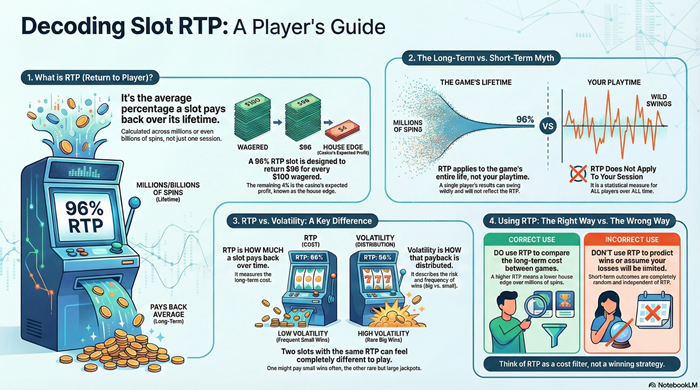
It is expressed as a percentage and represents the average amount of money a slot machine returns to players over time, relative to the total amount wagered.
For example:
- A slot with 96% RTP is programmed to return $96 for every $100 wagered
- The remaining $4 represents the casino’s expected profit (house edge)
This return is calculated across millions or billions of spins, not individual sessions.
RTP Is a Long-Term Mathematical Average
This is the most important concept to understand.
RTP applies:
- Over very large sample sizes
- Across all players combined
- Over the lifetime of the game
It does not apply:
- Per session
- Per player
- Per hour
- Per deposit
A single player can experience massive swings that have nothing to do with RTP in the short term.
Why RTP Does Not Predict Your Results
Many players misinterpret RTP as a promise.
Common incorrect assumptions:
- “This slot will give me most of my money back”
- “I won’t lose much on a high-RTP slot”
- “Losses are limited”
None of these are true.
A 96% RTP slot can:
- Lose 100% of your session bankroll
- Pay nothing for hundreds of spins
- Deliver wins in extreme clusters
RTP only describes expected behavior over massive repetition, not fairness in the moment.
For example, if you spin a 96% RTP slot 1,000 times, the expected amount returned may be roughly $960 for every $1,000 wagered — but actual outcomes can vary widely in the short term due to randomness. RTP only stabilizes toward its theoretical value over millions of spins.
How RTP Is Calculated
RTP is calculated during game design and testing. Developers simulate millions or billions of spins to ensure the game’s payout percentage matches the advertised RTP, and independent regulatory bodies often verify this during certification.
Developers:
- Assign probabilities to symbol combinations
- Define payouts for each combination
- Simulate millions of spins
- Adjust payout tables until the desired RTP is reached
Once the game is approved and deployed, RTP is fixed. Casinos do not change RTP dynamically based on players, time of day, or recent wins.
RTP vs House Edge (They Are Linked)
RTP and house edge are two sides of the same coin.
- RTP + House Edge = 100%
So:
- 96% RTP → 4% house edge
- 94% RTP → 6% house edge
Lower RTP means the slot is more expensive to play over time.
This is why RTP is best understood as a cost metric, not a reward metric.
Why RTP Differences Matter (Even When They Seem Small)
A 2% RTP difference sounds insignificant.
In practice:
- It compounds across every spin
- It scales with bet size
- It accelerates losses over time
For players who spin frequently, small RTP differences translate into meaningfully different bankroll drain rates.
This effect is invisible in short sessions but obvious over longer play.
RTP vs Volatility (Common Confusion)
RTP and volatility describe different things. While RTP sets the expected long-term return, volatility determines how that return is distributed, meaning frequent small wins can occur on a low-volatility game while a high-volatility game may pay less often but with larger amounts.
- RTP = how much a slot returns over time
- Volatility = how that return is distributed
Examples:
- High RTP + high volatility → rare big wins, long dry spells
- Lower RTP + low volatility → frequent small wins, steady losses
Two slots with the same RTP can feel completely different because volatility controls experience, not cost.
Why High RTP Slots Can Still Feel Brutal
Players often feel confused when high-RTP slots perform poorly.
This happens because:
- RTP doesn’t limit short-term losses
- High volatility delays payouts
- Wins cluster unpredictably
A high-RTP slot can still produce long losing streaks — and often does.
RTP does not smooth variance. It coexists with it.
Do Online Slots Have Higher RTP Than Casino Slots?
Often, yes — but not always. RTP percentages are often clearly published in online slots but less visible in land-based machines, even though both use the same return calculation methods.
Online slots:
- Frequently disclose RTP
- Often offer multiple RTP versions
- Tend to be more transparent
Land-based slots:
- Rarely display RTP publicly
- Often run lower RTPs on average
- Rely on player ignorance
However, transparency does not equal generosity. A disclosed low RTP is still a low RTP.
Why RTP Is Sometimes Hidden or Confusing
Casinos and platforms may:
- Bury RTP in help menus
- Offer multiple RTP configurations
- Avoid displaying it prominently
This is because RTP clarity makes cost comparison easy — and easy comparisons reduce profit.
RTP isn’t hidden because it’s dangerous knowledge.
It’s hidden because it’s useful knowledge.
How Players Should Use RTP Correctly
RTP should be used to:
- Compare slot costs
- Avoid extremely low-return games
- Set realistic expectations
- Understand why losses accumulate
RTP should not be used to:
- Predict wins
- Justify extended sessions
- Choose bet timing
- Override volatility considerations
RTP is a filter, not a strategy.
RTP Does Not Make Slots Beatable
This matters.
Even the highest RTP slots:
- Still favor the casino
- Still produce long-term losses
- Still rely on randomness
RTP tells you how expensive a game is, not whether it can be beaten.
There are no positive-expectation slot machines for players.
Why Players Overvalue RTP
Players overvalue RTP because:
- Percentages feel precise
- Higher numbers feel safer
- It’s one of the few visible metrics
In reality, RTP is only one dimension of a much larger system that includes volatility, speed of play, and psychological design.
Understanding RTP is necessary — but not sufficient.
The Real Value of Understanding RTP
Understanding RTP gives players:
- Clarity instead of hope
- Context instead of superstition
- Awareness instead of illusion
It doesn’t create winning sessions.
It prevents misunderstanding losses.
That alone is valuable.
Continue Learning About Slot Machines
- How Slot Machines Really Work
- Slot Volatility Explained (Low vs Medium vs High)
- How Slot Odds Are Determined
- RNG Explained: Are Slots Truly Random?
Final Thought: RTP Explains Cost, Not Outcomes
RTP is not a promise.
It’s not a safety net.
It’s not a strategy.
It is a mathematical description of how much a slot machine keeps over time.
Players who understand that stop asking when a slot will pay — and start recognizing when the cost is no longer worth the experience.
That shift is the beginning of honest slot play.