
RNG Explained — Are Slots Truly Random?
🎰🎲 Few casino concepts are surrounded by as much suspicion as randomness. Many slot players believe machines are programmed to tighten, loosen, react to wins, or respond to player behavior. Others suspect that randomness is selective — applied only when it benefits the casino.
The truth is both simpler and more uncomfortable: slot machines rely on true randomness, but that randomness operates inside a structure that always favors the house. To understand how that can be true at the same time, you need to understand how RNGs work. As explained in our guide on how slot machines really work, every slot outcome is generated by fixed probabilities applied through random number generation, not by reactive machine behavior.
This article explains what a Random Number Generator (RNG) actually is, how it determines slot outcomes, why randomness doesn’t make slots fair, and why many players misunderstand what “random” really means in casino games.
What an RNG Actually Is
An RNG, or Random Number Generator, is a software algorithm designed to produce unpredictable numerical sequences.
In slot machines, the RNG:
- Runs continuously, even when no one is playing
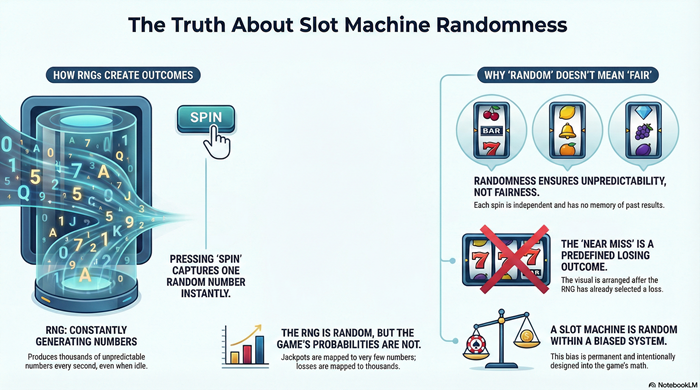
- Generates thousands of numbers every second
- Selects a number the instant a player presses spin
That number is then mapped to a predefined outcome in the game’s logic.
The RNG does not decide payouts. It selects outcomes from a pool whose probabilities were already defined when the slot was designed.
Why RNGs Run Continuously
A common myth is that RNGs activate only when you press spin. They do not.
RNGs run continuously so that:
- Outcomes cannot be timed
- Player behavior cannot influence results
- Spins cannot be predicted
By the time you see reels spinning, the result has already been determined.
Stopping reels early, delaying spins, or changing bet timing has no effect on the RNG’s selection.
RNG vs Probability: Clearing Up a Key Confusion
Randomness does not mean equal odds.
This is where many misunderstandings begin.
The RNG selects numbers randomly, but the probabilities assigned to outcomes are not equal. Rare outcomes are mapped to fewer numbers. Common outcomes are mapped to many.
For example:
- A jackpot outcome might be linked to one possible number
- A losing outcome might be linked to thousands
The RNG is fair in selection. The game design is not fair in distribution.
Why RNG Randomness Doesn’t Make Slots Fair
Players often assume that randomness implies fairness or balance. It does not.
Randomness ensures:
- Unpredictability
- Independence between spins
- No memory or pattern
It does not ensure:
- Even wins
- Short-term balance
- Protection against loss
Slots are random within a biased system. The bias is intentional and permanent.
Are Online Slots More Random Than Casino Slots?
Both online and land-based slots use RNGs.
The difference lies in:
- Transparency
- Regulation
- Disclosure
Online slots:
- Often disclose RNG certification
- May publish RTP publicly
- Are frequently audited
Land-based slots:
- Rarely show RTP
- Rely on regulatory approval without disclosure
- Use proprietary systems
Despite these differences, both rely on the same core RNG principle.
Can Casinos Manipulate RNGs During Play?
This is a common fear — and one worth addressing clearly.
Casinos:
- Cannot adjust RNG behavior per player
- Cannot switch odds mid-session
- Cannot tighten machines in real time
Slot machines are certified and regulated. Changing RNG behavior dynamically would violate gaming regulations and risk massive penalties.
What casinos can do is choose games with lower RTPs and higher volatility — decisions made before the game goes live.
Why Long Losing Streaks Still Happen in Random Systems
Randomness does not prevent streaks.
In fact, randomness guarantees that streaks will occur.
In slot play:
- Losing streaks are common
- Winning clusters occur unpredictably
- Long dry spells are normal
Humans interpret streaks as signals. Random systems produce streaks naturally.
The RNG is not reacting. It is behaving exactly as expected.
Near Misses and the Illusion of RNG Manipulation
Near misses make randomness feel suspicious.
Seeing:
- Two jackpot symbols align
- A bonus symbol miss by one position
creates the feeling that the RNG is “almost paying.”
In reality:
- Near misses are predefined outcomes
- They are visually arranged after the RNG selects the result
- They do not represent increased probability
Near misses exploit perception, not probability.
Why RNGs Make Slot Advice Useless
Advice based on:
- Timing spins
- Switching machines
- Playing after wins
- Avoiding “cold” slots
fails because RNGs eliminate memory and reaction.
Every spin:
- Is independent
- Has identical probability structure
- Ignores prior outcomes
RNGs remove momentum from the equation entirely.
Random Does Not Mean Randomly Generous
This distinction matters.
Slots are random in selection, not in generosity.
The house edge:
- Is built into probability mapping
- Applies to every spin
- Persists regardless of randomness
Randomness determines which outcome occurs, not whether outcomes are fair.
What Understanding RNGs Actually Gives Players
Understanding RNGs does not:
- Improve odds
- Reveal patterns
- Enable strategy
What it does provide is:
- Immunity to myths
- Resistance to manipulation narratives
- Clear expectations about streaks
Understanding RNGs helps players stop chasing meaning in noise.
Continue Learning About Slot Machines
If you want to see how randomness fits into the larger structure of slot machine design and player experience, these guides explain the related mechanics that shape outcomes:
- How Slot Machines Really Work
- What Is RTP in Slot Machines?
- Slot Volatility Explained (Low vs Medium vs High)
- How Slot Odds Are Determined
Each of these articles explains one core component of slot machines and why randomness does not translate to fairness or control.
Final Thought: Randomness Explains Unpredictability, Not Opportunity
Slot machines are random — but randomness is not a gift to players.
It exists to prevent prediction, not to provide balance. Once you understand that randomness operates inside a system with a built-in cost, the mystery fades.
What remains is clarity.
Clarity doesn’t beat slots.
It prevents confusion from making them more expensive than they already are.