
Blackjack Probability & Odds Explained: Why Math Beats Feeling
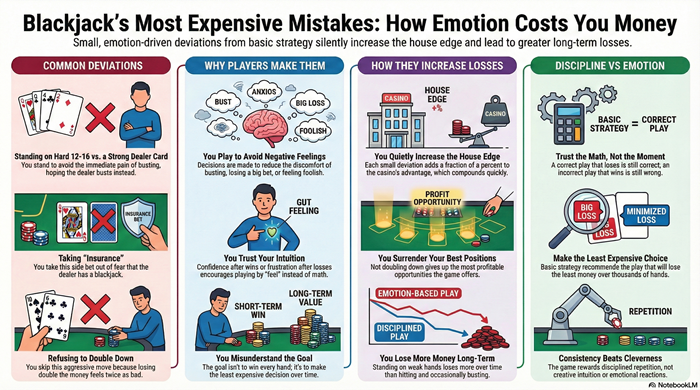
📈 Most blackjack players believe they understand odds — until the cards start falling the “wrong” way. A dealer makes five strong hands in a row, a hard 16 busts twice, and suddenly the game feels unfair or broken. In reality, nothing unusual is happening. What’s missing is an understanding of probability.
Blackjack is a game of incomplete information, not intuition. Every decision a player makes carries a statistical weight, whether they feel it or not. As explained in our Blackjack Basic Strategy guide, correct play is built entirely on probability and expected outcomes, not streaks or short-term results.
This article explains how blackjack probabilities work, why outcomes feel deceptive in the moment, and how understanding odds helps players stay disciplined and realistic.
🧠 What Probability Means in Blackjack
Probability in blackjack refers to the likelihood of a specific outcome occurring — such as busting, winning, losing, or pushing — based on the cards remaining in the deck and the rules of the game.
Unlike pure chance games, blackjack probabilities shift slightly with each card dealt. However, those shifts are small enough that basic strategy assumes average conditions, producing decisions that perform best over time.
Probability does not predict individual hands. It predicts trends over thousands of hands.
🎯 The Odds of Busting in Blackjack
One of the most important probabilities players misunderstand is busting.
For example:
- A hard 12 has a low bust risk
- A hard 16 has a high bust risk
- A soft hand cannot bust on the first hit
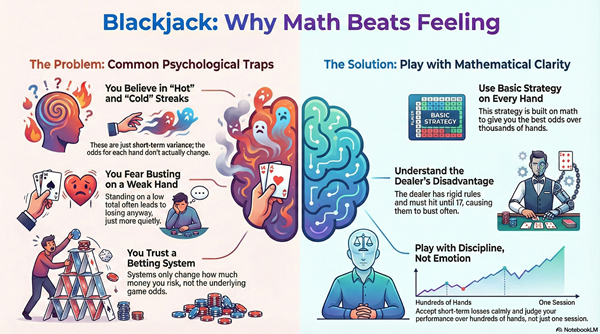
The problem is that players focus on fear of busting, not on what happens if they stand. Standing on weak totals often leads to losing anyway — just more quietly. Basic strategy chooses the option with the lowest expected loss, even if it feels aggressive.
🂡 Dealer Odds vs Player Odds
Dealer rules heavily influence probabilities.
Key facts:
- Dealers must hit until reaching at least 17
- Dealers cannot adapt or stop early
- Dealers bust more often than players realize
Because players act first, weak player hands feel more dangerous. In reality, dealer bust probability is one of the reasons hitting on marginal totals is often correct.
Probability favors action more often than emotion does.
📊 Why Blackjack Feels “Streaky”
Many players believe tables go hot or cold. This is a psychological response to variance, not a change in odds.
Short-term probability clusters outcomes:
- Wins can bunch together
- Losses can appear back-to-back
- Rare events feel memorable
This does not mean odds have changed. Each hand is still governed by the same underlying probabilities. Blackjack math has no memory.
🧪 Probability vs Expected Value
Probability answers “How often does this happen?”
Expected value answers “What does this cost over time?”
A play with a high probability of winning can still have a negative expected value if the losses are larger than the wins. This is why some “safe” plays are actually expensive in the long run.
Basic strategy exists because it balances probability and payout together — not because it avoids losing hands.
🧠 Why Systems Fail to Change the Odds
Betting systems do not alter probability. They only change how much money is exposed to the same odds.
Whether you bet:
- The same amount every hand
- More after losses
- More after wins
…the underlying probabilities remain unchanged. This is why systems can feel effective temporarily but fail over time.
Understanding probability makes this obvious.
📉 How Rule Changes Affect Probabilities
Rules slightly shift probabilities by changing:
- Dealer behavior
- Payouts
- Player options
For example:
- H17 rules give dealers more chances to improve
- 6:5 payouts reduce blackjack value
- No surrender forces players into poor outcomes
These changes don’t feel dramatic hand-to-hand, but they significantly alter long-term results.
📌 How to Use Probability as a Player
You don’t need to calculate odds mid-hand. You just need to respect them.
Smart players:
- Use basic strategy consistently
- Accept short-term losses calmly
- Avoid reacting emotionally to streaks
- Judge performance over hundreds of hands
Probability rewards discipline, not bravery.
🔚 Final Thought: Odds Don’t Care How You Feel
Blackjack probability does not respond to confidence, fear, or frustration. It doesn’t punish bad days or reward good instincts. It simply plays out over time.
Once players understand that, the game becomes quieter and more honest. Decisions feel less personal. Losses feel less insulting. Wins feel less misleading.
That clarity is what math gives you — if you let it.
🔗 Recommended Internal Links