
Soft Hands vs Hard Hands in Blackjack: What’s the Difference and Why It Matters
🂡 Few concepts in blackjack confuse players more than the difference between soft hands and hard hands. Many people know the basic definition, but far fewer understand why those differences change the correct decision — sometimes dramatically.
This confusion leads to one of the most expensive categories of mistakes in blackjack: playing soft hands too cautiously and hard hands too emotionally. As explained in our Blackjack Basic Strategy guide, optimal blackjack play depends on recognizing hand type first, then choosing the correct action based on probability — not comfort.
This article explains what soft and hard hands are, how they behave differently, and why misunderstanding them quietly increases the house edge over time.
🧠 What Is a Soft Hand?
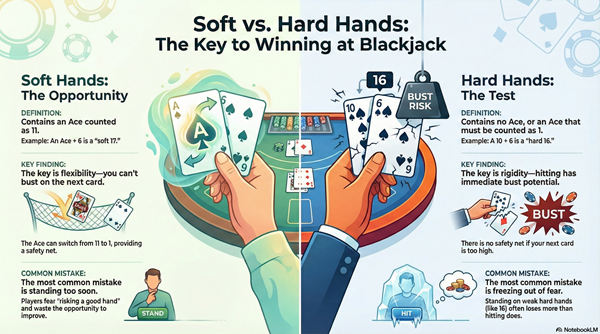
A soft hand is any hand that contains an Ace counted as 11 without causing the total to exceed 21.
Examples:
- Ace + 6 = soft 17
- Ace + 3 = soft 14
- Ace + 7 = soft 18
The defining feature of a soft hand is flexibility. If you draw a high card, the Ace can convert from 11 to 1, preventing an immediate bust.
This built-in safety net is what allows soft hands to be played more aggressively than most players expect.
🧱 What Is a Hard Hand?
A hard hand is any hand where:
- There is no Ace, or
- The Ace must be counted as 1 to avoid busting
Examples:
- 10 + 6 = hard 16
- Ace + 6 + 10 = hard 17
- 9 + 7 = hard 16
Hard hands offer no flexibility. If you hit and exceed 21, the hand busts immediately. Because of this, hard hands feel more dangerous — and often cause players to freeze or play defensively.
🔍 The Key Difference Isn’t the Total — It’s the Risk Structure
Many players think the difference between soft and hard hands is the number shown on the table. That’s incorrect.
The real difference is risk asymmetry.
- Soft hands allow aggression with limited downside
- Hard hands punish mistakes immediately
This is why two hands that both total 18 can require completely different actions depending on whether the hand is soft or hard.
Understanding this distinction is critical to playing correctly.
🂱 Why Soft Hands Are Meant to Be Played Aggressively
Soft hands are one of the most misunderstood areas of blackjack strategy. Players routinely stand too early on soft totals because the number looks “good enough.”
In reality, many soft hands benefit from:
- Hitting to improve
- Doubling when conditions are favorable
- Pressing small advantages
The reason is simple: the Ace protects you from busting on the next card. When players treat soft hands cautiously, they waste that protection.
A soft hand is an opportunity, not a warning sign.
⚠️ The Most Common Soft Hand Mistake
The most frequent error with soft hands is standing too soon.
Players often stand on:
- Soft 17
- Soft 18
- Even soft 16
…because they don’t want to “risk a good hand.” The problem is that these hands often lose if they aren’t improved.
Standing on a soft hand that still needs improvement hands control to the dealer and increases expected loss over time.
🧱 Why Hard Hands Feel Worse (But Aren’t Always)
Hard hands generate stress because the consequences of hitting are immediate. There is no safety net, no conversion, no forgiveness.
Hands like:
- Hard 12
- Hard 15
- Hard 16
…are emotionally uncomfortable. Players feel trapped between busting and standing.
The math behind blackjack accepts that discomfort. In many cases, hitting a hard hand is still the least costly option — even when busting feels likely.
📉 Why Standing on Weak Hard Hands Often Costs More
Standing on a weak hard hand feels conservative. In reality, it often produces a guaranteed loss instead of a probabilistic one.
For example:
- Standing on hard 16 frequently loses to dealer totals
- Hitting may bust — but also creates chances to survive
Basic strategy chooses the option that loses the least on average, not the option that avoids embarrassment.
Avoiding a bust does not equal playing well.
🧠 How the Dealer’s Upcard Changes Soft vs Hard Play
Neither soft nor hard hands exist in a vacuum. The dealer’s upcard heavily influences which action is correct.
Against weak dealer upcards:
- Soft hands are often doubled or hit to maximize value
- Hard hands may stand earlier
Against strong dealer upcards:
- Soft hands may continue hitting
- Hard hands may be forced into risky hits
This is why memorizing totals without context leads to mistakes. Blackjack decisions are relational, not static.
📊 Soft Hands, Hard Hands, and Expected Value
Expected value (EV) explains why soft and hard hands are treated differently.
- Soft hands often have positive improvement potential
- Hard hands have binary outcomes (improve or bust)
The presence of an Ace fundamentally changes EV calculations. What looks like a “safe” hand may have poor long-term value if it cannot improve further.
This is why strategy charts treat soft and hard hands as separate categories.
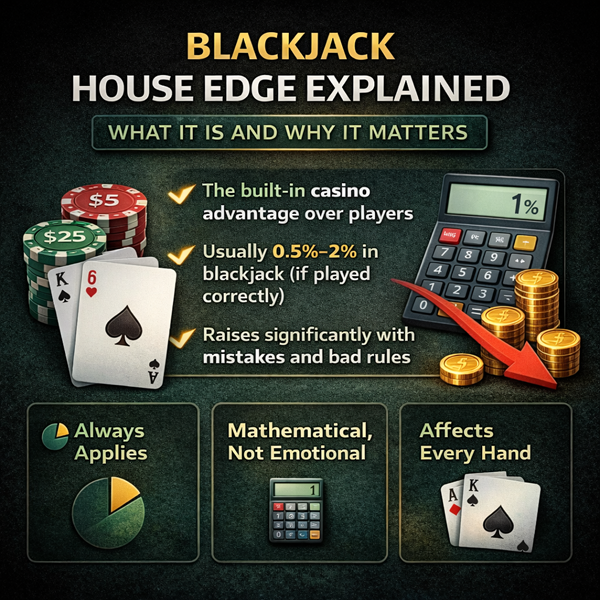
⚠️ How Misplaying Soft and Hard Hands Raises the House Edge
Every time a player:
- Stands too early on a soft hand
- Refuses to double when the Ace provides safety
- Freezes on a hard hand due to fear
…the house edge increases slightly.
These increases are subtle. They don’t show up immediately. But over hundreds of hands, they compound into a significant disadvantage.
Most players never notice because the losses feel random.
🧠 Why Intuition Fails Here
Human intuition struggles with asymmetric risk. Soft hands violate our instincts because:
- They look stronger than they are
- They allow “mistakes” without punishment
- They reward aggression that feels unsafe
Hard hands punish mistakes instantly, making players overly cautious.
Blackjack strategy corrects for these psychological biases. Ignoring that correction leads to predictable errors.
📌 How to Fix Soft vs Hard Hand Mistakes
Improvement starts with categorization.
Before making any decision:
- Identify whether the hand is soft or hard
- Consider the dealer’s upcard
- Choose the action that minimizes expected loss
Do not skip step one. Many incorrect decisions are made before strategy is even applied.
🔚 Final Thought: Hand Type Comes First
In blackjack, the number on the table is not enough. You must understand how that number is built.
A soft hand is an opportunity to push.
A hard hand is a test of discipline.
When players confuse the two, blackjack becomes expensive. When they separate them correctly, the game becomes far more predictable — and far less emotional.
🔗 Recommended Internal Links