
The Math Behind the Spin: Decoding the Mechanics of Online Casino Games
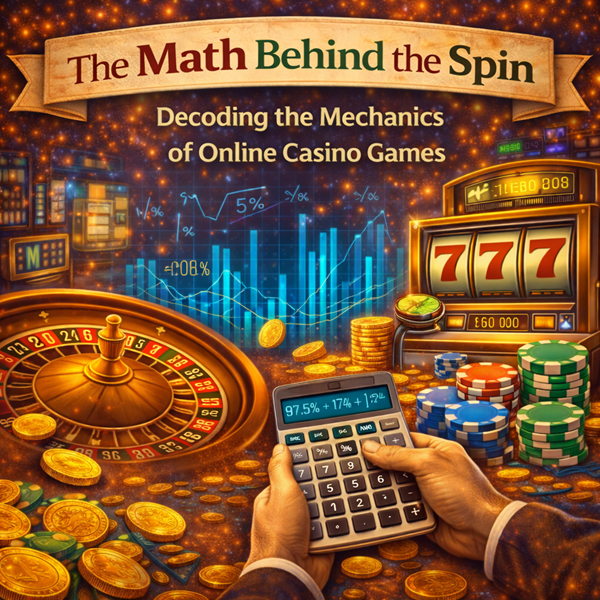
This analysis explores the structural mathematical mechanics—including RNG, RTP, and volatility—that fundamentally dictate the online gambling experience. By looking past the visual “skin” and marketing of these games, players can understand how outcomes are determined by software rather than luck or timing. This technical clarity serves as the only effective defense against the house’s inherent structural advantages, enabling players to move beyond common emotional misconceptions.
The Illusion of Randomness and the RNG
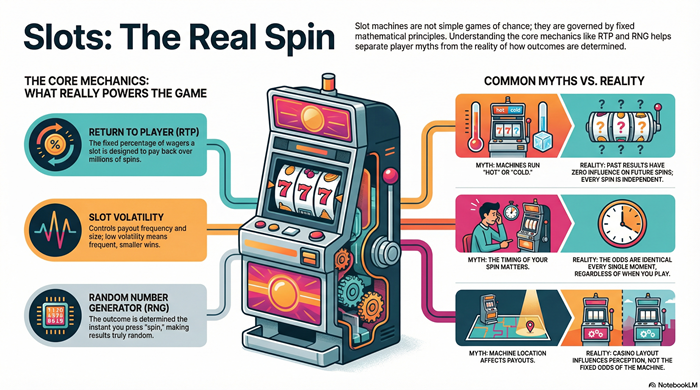
Online casino outcomes are governed by a Random Number Generator (RNG), a software engine that replaces human intuition with cold, mathematical noise. While the brain is evolved to seek patterns in any environment, the digital gambling landscape is intentionally designed to be a signal-free environment where every result is independent of the last.
- The Random Number Generator (RNG) is a software engine that produces sequences of numbers at an extraordinary speed, functioning constantly whether a person is actively playing or not.
- Because the RNG is generating billions of numbers thousands of times per second, the exact millisecond a player presses “spin” is what captures the specific result, though this timing remains impossible to control.
- The “gambler’s fallacy” is the irrational but common belief that past independent events influence future outcomes, whereas true randomness possesses no memory and never makes a machine “due” for a win.
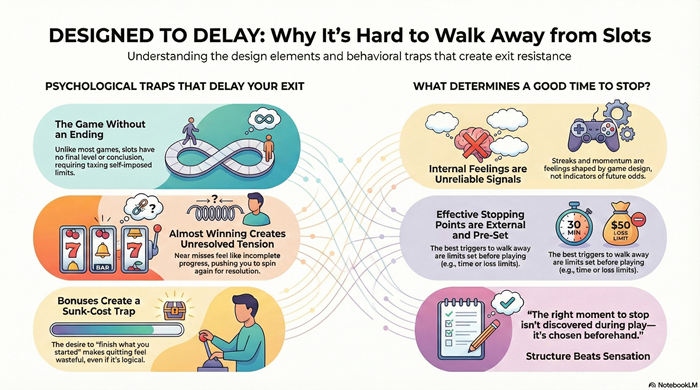
- Mathematical analysis reveals that “near misses” are nothing more than intentional visual design features; the proximity of symbols to a payline reflects nothing except the current position of a few pixels and does not indicate an imminent payout.
RTP: The Long-Run Average vs. The Session Reality
Return to Player (RTP) is a headline figure often used to gauge the fairness of a game, yet it is frequently misinterpreted as a guarantee of a single session’s performance. To evaluate this metric accurately, one must distinguish between the theoretical mathematical model and the volatile reality of active play.
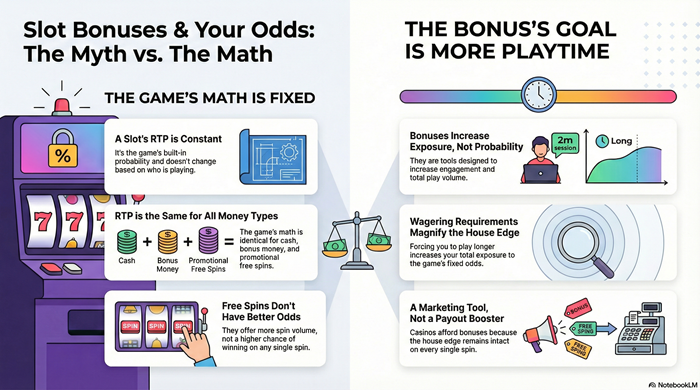
- Return to Player (RTP) is defined as the theoretical percentage of all wagered money that is paid back to the collective player base over the course of tens of millions of spins.
- A critical disconnect exists between a short session of 200 spins and the massive data set of roughly 50 million spins required for the theoretical RTP to actually assert itself mathematically.
- Players should be aware that casinos often configure games within a permitted range, meaning the RTP listed on third-party review sites may not match the actual configuration found in a specific platform’s in-game help section.
- A small 3% difference in RTP—the gap between a 94% and 97% configuration—effectively doubles the theoretical cost of play; a regular player wagering £20,000 annually would expect to lose £600 at 97% RTP compared to £1,200 at 94%.
Understanding Volatility and Your Bankroll
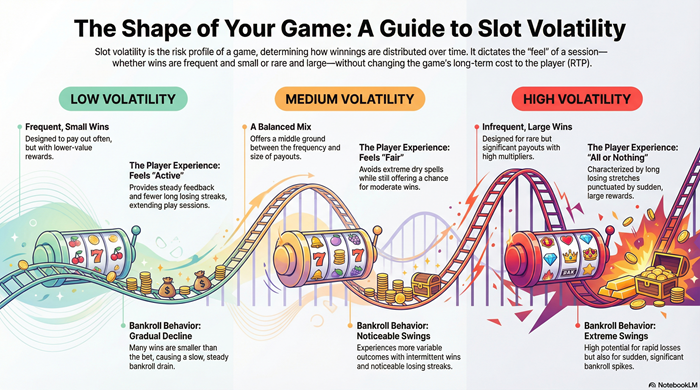
Volatility, or variance, describes the specific mathematical “path” a game takes to reach its average return. While two games may share an identical RTP, their volatility profiles dictate whether a player encounters a predictable decline or a turbulent session defined by long droughts and high-value spikes.
- Volatility measures the spread between outcomes, contrasting low-volatility games that offer frequent small wins with high-volatility games that produce infrequent but significantly larger payouts.
- To survive the inevitable long “dry spells” of a high-volatility game, players require a significantly larger bankroll buffer, with analysts suggesting 200 to 400 times the stake to remain in the game.
- It is vital to understand that volatility determines the specific distribution of payouts, often involving exhausting stretches of silence followed by a spike, rather than changing the total mathematical return.
- Players should choose volatility levels based on their goals—such as sustained entertainment versus chasing a significant win—while remembering that playing high-volatility slots with a small bankroll is mathematically equivalent to leaving a cinema after fifteen minutes.
The Persistent Reality of the House Edge
The house edge is the mathematical certainty that ensures casino profitability without the need for game manipulation. Because this edge is a structural component of the rules and paytables, the house is inherently “patient,” allowing the math to work across millions of bets.
- The house edge is the mathematical inverse of RTP, representing the specific percentage of every bet that the casino expects to retain with mathematical certainty over the long run.
- Because the edge is built directly into the game’s structural design, there is no need for a casino to manipulate outcomes or “rig” games to ensure they remain profitable businesses.
- In games of pure chance like slots or roulette, no player strategy, “lucky routine,” or betting pattern can alter the built-in mathematical house edge.
- While games like Blackjack allow players to apply “basic strategy” to reduce the house edge to between 0.5% and 1%, the advantage is never eliminated, and short-term variance is powerful enough to mask this reality during a single session.
For More
For additional practical insights and detailed information on game mechanics, visit the Slot Machine Guides. Plus, for a more detailed look on the above, the Ebook “Rigged by Design: How Online Gambling Really Makes Money” is available on Google Books and Amazon.