
Why Slot Machines Feel “So Close” Even When Nothing Is Changing
🎰🔍 Slot play is full of moments that feel meaningful: reels stop just short, bonus symbols cluster, jackpots loom large, and the next spin seems promising. Players often describe these moments as being “right there” or “almost hitting.”
But nothing is actually moving closer. Odds aren’t improving. Progress isn’t accumulating. The feeling of closeness is an illusion created by how outcomes are presented, not by how they are determined. To understand why this sensation is so persistent, you have to separate probability from perception. As explained in our guide on how slot machines really work, each spin is independent and governed by fixed probabilities — even when the experience suggests momentum.
This article explains why slots feel close to paying, how design sustains that feeling, and why chasing it increases cost without changing outcomes.
What “Feeling Close” Actually Refers To
When players say a slot feels close, they usually mean:
- Symbols frequently align near paylines
- Bonus triggers appear repeatedly
- Jackpots are visually emphasized
- Wins and losses feel tightly spaced
These signals don’t measure probability. They measure attention.
Closeness is an emotional interpretation of presentation — not a statistical reality.
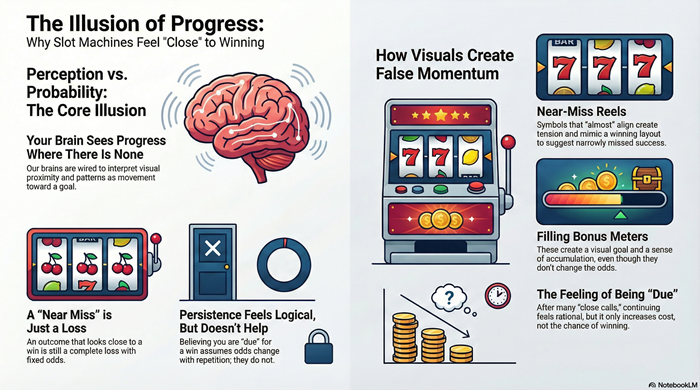
Why the Brain Interprets Visual Proximity as Progress
Humans are pattern-seeking.
When elements repeatedly appear near each other:
- The brain infers movement
- Near outcomes feel connected
- Continuation feels justified
In slots, visual proximity substitutes for actual progress. Seeing symbols “almost” align feels like advancement, even though no underlying variable has changed.
Near Misses Reinforce the Illusion
Near misses are the most direct source of perceived closeness.
They:
- Mimic winning layouts
- Create unresolved tension
- Suggest narrowly missed success
But a near miss is a fully losing outcome. The jackpot or bonus result was never selected.
The closeness exists only in how the loss is displayed.
Why Bonus Meters Create False Momentum
Bonus meters fill, flash, and reset.
This creates:
- A sense of accumulation
- A visual goal
- Emotional investment
But bonus meters don’t reflect probability. They track presentation states, not likelihood.
Completion feels earned, even though the odds never shifted.
Jackpot Displays Magnify Perceived Proximity
Large jackpot numbers dominate attention.
As jackpots grow:
- Visibility increases
- Emotional pull strengthens
- Urgency forms
Yet jackpot odds remain fixed. The meter affects reward size, not chance.
Bigger numbers feel closer, even when they’re statistically unchanged.
Why Frequent Feedback Sustains “Almost” Feelings
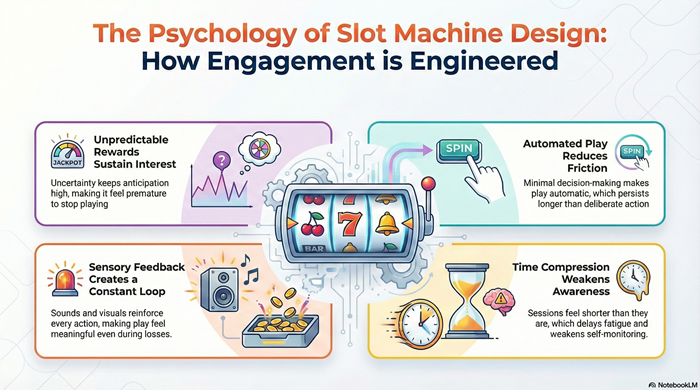
Slots are designed to minimize dead space.
Frequent:
- Animations
- Sounds
- Micro-events
ensure the session feels active. Activity creates the impression that something is happening — even when outcomes are static.
Motion replaces meaning.
The Role of Volatility in Perceived Closeness
High-volatility slots heighten contrast.
They produce:
- Long losing stretches
- Rare big wins
- Dramatic near events
This contrast makes the next big event feel imminent, even when probability says otherwise.
Contrast sharpens expectation without improving odds.
Why Persistence Feels Logical
When closeness feels constant, persistence feels rational.
Players think:
- “It has to hit eventually”
- “I’ve seen it so many times”
- “I’m due”
These beliefs assume probability responds to repetition. It does not.
Repetition increases cost — not likelihood.
How Time Distortion Amplifies Closeness
When sessions feel short:
- Multiple near events feel condensed
- Progress seems rapid
- Outcomes feel linked
Time compression makes isolated events feel like steps in a sequence.
Sequence implies movement. Slots provide none.
Why Closeness Feels Better Than Losing
Clear losses prompt stopping.
Near losses:
- Maintain hope
- Reduce finality
- Delay exit decisions
Feeling close is emotionally easier than accepting loss. That comfort keeps players engaged longer.
Online Slots Intensify the Effect
Online slots amplify closeness by:
- Faster spins
- Cleaner visuals
- Persistent overlays
Closeness cues appear more frequently, accelerating the illusion of momentum.
Speed compresses distance.
Why Understanding This Illusion Is Uncomfortable
Recognizing that nothing is changing:
- Removes hope-based logic
- Challenges intuition
- Disrupts immersion
Discomfort often drives players to ignore the explanation rather than accept it.
The illusion survives because it feels better than the truth.
What Understanding “Closeness” Changes
Understanding perceived closeness does not:
- Improve odds
- Predict wins
What it changes is interpretation.
Players who recognize the illusion:
- Stop chasing “almosts”
- Evaluate sessions more clearly
- End play intentionally
Awareness dissolves false momentum.
Continue Learning About Slot Machines
If you want to understand how perception repeatedly overrides probability in slot play, these guides explain the mechanisms behind that disconnect:
- How Slot Machines Really Work
- How Near Misses Manipulate Player Perception
- Why Small Wins Feel Like Progress
- Why Slot Sessions Feel Shorter Than They Are
- Why Slot Jackpots Feel Closer Than They Are
- When to Walk Away From Slot Play
- Why Slot Machines Never Feel Finished
Each article explains one way slot design creates the illusion of movement without change.
Final Thought: Feeling Close Is Not Being Close
Slot machines don’t move toward payouts.
They repeat probabilities.
Feeling close is a psychological state created by presentation, not evidence of progress. The moment you recognize that, “almost” loses its power.
Nothing is getting closer — and that knowledge is freeing.