
Why Betting Systems Fail in Baccarat
Betting systems fail in baccarat for a structural reason: they attempt to change outcomes without changing the rules that generate those outcomes. Once baccarat is understood as a fixed probability system with independent hands and predetermined payouts, the failure of systems becomes unavoidable rather than surprising.
This article explains why no betting system—regardless of how it is framed—can overcome baccarat’s mathematics.
Fixed Expectation Cannot Be Rearranged
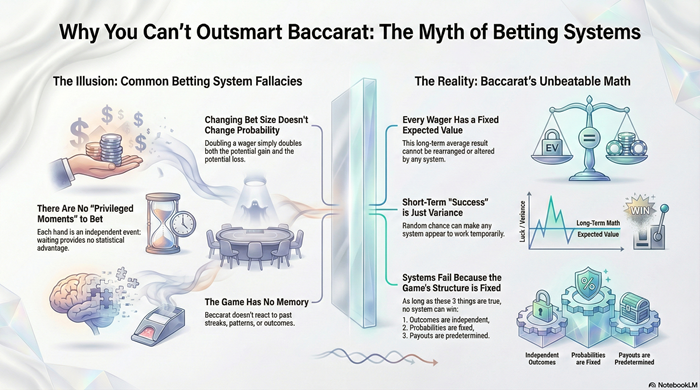
Every wager in baccarat has a fixed expected value. That expectation is determined by the relationship between probability and payout and applies independently to each hand.
A betting system may change:
- The order in which wins and losses appear
- The size of individual wins and losses
- The emotional experience of a session
It cannot change the average result per hand over time.
Reordering outcomes does not alter expectation. It only redistributes variance.
Bet Sizing Does Not Change Probability
Many systems rely on changing wager size in response to previous outcomes. The implicit assumption is that increasing or decreasing bet size can influence probability. In baccarat, it cannot.
Changing bet size:
- Scales risk and reward proportionally
- Increases exposure during unfavorable sequences
- Leaves the probability of outcomes unchanged
Doubling a wager doubles both potential gain and potential loss. It does not improve the odds. No sequence of bet sizes can convert a negative expectation into a positive one without altering probability itself.
Timing Assumes Privileged Moments
Some systems focus on timing—waiting for “the right moment” to bet. This assumes that certain points in a sequence are more favorable than others.
Baccarat does not support this assumption.
Each hand is resolved independently. Probability does not improve because a player waited, nor does it degrade because a player acted earlier. There are no privileged moments embedded in the game’s structure.
Timing changes participation, not probability.
Outcome Switching Relies on Memory That Does Not Exist
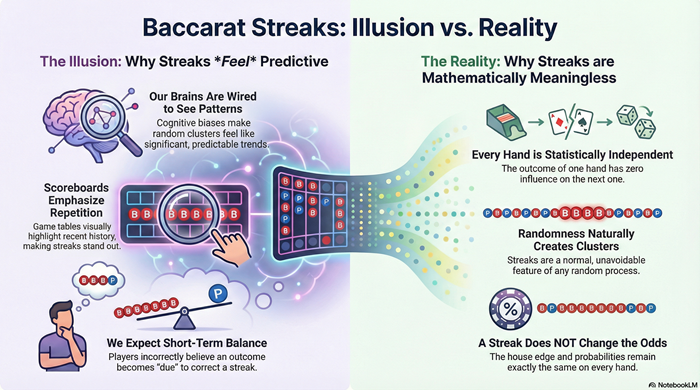
Another common system approach involves switching between outcomes based on recent history—changing wagers after streaks, alternations, or perceived shifts.
This assumes the game reacts to its own past.
Baccarat does not:
- Remember outcomes
- Correct streaks
- Compensate for imbalance
- Respond to pattern length
Switching outcomes changes the label on the wager, not the mechanism resolving the hand.
Variance Creates Temporary Validation
In the short run, variance allows systems to appear successful. Favorable sequences can align with almost any rule set by chance alone.
Systems often seem to work because:
- Losses are delayed rather than eliminated
- Wins occur early in a sequence
- Contradictory results are discounted or reinterpreted
Variance can mask expectation temporarily, but it cannot eliminate it.
Short-term success does not validate a system. It reflects randomness.
Systems Fail at the Structural Level
The failure of betting systems is not psychological or emotional. It is mathematical.
As long as:
- Outcomes are independent
- Probabilities are fixed
- Payouts are predetermined
No external rule set can alter the long-run result.
This conclusion does not depend on examining individual systems. It follows directly from the game’s structure.
Why Systems Continue to Be Invented
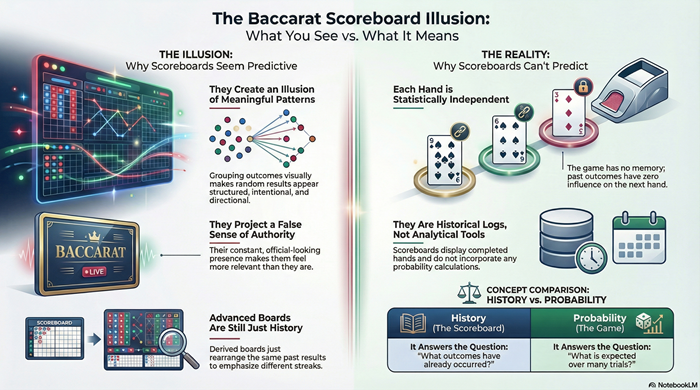
Systems persist because baccarat produces visible sequences that invite explanation. Scoreboards, streaks, and short-term swings provide material for interpretation.
When a system aligns with variance, confidence grows. When it fails, the failure is often attributed to execution rather than structure.
This cycle allows systems to survive even though none can succeed mathematically.
Understanding Ends the Search
Once baccarat is understood as a fixed probability system, the search for a system loses its foundation. There is no hidden mechanism to exploit, no timing window to capture, and no pattern to decode.
What remains is not strategy, but clarity.
Understanding does not change outcomes—but it explains them.