
Why Baccarat Hands Are Statistically Independent
This article is part of our complete guide on How Baccarat Really Works: Odds, House Edge, and Why Systems Fail, which explains baccarat odds, house edge, card structure, and why betting systems fail.
This article explains what statistical independence means in baccarat, why each hand is unaffected by previous outcomes, and why perceived patterns do not alter probability. It does not discuss betting methods, systems, or wagering behavior. Its purpose is to clarify a foundational probability concept that underpins all baccarat outcomes.
What “Statistical Independence” Means
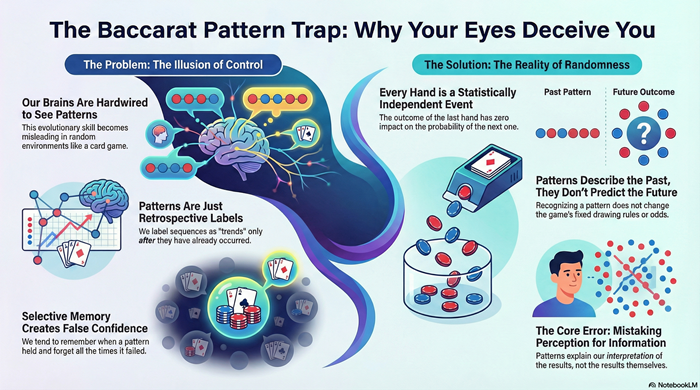
In probability theory, events are statistically independent when the outcome of one event does not influence the outcome of another. In baccarat, each hand is an independent event.
This means that once a hand is completed:
- Its result does not affect the next hand
- No outcome becomes more or less likely because of what just occurred
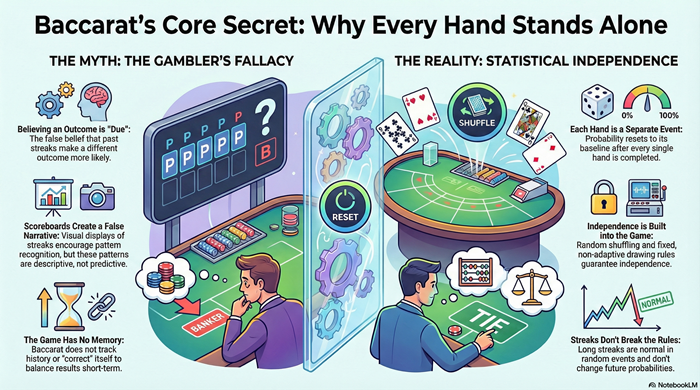
- Probability resets to its structural baseline every hand
Independence is a property of the game’s design, not a theory or assumption.
Why Baccarat Hands Are Independent by Design
Baccarat’s independence comes from the way the game is constructed:
- Cards are shuffled randomly before play
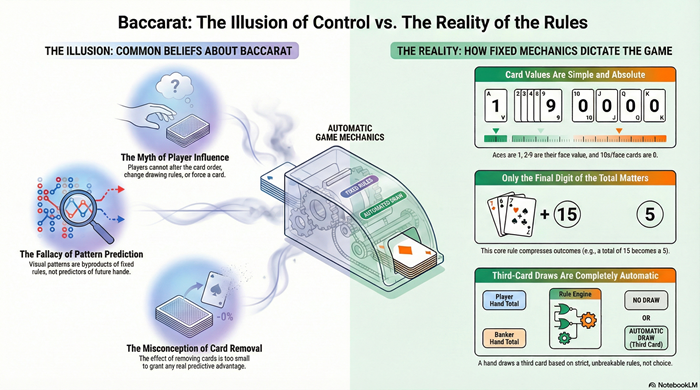
- Drawing rules are fixed and non-adaptive
- No player decisions influence card distribution
Once cards are shuffled into the shoe, the order is predetermined but unknowable. Each hand simply reveals the next portion of that order without altering the probabilities defined by the rules.
The game does not track history, adjust outcomes, or rebalance results.
Independence vs. Randomness: A Common Confusion
Randomness describes unpredictability. Independence describes non-influence. The two are related but not identical.
In baccarat:
- Outcomes are random because card order is unknown
- Outcomes are independent because rules do not respond to history
A streak does not violate randomness. A streak also does not reduce independence. Both concepts coexist without contradiction.
Why Previous Outcomes Do Not Change Future Probability
A frequent misconception is that probability should “correct itself” after a series of similar results. This belief assumes that the game actively enforces balance over short periods.
In baccarat:
- Probability balances only in aggregate
- No mechanism exists to favor underrepresented outcomes
- Short-term imbalance is normal, not anomalous
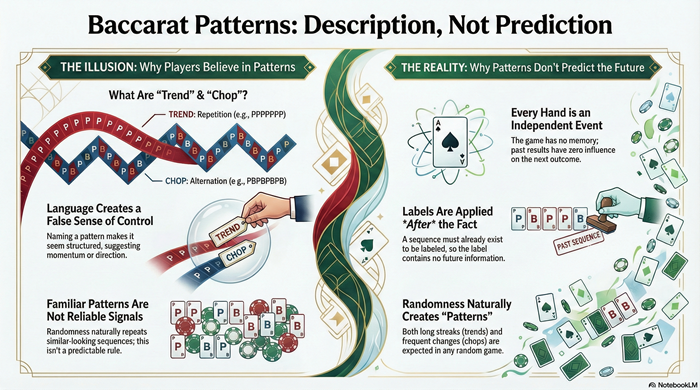
The game has no memory. Each hand is resolved using the same process, regardless of what came before.
The Gambler’s Fallacy in Baccarat
The belief that an outcome is “due” after a streak is known as the gambler’s fallacy. It arises from misunderstanding independence.
The fallacy assumes:
- Past frequency influences future probability
- Balance must occur within observable windows
- Outcomes compensate for one another
None of these assumptions apply to baccarat. Probability does not enforce fairness on human time scales.
Shoe Depletion and the Illusion of Dependency
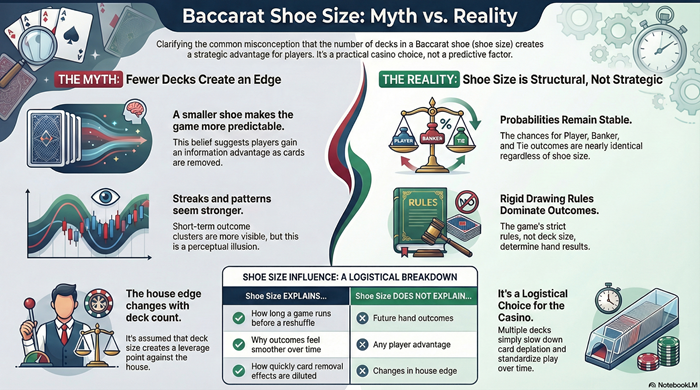
As cards are dealt, the composition of the shoe changes. While this is mathematically true, it does not negate independence in a practical sense.
Reasons shoe depletion does not create dependency:
- Drawing rules dominate outcome behavior
- Hand values are heavily compressed
- Small composition shifts have negligible effect relative to variance
Independence is preserved because no feedback loop exists between outcomes and future dealing.
Why Visual Patterns Feel Meaningful
Baccarat scoreboards and bead roads visually emphasize streaks and clusters. These displays encourage pattern recognition, even though the patterns are descriptive, not predictive.
Visual grouping creates the impression of structure, but it does not introduce dependency. The pattern exists only in hindsight.
What Statistical Independence Explains — and What It Does Not
Statistical independence explains:
- Why streaks can occur without changing probability
- Why outcomes do not self-correct
- Why timing-based interpretations fail
Statistical independence does not explain:
- Short-term volatility
- Session results
- Emotional responses to streaks
Misunderstanding independence is one of the primary reasons baccarat myths persist.
Conclusion: Independence Is the Non-Negotiable Rule
Every baccarat hand is resolved in isolation. No result influences the next. No outcome becomes due, delayed, or accelerated.
This is not a limitation of analysis—it is the foundation of the game. Any interpretation that assumes memory, correction, or momentum contradicts the mathematics that govern baccarat.