
What Baccarat Odds Actually Mean (And What They Don’t)
This article is part of our complete guide on How Baccarat Really Works: Odds, House Edge, and Why Systems Fail, which explains baccarat odds, house edge, card structure, and why betting systems fail.
What “Odds” Mean in Casino Games
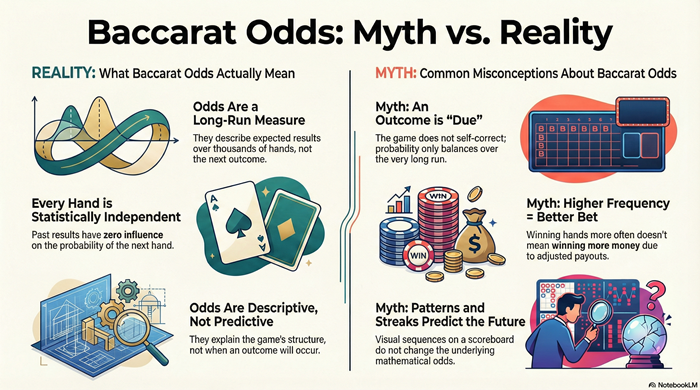
In casino games, odds are commonly misunderstood as a signal of opportunity. In reality, odds describe probability, not prediction. They indicate how often an outcome is expected to occur over a very large number of trials—not whether it is “likely” to happen next.
Odds do not account for timing, streaks, or recent outcomes. They are descriptive, not actionable. In baccarat, this distinction is critical because the game’s simplicity makes probability feel intuitive when it is not.
Probability Is a Long-Run Measure
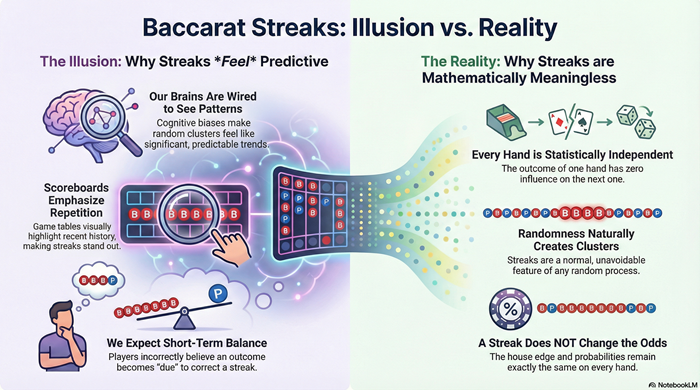
Probability only stabilizes in the long run. Short sessions produce noise, not evidence. A player may observe several identical outcomes in a row, but that observation does not alter the underlying probability of the next hand.
This gap between expectation and experience is where most baccarat misconceptions begin. Odds describe averages across thousands of hands, not patterns within a single shoe or session.
Baccarat’s Three Outcomes Explained by Probability
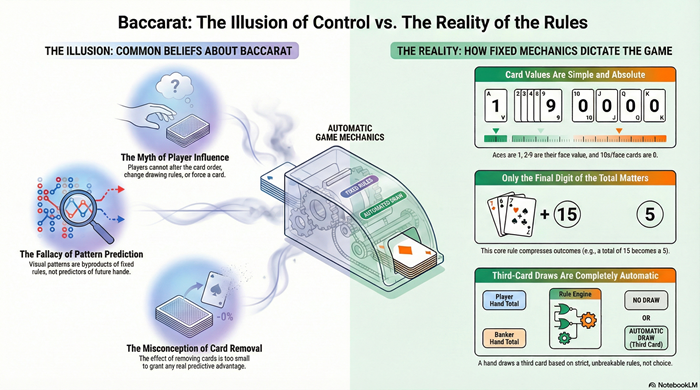
Each baccarat hand resolves into one of three outcomes: Player, Banker, or Tie. These outcomes are governed by the rules of card drawing, not by player behavior or table conditions.
From a probability standpoint, the game is mechanically fixed. The cards dictate the outcome, and the rules determine how those cards are drawn.
What matters is not which outcome appears most often in a short span, but how the structure of the game distributes results over time.
Why These Probabilities Don’t Add Up the Way People Expect
Many players expect baccarat probabilities to feel symmetrical. They are not.
The Banker hand includes a commission mechanism that alters payouts without changing how often Banker hands occur. The Tie outcome exists as a low-frequency event with a disproportionate payout structure.
These design features create the illusion of imbalance while preserving the casino’s long-run expectation. The probabilities themselves are stable; it is the interpretation of those probabilities that becomes distorted.
Why “Higher Odds” Doesn’t Mean “Better”
A frequent mistake in baccarat is assuming that a more common outcome is somehow more favorable. This confusion comes from mixing win frequency with expected value.
An outcome can occur more often while still producing a negative expectation over time. Frequency alone does not determine fairness, advantage, or value.
In baccarat, payouts are adjusted precisely to offset how often outcomes occur. This is why observing more frequent results does not translate into reduced loss.
The Difference Between Being Right Often and Losing Slowly
Winning more individual hands does not imply winning more money over time. An outcome with a higher hit rate can still produce steady losses when payouts are reduced.
This distinction explains why baccarat outcomes can feel contradictory: players may feel “right” while still trending downward over long sessions. The math remains consistent even when perception does not.
Independence: Why Odds Don’t Change Hand to Hand
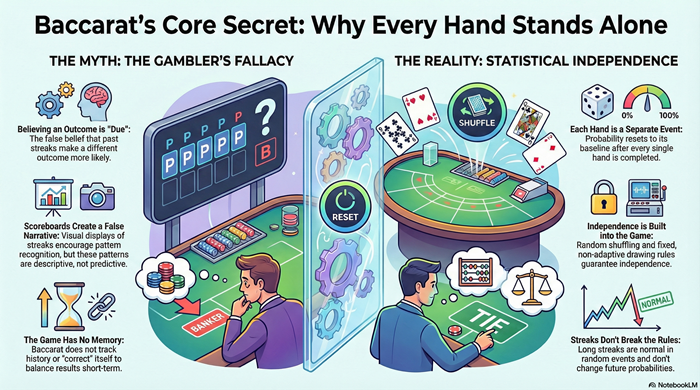
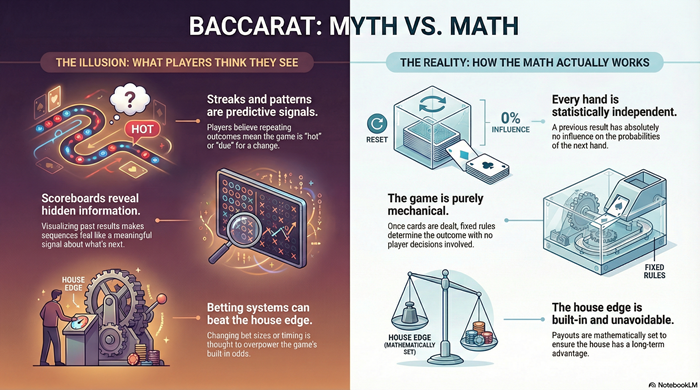
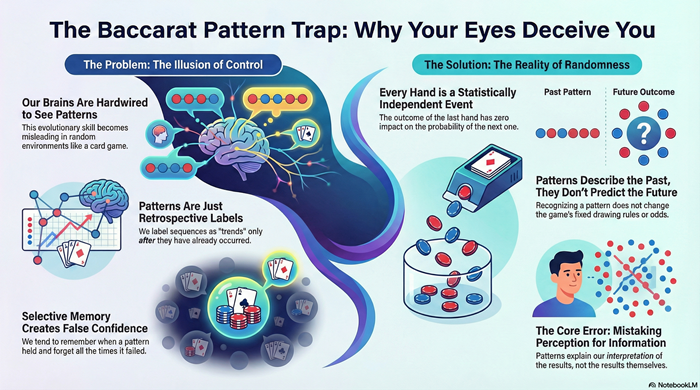
Each baccarat hand is statistically independent. This means the probability of an outcome on the next hand does not depend on previous hands.
The cards do not remember past results. The table does not correct itself. Patterns observed in hindsight do not affect forward probability.
This principle applies whether a shoe appears “streaky” or “choppy.” Visual sequences do not imply mathematical dependency.
Why “Due” Is Not a Mathematical Concept
The idea that an outcome is “due” assumes the game self-corrects. Baccarat does not.
Probability does not track fairness in short windows. It only balances in aggregate. Expecting correction within a session is a perception error, not a feature of the game.
What Baccarat Odds Can and Cannot Tell You
Baccarat odds can explain how the game behaves over time. They describe structural probability, expected distribution, and long-run outcomes.
They cannot predict individual hands. They cannot signal timing. They cannot identify opportunity.
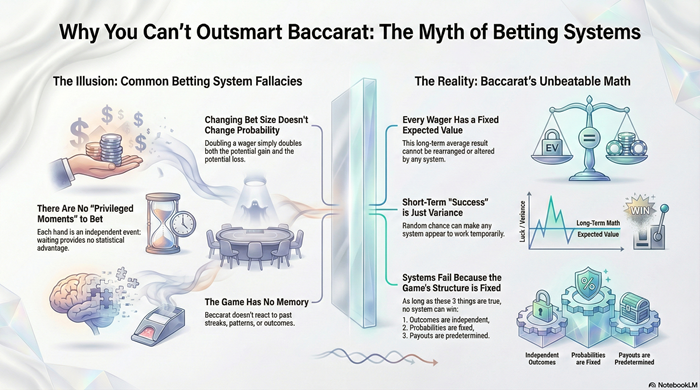
Understanding what odds do not provide is as important as understanding what they do. This boundary is where most betting systems and progression theories collapse.
Related Pages Section