
House Edge in Baccarat: How the Casino Advantage Is Built In
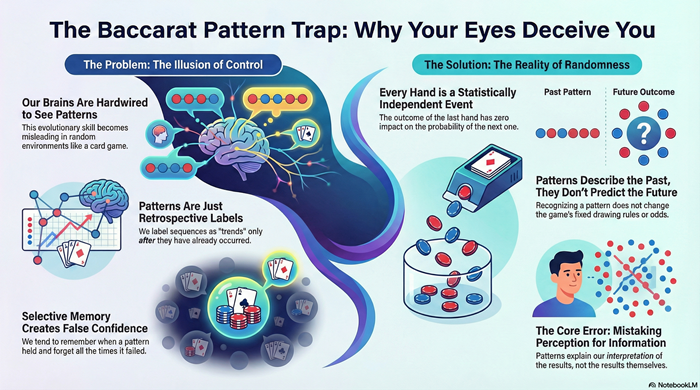
In baccarat, the casino advantage is not created by player behavior, timing, or interpretation. It is embedded directly into the game’s mathematics. The house edge exists because of how probabilities and payouts are paired, not because of how the game is played or observed.
Understanding the house edge in baccarat requires separating outcome frequency from payout design and examining how those two elements interact.
What “House Edge” Actually Means
House edge is the average amount the casino expects to retain from each unit wagered over the long run. It is not a fee charged per hand, nor is it a guarantee of short-term loss. It is a statistical expectation that emerges only over many hands.
A game can:
- Produce frequent wins in the short run
- Feel fair or even favorable during a session
and still maintain a house edge.
House edge is a property of the system, not of individual outcomes.
Probability Comes First, Payout Comes Second
Every outcome in baccarat occurs with a specific probability determined by:
- Card values
- Deck composition
- Fixed drawing rules
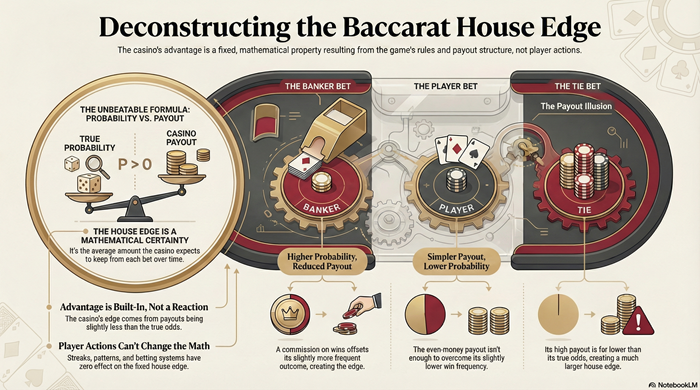
Once those probabilities are known, payouts are set. The casino advantage arises when the payout is slightly less favorable than the true odds would require for a break-even game.
This mismatch is small, but persistent.
Why the Banker Outcome Has a Lower House Edge
The Banker outcome occurs slightly more often than the Player outcome because of the drawing rules. Banker draws last and under more restrictive conditions, which increases its long-run frequency by a small margin.
To offset this higher probability, casinos apply a commission to Banker wins. That commission reduces the payout just enough to restore the casino’s advantage.
The result is:
- A higher probability outcome
- A slightly reduced payout
- A small but stable house edge
The key point is that the commission does not “punish” the player—it aligns payout with probability in a way that preserves the house advantage.
Why the Player Outcome Still Has an Edge Against It
The Player outcome does not carry a commission, but it also occurs slightly less often than the Banker outcome. The payout is even money, which is not sufficient to compensate for the lower probability.
This imbalance creates a house edge even without an explicit fee.
The edge exists not because the payout is unfair in appearance, but because it is subtly mismatched to probability.
The Tie Outcome and Payout Illusion
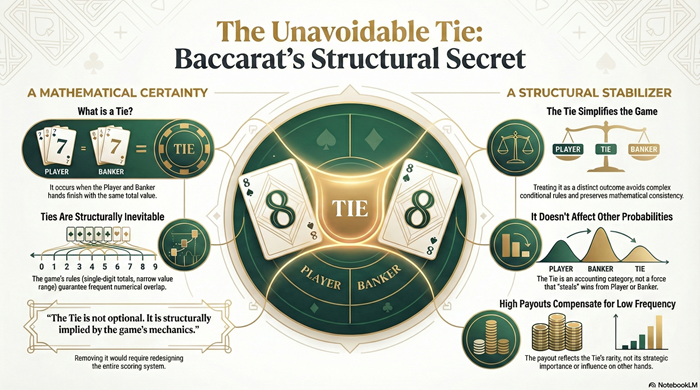
The Tie outcome is where the house edge becomes most obvious. Ties occur infrequently compared to Player and Banker results. However, the payout offered is typically far lower than what the true odds would require.
High payout numbers create visual appeal, but they do not imply value. The gap between probability and payout on the Tie outcome is much larger than on the other outcomes, producing a significantly higher house edge.
The Tie is not a “trap.” It is a structural outcome priced to maintain the casino’s advantage.
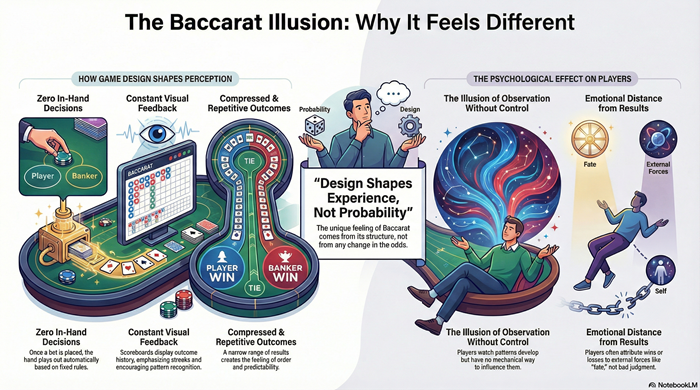
House Edge Is Not Affected by Observation
Nothing a player does can alter the house edge in baccarat. It is unaffected by:
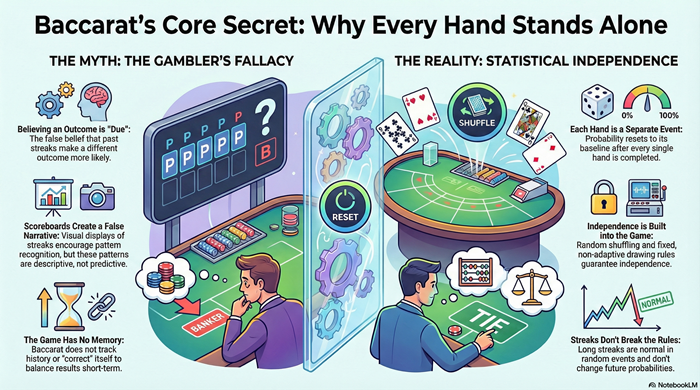
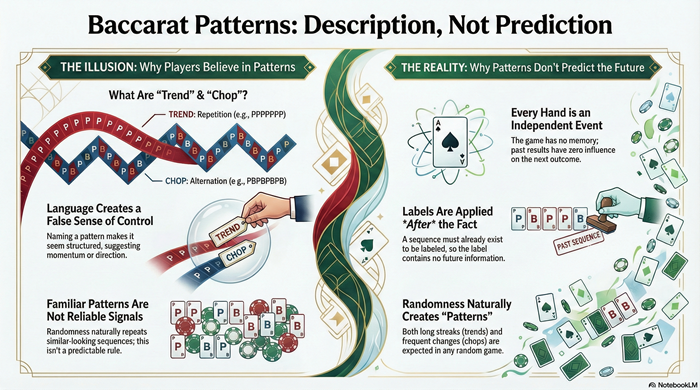
- Streaks
- Patterns
- Scoreboards
- Shoe size
- Timing
- Bet sequencing
The house edge applies equally to every hand, regardless of context.
Changing behavior may change how variance is experienced, but it does not change expectation.
Why the Edge Persists Despite Short-Term Wins
Short-term results are dominated by variance. Variance allows outcomes to deviate widely from expectation in small samples. This is why players can experience long winning or losing stretches without contradicting the house edge.
The edge asserts itself slowly, across many hands, where randomness averages out and expectation becomes visible.
A house edge does not prevent wins. It governs averages.
The Casino Advantage Is Structural
The most important insight about baccarat’s house edge is that it is not hidden. It is not secret. It is not reactive.
It is built into:
- The probabilities generated by the rules
- The payouts assigned to outcomes
As long as those two elements remain fixed, the casino advantage remains fixed as well.
No system, observation method, or adjustment can remove it.
Understanding the Edge Correctly
Understanding house edge does not make baccarat less interesting. It makes it more honest.
The game does not deceive players by shifting odds or responding to behavior. It does exactly what its structure dictates.
Once the relationship between probability and payout is understood, the casino advantage stops being mysterious and becomes simply a feature of the system.