
Do Hot and Cold Tables Exist in Blackjack?
🔥Few beliefs are as persistent in blackjack as the idea of hot and cold tables. Players swear by it. Dealers joke about it. Entire casino floors shift as people chase streaks or flee losing shoes. The belief feels intuitive: if a table keeps winning, it must be hot; if it keeps losing, it must be cold.
The problem is that blackjack doesn’t work that way. As explained in our Blackjack Basic Strategy guide, the game is governed by probability and independence, not momentum. Hands don’t remember what came before them, and tables don’t develop moods.
This article explains why the hot-and-cold table myth exists, how variance creates convincing streaks, and why believing in table temperature quietly increases the house edge.
🧠 What People Mean by “Hot” and “Cold” Tables
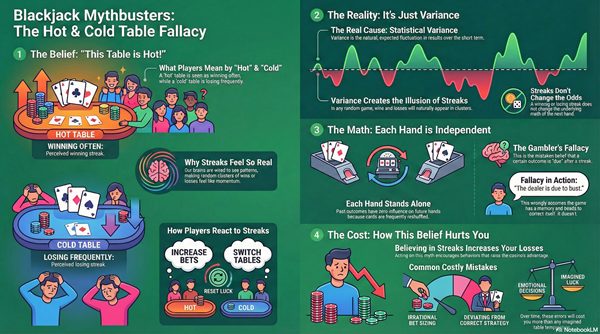
A hot table is believed to be one where players are winning frequently or the dealer is busting often. A cold table is believed to be the opposite — frequent dealer wins, player busts, or long losing runs.
Players often respond by:
- Joining hot tables late
- Increasing bets on winning streaks
- Leaving tables after losses
- Switching seats or tables to “reset luck”
These behaviors feel proactive. Unfortunately, they are based on a misunderstanding of how probability works.
🎯 Why the Belief Feels So Real
The hot-table belief survives because blackjack outcomes are clustered, not evenly spaced. Wins and losses often appear in streaks, even when outcomes are random.
Two psychological effects fuel the belief:
- Pattern recognition — the brain looks for order in randomness
- Recency bias — recent outcomes feel more important than older ones
When three or four strong hands appear in a row, players interpret it as momentum rather than coincidence. When losses pile up, the table feels cursed.
The feelings are real. The cause is not.
📊 Variance: The Real Explanation Behind Streaks
Variance describes natural fluctuation around expected outcomes. In blackjack, variance means:
- Wins and losses will cluster
- Short runs will deviate from long-term averages
- Unlikely sequences will still occur
Even with perfect strategy, players can experience extended losing streaks. Likewise, players using poor strategy can enjoy short-term success.
Variance creates the appearance of hot and cold tables without any change in underlying odds.
🧪 Why Each Hand Is Independent
In standard blackjack:
- Cards are reshuffled frequently (or continuously online)
- Each hand’s outcome depends only on current cards and rules
- Past hands do not influence future ones
This is called independence. A losing hand does not make a win more likely. A winning streak does not make another win more likely.
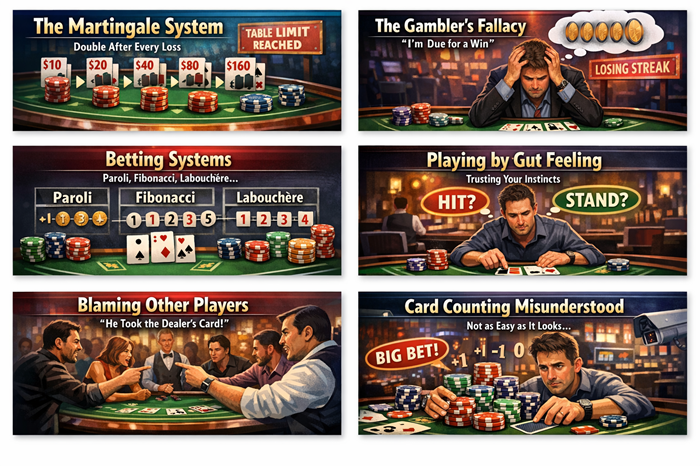
Believing otherwise is known as the gambler’s fallacy — the belief that past outcomes affect future probabilities.
⚠️ The Gambler’s Fallacy in Action
Common examples include:
- “The dealer is due to bust.”
- “The table is hot — jump in now.”
- “It can’t lose again.”
Each statement assumes memory in a system that has none.
Blackjack doesn’t correct streaks. It continues forward with the same probabilities it always had.
🏛️ Why Casinos Don’t Discourage the Myth
Casinos benefit from hot-and-cold thinking because it:
- Encourages bet increases after wins
- Encourages emotional decision-making
- Keeps players chasing losses
- Distracts from house edge and strategy
Importantly, casinos don’t need to manipulate outcomes. Human psychology does the work for them.
A player who believes in hot tables is more likely to abandon discipline during emotional swings.
💸 How the Hot/Cold Belief Increases Losses
The belief itself isn’t harmless. It leads to behaviors that raise the house edge, including:
- Changing bet sizes irrationally
- Deviating from basic strategy
- Switching tables mid-shoe
- Overplaying during winning runs
Each behavior introduces additional errors. Over time, these errors cost more than any imagined table temperature.
🧠 Why Card Counting Doesn’t Support “Hot Tables”
Some players confuse card counting with hot-table logic. They are not the same.
Card counting:
- Tracks deck composition
- Estimates advantage based on remaining cards
- Applies only in specific conditions
Hot-table belief:
- Relies on past outcomes
- Ignores deck structure
- Assumes momentum
Counting evaluates what remains, not what already happened. Even then, advantage shifts are subtle — not emotional streaks.
📉 Why Leaving a “Cold” Table Doesn’t Fix Anything
Leaving a table after losses feels like damage control. In reality, it resets nothing.
If:
- The rules are the same
- The bet size is the same
- The strategy is the same
…the expected outcome is unchanged.
Table switching introduces friction, emotional resets, and often poorer decisions — all without changing the math.
📌 What Actually Helps During Streaks
Smart players respond to streaks with consistency, not reaction.
That means:
- Keeping bet sizes stable
- Following basic strategy exactly
- Ignoring recent outcomes
- Evaluating results over many hands
Streaks are noise. Discipline is signal.
🧠 Why Accepting Randomness Improves Play
Once players accept that:
- Tables are not hot or cold
- Streaks are normal
- Losses are part of variance
…the game becomes calmer and more predictable.
This mindset:
- Reduces emotional errors
- Improves decision consistency
- Lowers long-term losses
Acceptance doesn’t remove variance. It removes the damage caused by reacting to it.
🔚 Final Thought: Tables Don’t Have Temperatures
Blackjack tables don’t heat up. They don’t cool down. They don’t reward loyalty or punish impatience.
What does change is the player’s behavior.
Those who chase streaks make mistakes.
Those who ignore them quietly outperform expectations.
In blackjack, believing less often leads to losing less often.
🔗 Recommended Internal Links