
The Best Blackjack Rules to Look For (and the Worst to Avoid)
🧩📋 Two blackjack tables can look identical — same cards, same chips, same dealer motions — yet one quietly costs players far more than the other. The difference isn’t luck. It’s the rules.
Blackjack rules determine how expensive the game is before a single card is dealt. As explained in our Blackjack Basic Strategy guide, strategy only works within the framework of the rules you’re playing under. Some rules protect players. Others exist to extract more money without changing the feel of the game.
This article explains which blackjack rules are worth seeking out, which ones should trigger immediate caution, and how small rule changes compound into large long-term losses.
Why Blackjack Rules Matter More Than Most Decisions
Many players focus intensely on how they play hands while ignoring the environment those hands exist in. This is backwards.
Rules affect:
- Payout value
- Risk exposure
- Dealer behavior
- Player options
Once you sit down, rules are locked. You can adjust strategy slightly — but you cannot undo a bad ruleset.
The Best Blackjack Rules for Players
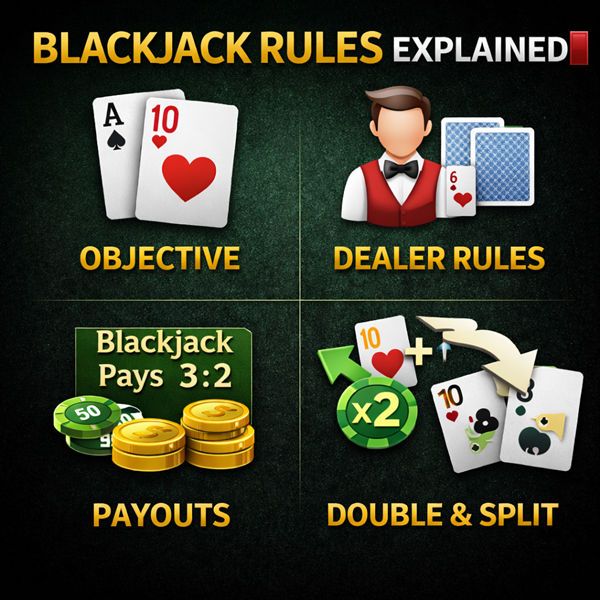
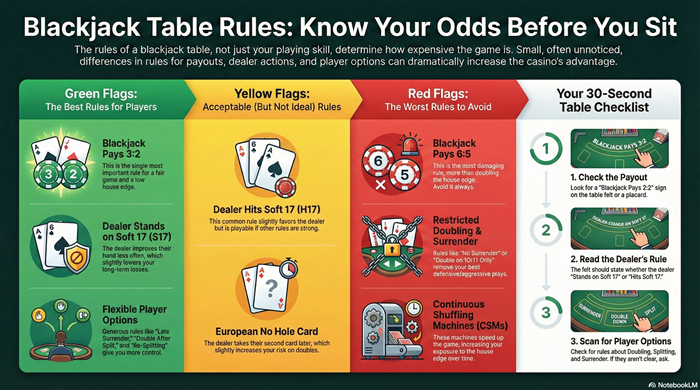
Blackjack Pays 3:2
This is the single most important rule to check.
A 3:2 payout:
- Properly rewards natural blackjacks
- Keeps the house edge low
- Preserves blackjack’s reputation as a fair game
If a table does not pay 3:2, nothing else about it matters.
Dealer Stands on Soft 17 (S17)
When the dealer stands on soft 17:
- Dealer improves less often
- Bust rates increase slightly
- Player losses decrease over time
This rule alone can significantly reduce long-term cost. It’s subtle, but real.
Late Surrender Available
Late surrender allows players to:
- Cut losses in extreme disadvantage situations
- Reduce volatility
- Preserve bankroll during bad matchups
Surrender isn’t common — but when it applies, it matters. Tables that offer it are generally more player-friendly.
Double After Split Allowed (DAS)
This rule allows players to double after splitting pairs.
Why it matters:
- Increases flexibility
- Improves value of splits
- Recovers lost expectation after breaking pairs
DAS turns some marginal situations into profitable ones.
Re-Splitting Allowed (Especially Aces)
Allowing re-splits:
- Reduces downside of pair hands
- Improves long-term expectation
- Indicates a generous ruleset
Re-splitting Aces is especially valuable, though not always offered.
Acceptable Rules (Not Ideal, But Playable)
Dealer Hits Soft 17 (H17)
H17 slightly favors the dealer, but not dramatically. This rule is common and tolerable if other rules are strong.
H17 becomes dangerous when combined with:
- 6:5 payouts
- No surrender
- Restricted doubling
Rule combinations matter more than individual changes.
European No Hole Card
European blackjack delays the dealer’s hole card, increasing risk on doubles and splits.
This rule:
- Slightly increases the house edge
- Requires adjusted expectations
- Is still playable under good payouts
It’s not ideal — but it’s far from the worst option.
The Worst Blackjack Rules to Avoid
Blackjack Pays 6:5
This is the most damaging rule in modern blackjack.
6:5 payouts:
- More than double the house edge
- Cannot be fixed by strategy
- Are often paired with low minimums to attract players
A $5 minimum 6:5 table is more expensive than a $25 minimum 3:2 table over time.
No Surrender Allowed
Removing surrender:
- Forces full losses in extreme situations
- Increases variance
- Raises the house edge subtly but consistently
This rule hurts most during already difficult hands — exactly when protection matters most.
Restricted Doubling Rules
Rules like:
- Doubling only on 10 or 11
- No doubling after split
These restrictions:
- Remove high-value plays
- Penalize correct aggression
- Increase long-term losses
Flexible doubling is a hallmark of good blackjack.
Continuous Shuffling Machines (CSMs)
CSMs reshuffle cards constantly.
Consequences:
- Eliminate deck penetration
- Remove advantage play entirely
- Encourage longer sessions
While not always the worst mathematically, CSMs increase exposure by design.
Why Casinos Mix Good and Bad Rules
Casinos rarely use one bad rule in isolation.
Instead, they:
- Combine small disadvantages
- Hide changes behind marketing
- Emphasize minimum bets over payouts
- Rely on inattention
Players often notice one rule but miss the full picture.
How to Evaluate a Table in 30 Seconds
Before buying in, check:
- Blackjack payout signage
- Dealer soft-17 behavior
- Surrender availability
- Doubling and splitting rules
- Presence of CSMs or heavy side-bet promotion
If rules aren’t clearly displayed, that’s usually intentional.
Why Good Rules Matter More Than Skill Level
Even perfect strategy cannot overcome a bad ruleset.
Conversely, average strategy at a good table often outperforms perfect play at a bad one.
Rule selection is the easiest, least emotional way to reduce losses.
How Rule Awareness Changes Player Behavior
Players who understand rules:
- Walk away from bad tables
- Ignore cosmetic features
- Focus on cost, not comfort
- Play fewer, better hands
This awareness alone saves money — without changing how a single hand is played.
Final Thought: The Best Blackjack Decision Is Often Standing Up
The best blackjack rules are quiet. They don’t advertise themselves with flashing lights or jackpots.
Bad rules rely on distraction.
Good rules reward attention.
If a table makes it hard to understand the rules, it’s usually because understanding them would change your mind.
🔗 Recommended Internal Links