
Surrender Strategy Explained: When Giving Up Saves Money in Blackjack
🚪In most games, quitting is a mistake. In blackjack, surrendering can be one of the smartest decisions a player can make. The problem is that many players don’t understand what surrender really is, when it’s allowed, or why it exists in the first place.
Surrender feels wrong because it guarantees a loss — but blackjack isn’t about avoiding losses entirely. It’s about minimizing them. As explained in our Blackjack Basic Strategy guide, correct play focuses on expected value, not emotional satisfaction. In certain situations, surrendering loses less than playing the hand out, even when that feels counterintuitive.
This article explains what surrender is, why it exists, when it’s mathematically correct, and how misunderstanding it quietly increases the house edge.
🧠 What Is Surrender in Blackjack?
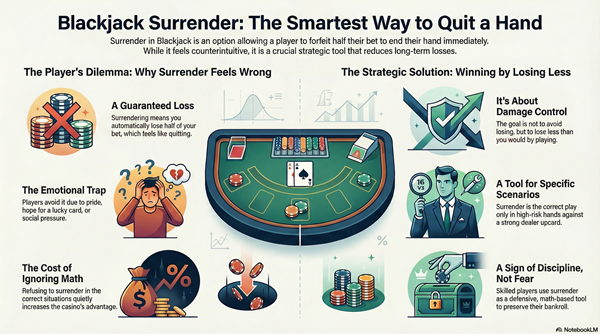
Surrender is an option that allows a player to forfeit half of their bet and end the hand immediately. Once surrendered, the player takes no further action and the dealer continues the round without that hand.
There are two main types of surrender:
- Late surrender
- Early surrender (rare)
In most modern blackjack games, surrender is optional and rule-dependent. Some tables offer it. Many do not. And many players ignore it even when it’s available.
🕰️ Early Surrender vs Late Surrender
Early surrender allows a player to surrender before the dealer checks for blackjack. This version is extremely player-friendly and rarely offered because it significantly lowers the house edge.
Late surrender allows surrender only after the dealer checks for blackjack and confirms they do not have it. This is the most common form available today.
Even late surrender is valuable. It exists because there are situations where playing the hand further is mathematically worse than giving up half the bet.
📉 Why Surrender Exists at All
Casinos do not offer surrender out of generosity. They offer it because:
- It reduces volatility for players
- It simplifies some extreme situations
- It still preserves a house edge overall
From a math perspective, surrender exists because certain hands perform so poorly against specific dealer upcards that cutting losses in half is the least expensive option.
If surrender did not benefit the casino in aggregate, it wouldn’t be offered.
🎯 When Surrender Is Typically Correct
Surrender is not common. It applies to a narrow set of high-risk situations where the probability of losing is extremely high and the chance of recovery is low.
These situations usually involve:
- Weak player totals
- Strong dealer upcards
- Limited improvement potential
In these cases, hitting or standing both perform worse over time than surrendering.
Importantly, surrender decisions are not about predicting the next card. They are about accepting a controlled loss instead of exposing the full bet to unfavorable odds.
⚠️ Why Players Avoid Surrender (and Why That’s Costly)
Most players avoid surrender for emotional reasons:
- It feels like quitting
- It guarantees a loss
- It looks bad socially
- It feels unnecessary if “anything can happen”
The math doesn’t care about those feelings.
Refusing to surrender in the correct situations:
- Increases the house edge
- Exposes the full bet to poor odds
- Turns a controlled loss into an uncontrolled one
Ironically, players who hate surrender often accept larger losses more frequently as a result.
🧠 Surrender vs Standing: The Subtle Difference
Standing and surrendering can look similar — both involve stopping play. But they are fundamentally different decisions.
- Standing keeps the full bet at risk
- Surrendering ends the hand at half loss
If a hand is unlikely to improve and unlikely to beat the dealer, standing often loses the full bet anyway. Surrender accepts that reality early and reduces exposure.
The key insight is this: surrender doesn’t prevent losing — it prevents losing more than necessary.
🧪 How Surrender Affects the House Edge
When used correctly, surrender slightly reduces the house edge. Not by a dramatic amount, but enough to matter in a low-edge game like blackjack.
This reduction comes from:
- Avoiding high-negative-EV situations
- Preserving bankroll during extreme disadvantage
- Smoothing long-term losses
Players who never surrender pay a small but persistent penalty over time.
🏛️ Rule Variations That Affect Surrender Value
The value of surrender depends heavily on table rules, including:
- Whether surrender is offered at all
- Whether it’s early or late surrender
- Dealer behavior on soft 17
- Doubling and splitting rules
This is why surrender decisions must align with the specific ruleset in play. Using surrender in the wrong context — or skipping it when it’s valuable — quietly raises the cost of the game.
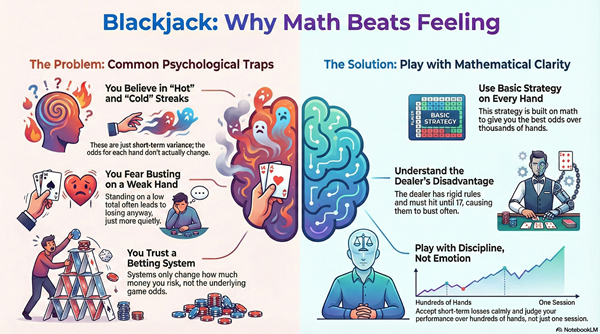
📊 Surrender and Psychology: Why It Feels So Wrong
Surrender clashes with human instincts because it:
- Makes loss explicit
- Removes hope of recovery
- Ends the hand prematurely
Blackjack strategy intentionally overrides those instincts. It prioritizes long-term outcomes over short-term comfort.
Once players accept that blackjack is a game of cost control, surrender stops feeling weak and starts feeling rational.
📌 Why Surrender Is a Sign of Discipline, Not Fear
Strong blackjack players don’t surrender because they’re afraid. They surrender because they understand when the odds are stacked heavily against them.
Surrender is:
- A defensive tool
- A math-based exit
- A way to preserve long-term performance
Ignoring it doesn’t make a player brave. It makes them predictable.
🔚 Final Thought: Sometimes the Smartest Play Is to Leave the Hand
Blackjack doesn’t reward pride. It rewards discipline.
Surrender exists for a reason. It’s not common, flashy, or emotionally satisfying — but when used correctly, it quietly reduces losses and keeps the game fairer.
In blackjack, knowing when to stop is just as important as knowing when to push.
🔗 Recommended Internal Links