
Blackjack Strategy Deviations That Cost Players the Most
🧠📉 Blackjack doesn’t punish players for bad luck — it punishes them for bad deviations. Many losses that feel unavoidable actually come from small, repeated decisions that drift away from basic strategy. These deviations rarely feel dramatic. In fact, they often feel reasonable.
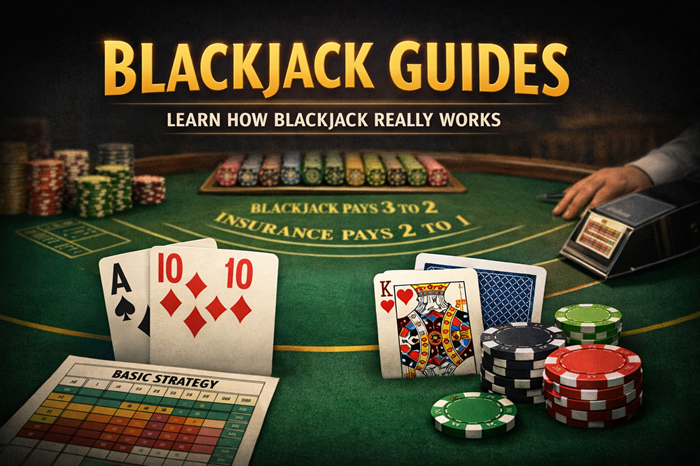
As explained in our Blackjack Basic Strategy guide, the chart isn’t about maximizing wins in the short term. It’s about minimizing losses over thousands of hands. Deviating from it — even occasionally — increases the house edge in ways most players never notice.
This article breaks down the most expensive blackjack strategy deviations, why players make them, and how they quietly undermine otherwise solid play.
Why Strategy Deviations Matter So Much
Blackjack strategy is built on expected value, not comfort. Every recommendation represents the least expensive option among bad choices.
When players deviate:
- They increase expected loss
- They introduce emotion into decisions
- They compound errors over time
One deviation won’t ruin a session. Repeated deviations will.
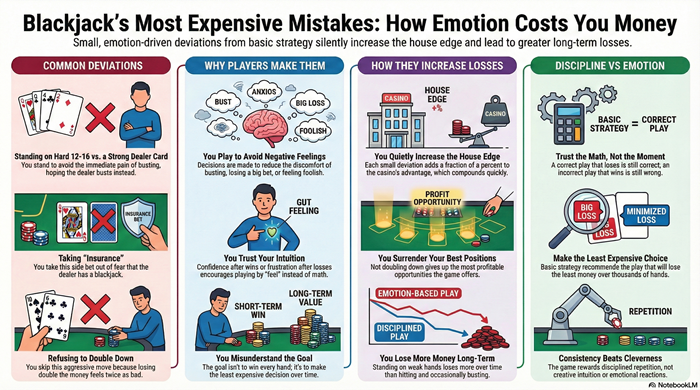
Deviation #1: Standing on Hard 12–16 Against Strong Dealer Cards
This is one of the most common and costly mistakes in blackjack.
Players stand because:
- Busting feels worse than losing
- The dealer might bust
- Standing feels conservative
In reality, standing on weak totals against strong dealer upcards loses more money than hitting. The dealer busts too infrequently to justify passivity.
This deviation alone can add significant cost over time.
Deviation #2: Taking Insurance Without a Count
Insurance is mathematically incorrect for non-counters, yet many players take it reflexively.
Why it happens:
- Fear of dealer blackjack
- Misunderstanding of probability
- The illusion of protection
Insurance has a high house edge and operates independently of your hand. Taking it regularly turns a low-edge game into a much more expensive one.
Deviation #3: Refusing to Double “Because It’s Risky”
Doubling feels aggressive. Losing a double hurts twice as much emotionally — which is why players avoid it.
Common situations players skip doubles:
- Soft hands
- Marginal totals
- Unfamiliar spots
But doubling is recommended because it reduces expected loss. Avoiding doubles doesn’t make the game safer — it makes it more expensive.
Deviation #4: Splitting the Wrong Pairs (or Not Splitting at All)
Pair decisions are uncomfortable because they break symmetry.
Players often:
- Refuse to split Eights to avoid losing twice
- Split Tens chasing big wins
- Ignore context entirely
Failing to split Eights traps players in weak hands. Splitting Tens sacrifices strong positions. Both deviations cost real money over time.
Deviation #5: Playing by “Feel” After a Few Wins or Losses
Confidence after wins and frustration after losses both encourage intuition-based play.
This leads to:
- Strategy shortcuts
- Emotional bet sizing
- Selective rule-breaking
Blackjack intuition is unreliable. The game rewards repetition, not creativity. Playing by feel is one of the fastest ways to erode edge discipline.
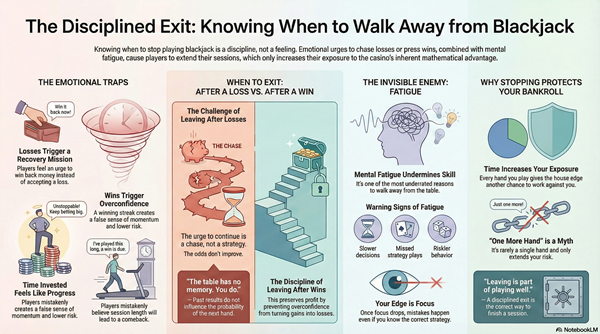
Deviation #6: Chasing Losses With Bet Increases
Betting progression is often disguised as strategy.
In reality:
- Increasing bets after losses doesn’t change odds
- It increases exposure during negative variance
- It amplifies bankroll swings
Chasing losses doesn’t recover money. It magnifies risk.
Deviation #7: Standing on Soft Hands That Should Be Hit
Soft hands feel safe — but they are dynamic, not defensive.
Players stand because:
- They don’t want to break a “good-looking” hand
- They misunderstand soft totals
- They fear busting unnecessarily
Soft hands are designed for flexibility. Standing too early prevents improvement and costs value.
Deviation #8: Ignoring Surrender When It’s Available
Many players never surrender because:
- It feels like quitting
- They forget it exists
- They don’t want to lock in a loss
Surrender is not weakness. It’s loss minimization. Ignoring it when available forces players into worse outcomes.
Deviation #9: Letting Other Players Influence Decisions
Table dynamics can pressure players into bad choices.
Examples:
- Avoiding correct hits to avoid blame
- Changing strategy to appease others
- Following table “rules” instead of math
Other players do not share your bankroll. Playing to satisfy them increases your costs.
Deviation #10: Adjusting Strategy Based on Short-Term Results
Evaluating decisions by recent outcomes leads to:
- Second-guessing correct plays
- Abandoning structure
- Strategy drift
A correct decision that loses is still correct. An incorrect decision that wins is still wrong. Blackjack doesn’t grade on vibes.
Why These Deviations Feel Reasonable
These mistakes persist because they:
- Reduce emotional discomfort
- Feel cautious or polite
- Avoid visible embarrassment
- Create narratives for losses
They trade short-term comfort for long-term cost.
How Much These Deviations Really Cost
Each deviation may add only a fraction of a percent to the house edge.
But combined:
- Costs compound quickly
- Losses accelerate silently
- Discipline erodes
Many players lose far more from strategy drift than from bad rules or variance.
How to Eliminate Strategy Deviations
The fix is not memorization. It’s commitment.
Good players:
- Make decisions before emotion kicks in
- Follow the chart even when it hurts
- Accept short-term discomfort
- Ignore table narratives
Consistency beats cleverness every time.
Final Thought: Blackjack Punishes Inconsistency, Not Mistakes
You don’t need perfect sessions to play blackjack well.
You need:
- Repetition
- Discipline
- Acceptance of variance
The most expensive blackjack strategy isn’t one big error — it’s a hundred small deviations that feel harmless in the moment.
Structure is boring.
Structure is cheaper.
🔗 Recommended Internal Links