
Why Roulette “Patterns” Appear (and Why They Aren’t Real)
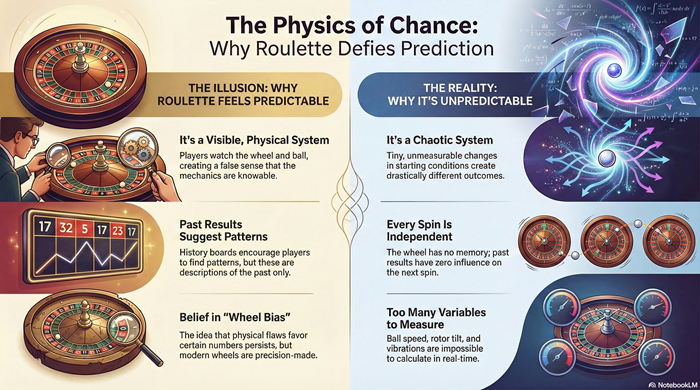
Roulette displays often look meaningful. Long runs of a single color, repeating numbers, or clustered outcomes seem too orderly to be random. These impressions come from how humans perceive randomness, not from anything the wheel is actually doing.
This article is part of our complete guide on How Roulette Really Works: Odds, House Edge, and Why Systems Fail, which explains roulette odds, house edge, wheel types, and why betting systems fail.
What People Mean by “Patterns” in Roulette
When players talk about patterns, they usually mean visual regularities in recent outcomes. These can feel compelling because they appear structured and interpretable.
Common examples include:
- Long streaks of red or black
- Repeating numbers within short windows
- Alternating color sequences
- Clusters of high or low numbers
None of these imply predictability. They describe what has already happened, not what will happen next.
Randomness Naturally Produces Clusters
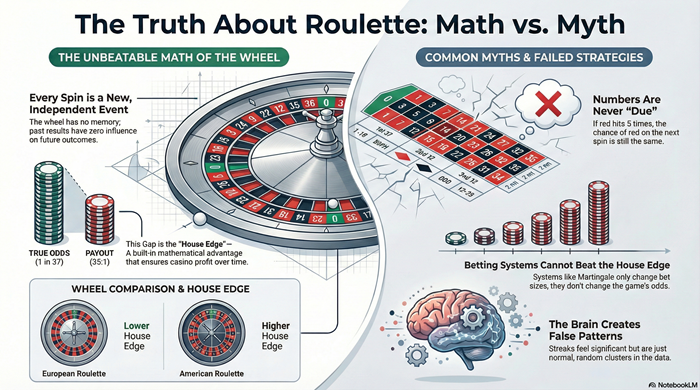
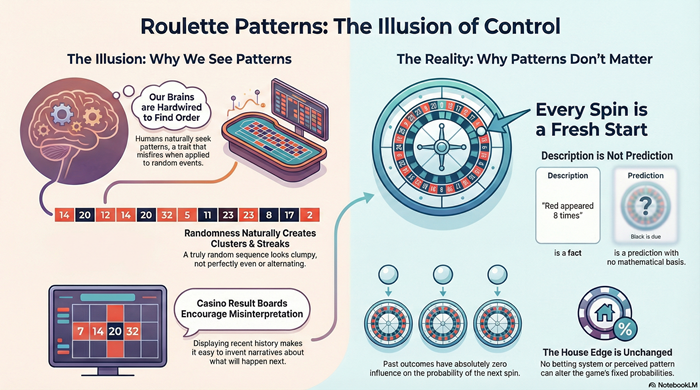
True randomness does not look evenly spaced or orderly in the short term. It produces clumps, streaks, and repetition as a normal feature.
In roulette:
- Outcomes are independent
- Clusters occur by chance
- Gaps and repetitions are expected
A perfectly alternating sequence would actually be less random than a streaky one.
Why the Brain Invents Meaning
Humans are pattern-detection machines. This trait is useful in causal systems, but it misfires in random ones.
The brain:
- Seeks order in noise
- Assigns meaning to coincidence
- Confuses description with prediction
Once a pattern is noticed, confirmation bias reinforces it. Contrary outcomes are ignored or explained away.
Past Sequences Do Not Affect Future Spins
No pattern carries forward.
- A streak does not increase reversal odds
- A repeating number is not more likely to repeat
- A long absence does not raise probability
Each spin resets completely. The probability of every outcome is unchanged, regardless of what the display shows.
Result Boards Encourage Pattern Interpretation
Casinos do not need to fabricate patterns. Displaying history is enough.
Result boards:
- Emphasize recent outcomes
- Visually group similar results
- Invite interpretation and narrative
These displays present data without context, making randomness look meaningful.
Why Pattern-Based Systems Feel Convincing
Many roulette systems are built around identifying or responding to patterns. They often feel effective because they align with short-term variance.
These systems rely on:
- Selective entry after streaks
- Assumptions of reversal or continuation
- Emotional reinforcement during wins
When outcomes cooperate briefly, the system feels validated. When they don’t, the failure is blamed on timing.
The Difference Between Description and Prediction
It is always possible to describe what roulette just did. It is never possible to use that description to predict what comes next.
- Description: “Red has appeared 8 times in a row.”
- Prediction: “Black is more likely now.” ❌
The first is factual. The second has no mathematical basis.
Why Patterns Seem Clearer in Short Sessions
Short samples exaggerate structure. With fewer data points, randomness looks intentional.
In short sessions:
- Streaks dominate perception
- Averages have no time to emerge
- Variance overwhelms expectation
As the number of spins increases, apparent patterns dissolve into distribution.
Patterns Do Not Change Expected Value
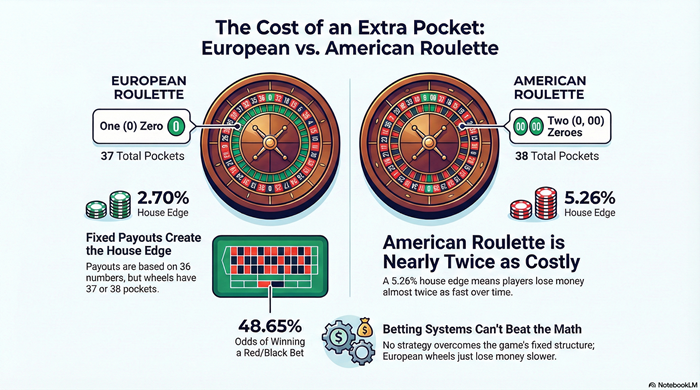
Even if a pattern were real—which it isn’t—it would not change the house edge unless it changed probabilities.
Patterns:
- Do not alter pocket count
- Do not adjust payouts
- Do not affect independence
The expected loss per unit wagered remains the same.
Why Letting Go of Patterns Matters
Belief in patterns fuels false confidence. It encourages overinterpretation and system building where none is justified.
Understanding that patterns are illusions:
- Reduces false expectations
- Explains why systems fail
- Clarifies the role of randomness
Roulette becomes simpler, not more mysterious.
What Patterns Actually Represent
Patterns in roulette represent how randomness looks to humans, not how probability behaves.
They are:
- Retrospective
- Visually compelling
- Emotionally persuasive
They are not:
- Predictive
- Actionable
- Meaningful for future outcomes
Recognizing this distinction is essential for understanding roulette honestly.