
Why Pattern Recognition Fails in Baccarat
This article is part of our complete guide on How Baccarat Really Works: Odds, House Edge, and Why Systems Fail, which explains baccarat odds, house edge, card structure, and why betting systems fail.
This article explains why human pattern recognition does not translate into predictive power in baccarat, how visual and cognitive biases distort interpretation of outcomes, and why recognizing patterns does not change probability. It does not discuss how to follow patterns or how to wager. Its purpose is to explain why perceived structure fails mathematically.
What Is Pattern Recognition in Baccarat
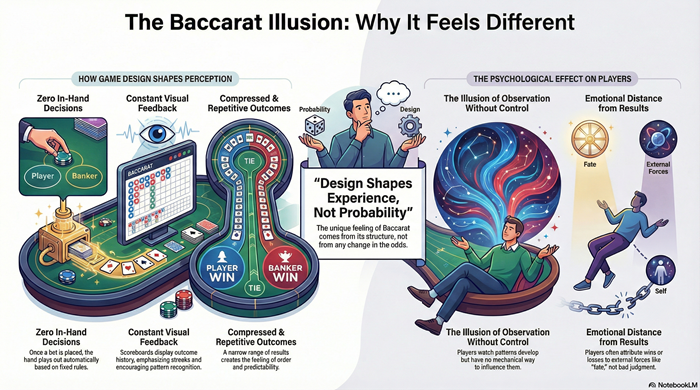
Pattern recognition refers to the tendency to interpret repeated outcomes as meaningful signals. In baccarat, this often involves labeling sequences as trends, chops, runs, or cycles.
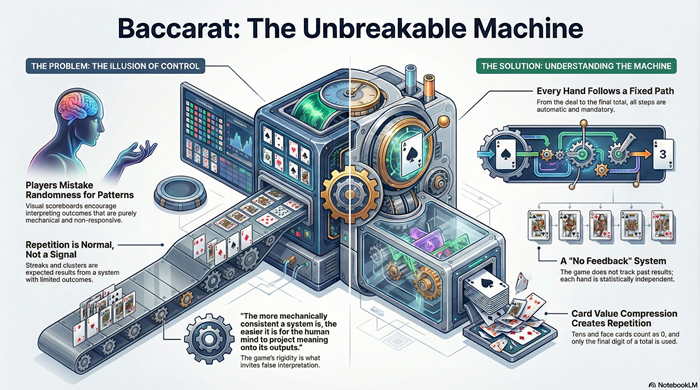
These patterns are identified after outcomes occur. They do not exist as properties of the game itself. The game produces outcomes; patterns are imposed by observers.
Why Humans Are Wired to See Patterns
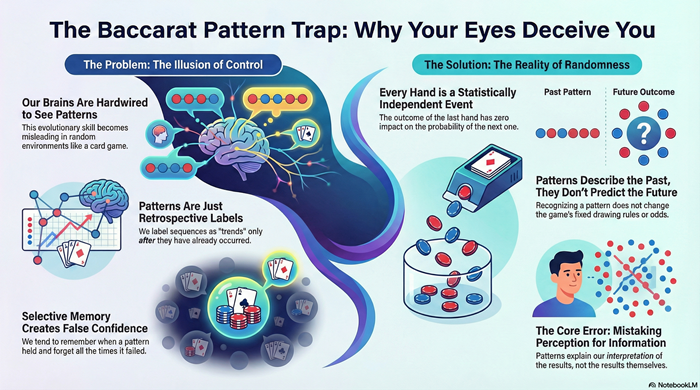
Human cognition evolved to detect structure quickly. This ability is useful in many real-world contexts, but it becomes misleading in random environments.
Several cognitive tendencies contribute to false pattern detection:
- Overweighting recent outcomes
- Assuming balance must occur quickly
- Assigning meaning to repetition
In baccarat, these instincts activate automatically, even when no causal relationship exists.
Random Sequences Contain Apparent Structure
Random processes regularly produce sequences that appear ordered. Clusters, streaks, and alternation all occur naturally without intent.
In baccarat:
- Long runs occur without cause
- Alternation appears sporadically
- Irregularity is normal
The presence of structure in a sequence does not imply a mechanism producing it.
Why Patterns Do Not Influence Future Hands
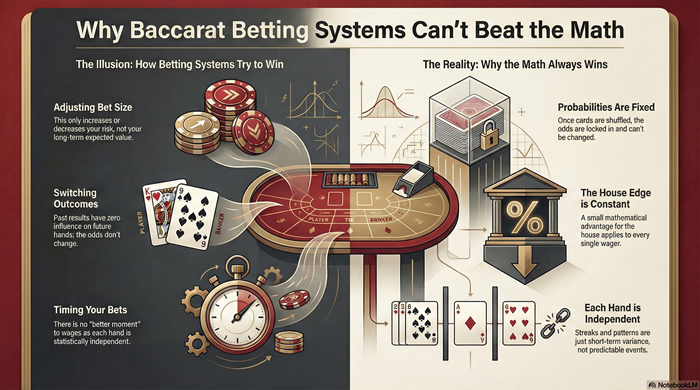
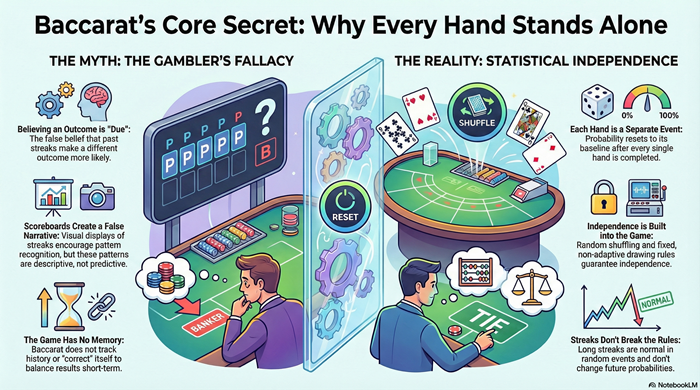
For a pattern to matter, it would need to alter the probability of future outcomes. Baccarat offers no mechanism for this.
Each hand:
- Is resolved independently
- Uses fixed drawing rules
- Ignores prior outcomes
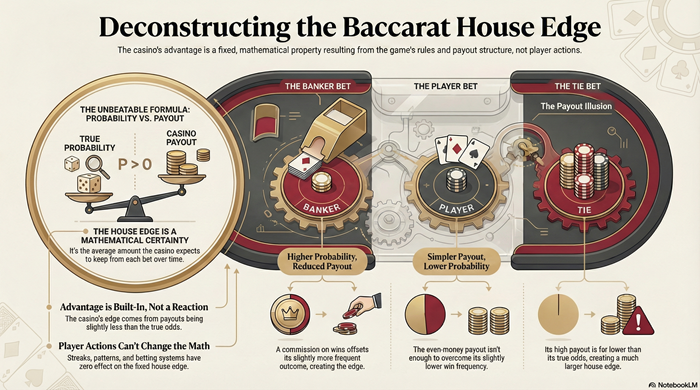
Recognizing a pattern does not feed information back into the game. Probability remains unchanged.
Retrospective Labeling vs. Predictive Power
Most baccarat patterns are identified retrospectively. A sequence is labeled only after it becomes visible.
This creates the illusion that:
- The pattern was forming deliberately
- Continuation or reversal is implied
- A response is warranted
In reality, the label adds no information about what comes next.
Why Pattern Consistency Does Not Equal Predictability
Some patterns appear to recur across shoes or sessions. This does not make them predictive.
Random processes generate similar-looking sequences repeatedly. Familiarity is mistaken for reliability.
Consistency of appearance is not evidence of causation.
Pattern Recognition and Selective Memory
People tend to remember instances where a perceived pattern aligned with outcomes and forget cases where it did not.
This selective recall reinforces belief in pattern usefulness while ignoring contradiction. Over time, confidence increases without corresponding evidence.
What Pattern Recognition Explains — and What It Does Not
Pattern recognition explains:
- Why baccarat outcomes feel structured
- Why visual displays encourage interpretation
- Why confidence can grow without accuracy
Pattern recognition does not explain:
- Changes in probability
- Future outcomes
- Expected value
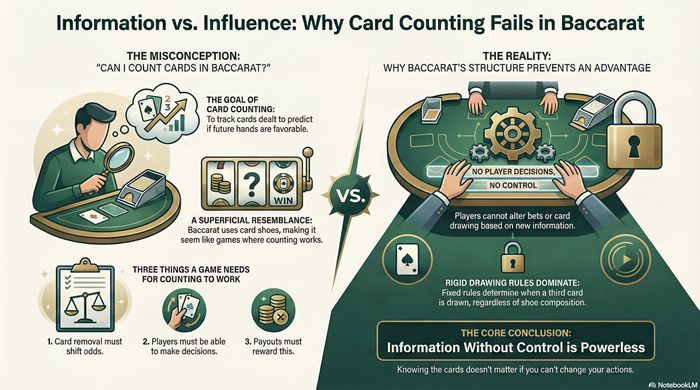
Treating patterns as information rather than perception is the core error.
Conclusion: Patterns Describe, They Do Not Predict
Baccarat patterns exist only as descriptions of past outcomes. They do not influence cards, probabilities, or results.
Recognizing patterns does not change the game’s mathematics. It changes only how results are interpreted. Understanding this distinction removes one of the most persistent sources of misconception in baccarat.